Entertainment news and discussion on TalkFuse.
In 1974, CSNY announced Richard Nixon’s resignation at a ‘Woodstockian’ concert in Jersey City. It marked the undying legacy of the 1960s
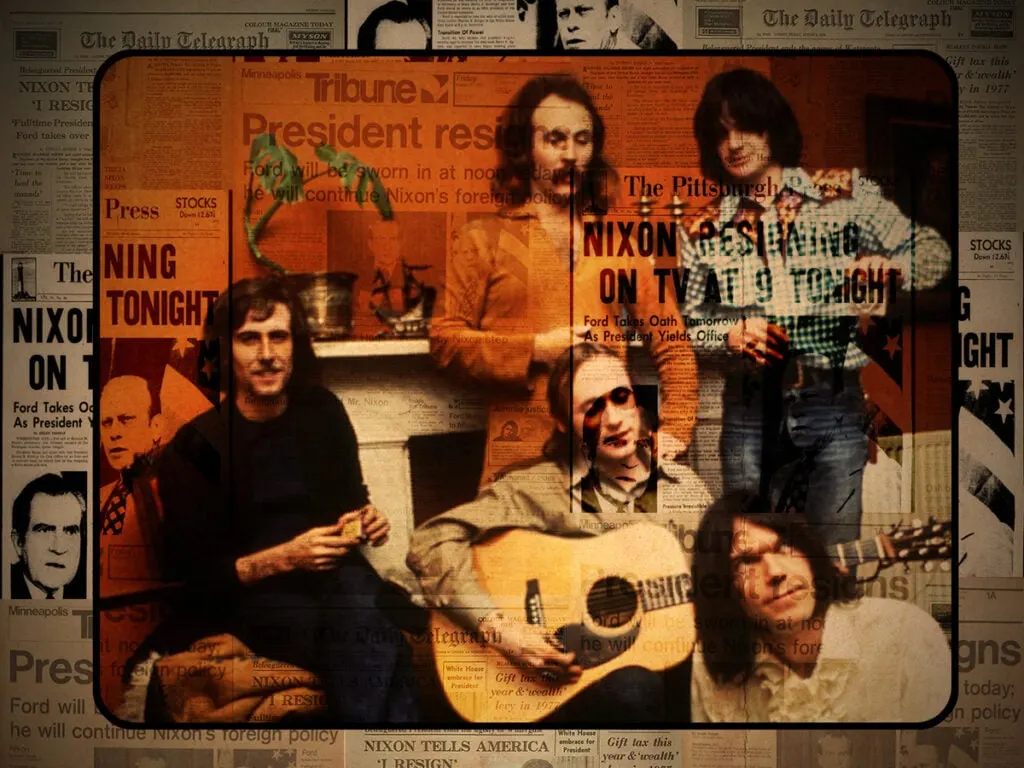
CSNY told a crowd of about 50,000 in Jersey City that Richard Nixon had resigned on 8 August 1974, as the band prepared to perform. The unusual overlap between a major political moment and a high-profile reunion concert made the night a symbol, for some, of the 1960s’ lasting influence and anti-war ideals.
Promoter Bill Graham tried to arrange a large screen to show Nixon’s address, but it was not relayed through the sound system; Graham Nash announced the resignation instead. Nash later recalled a Woodstock-like sense of shared purpose, while journalist John Rockwell described a brief cheer and a more subdued reaction. CSNY’s 31-show reunion tour reached more than a million people and later became known as the “Doom Tour”, associated with its money and cocaine-fuelled excess.
In short
- CSNY announced Nixon’s resignation to 50,000 concertgoers.
- Nash recalled a Woodstock-like moment of collective purpose.
- A reporter described a brief, restrained crowd reaction.
Steelman: both sides, in good faith
The strongest fair case each way — we don't pick a winner.
The case for
The concert’s timing gave the resignation a powerful shared setting: a huge crowd heard the news together, just as a band associated with the 1960s’ protest culture was returning to the stage. For those who saw it as Woodstock-like, the moment suggested that anti-war ideals and collective political engagement still resonated beyond the decade itself.
The case against
The episode can be read as an evocative coincidence rather than evidence that the 1960s’ ideals remained a durable political force. Contemporary accounts describe a brief cheer or subdued response, and the reunion tour’s later reputation for commercial excess and drug use complicates any portrayal of it as a continuation of Woodstock’s shared purpose.
Explained simply
Crosby, Stills, Nash & Young (CSNY) were a popular American rock group whose members had also performed in other prominent bands. Their music was associated with the counterculture of the 1960s, a period of protest against the Vietnam War and wider challenges to established authority.
Richard Nixon was US president during much of the Vietnam War. In 1974, he announced he would leave office after the Watergate scandal, in which members of his administration were implicated in a break-in and efforts to cover it up; he was the first US president to resign.
The Jersey City concert was part of CSNY’s reunion tour, which drew large crowds but later gained a reputation for excess. The evening brought together popular music and a major political turning point, prompting different accounts of how strongly the crowd responded.