Technology news and discussion on TalkFuse.
These ‘Ghostly’ Galaxies Have Lost Their Dark Matter
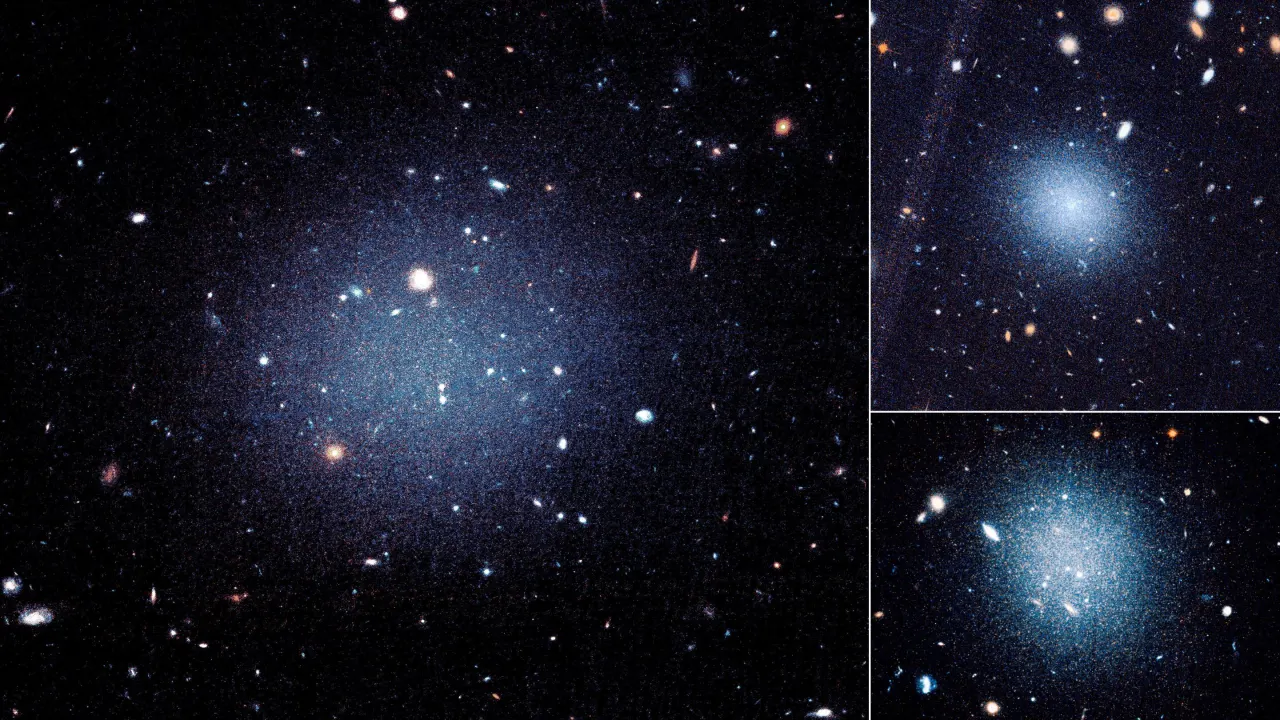
Astronomers studying three faint galaxies, DF2, DF4 and DF9, found that they contain little dark matter, despite dark matter being thought to dominate most galaxies. A study published in June 2026 proposes that the galaxies formed after two ordinary galaxies collided: gas and dust clumped together while dark matter passed through, leaving three galaxies with little dark matter.
The finding supports the idea that dark matter is a physical substance rather than simply a modification of gravity, although its nature remains unknown and it has not been directly detected. DF2 was identified in 2018 and appears to have up to 400 times less dark matter than expected; DF4 was reported in 2019, and DF9 was announced in 2026. DF9 has a mass of about 100 million suns, consistent with its ordinary matter alone; with dark matter, it would be about 100 times more massive.
In short
- Three faint galaxies appear to contain little dark matter.
- A collision may explain how they formed.
- Their properties support dark matter as physical matter.
Explained simply
Most galaxies are thought to contain dark matter, an unseen substance whose gravity helps explain how stars and gas move. It has not been directly detected, and scientists do not yet know what it is.
DF2, DF4 and DF9 are unusually faint galaxies with much less dark matter than expected. Astronomers have proposed that they formed when two galaxies collided: ordinary gas and dust gathered into new galaxies, while dark matter continued on.
These galaxies give scientists a way to study what dark matter may be and how it behaves. Their existence is also relevant to a competing idea that the effects attributed to dark matter might instead come from changes to the laws of gravity.