World news and discussion on TalkFuse.
Trump knocks ‘old school’ diplomacy as he urges China and Russia to reduce nukes in opening trilateral remarks
Developed over time first seen 1 day ago
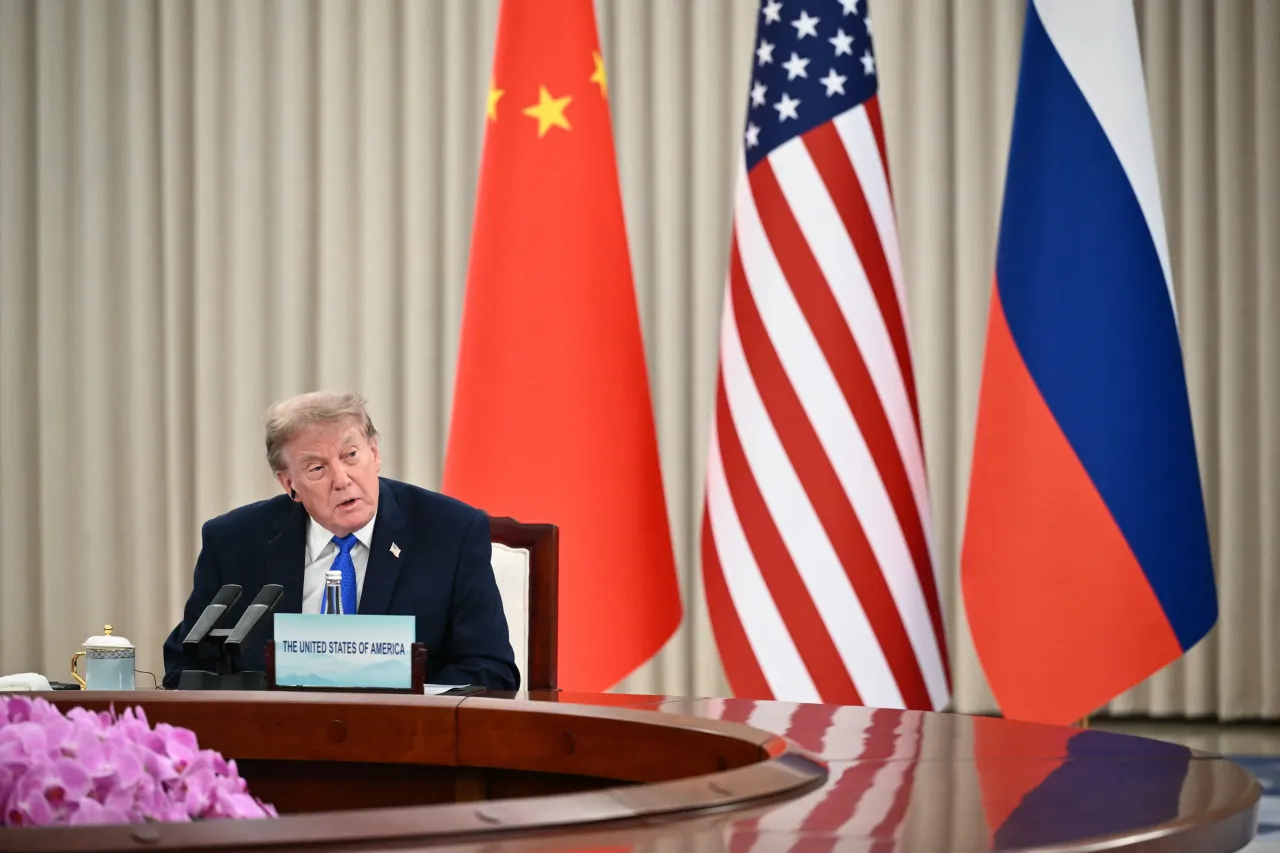
Donald Trump opened the first trilateral summit between the leaders of the United States, Russia and China by urging nuclear arms reductions and arguing that engagement was better than what he called “old school” diplomacy. He presented the talks as a chance to address global risks, while officials had described nuclear discussions as preliminary rather than likely to produce an immediate agreement.
The meeting in Shenzhen lasted 80 minutes, including opening remarks to the media. A four-point declaration issued by China and Russia called for further dialogue on reducing nuclear risks and preventing proliferation, alongside unspecified United Nations reforms, increased oil production and criticism of the International Criminal Court; the White House had not immediately confirmed it. Trump cited estimated stockpiles of 4,000 US, 3,800 Russian and 400 to 500 Chinese nuclear weapons, while Xi endorsed the goal of a nuclear-free world in principle.
- Sources
- 2
- Outlets
- 2
- Left · Centre · Right
- 1 · 0 · 1
In short
- Trump urged the US, Russia and China to discuss reducing nuclear arms.
- The 80-minute summit produced a declaration calling for further dialogue on nuclear risks.
- Trump cited stockpiles of 4,000 US, 3,800 Russian and up to 500 Chinese weapons.
How this story developed
- 19 hours ago The first trilateral summit between the leaders of the United States, Russia and China opened in Shenzhen, with Donald Trump urging nuclear arms reductions and criticising what he called “old school” diplomacy.
- 1 day ago Donald Trump criticised what he called “old school” US diplomacy at the first trilateral summit involving the leaders of the United States, Russia and China.
- 1 day ago Donald Trump opened the first trilateral summit between the leaders of the United States, Russia and China by urging nuclear arms reductions and arguing that engagement was better than what he called “old school” diplomacy.
Full account
Donald Trump used the opening of a trilateral meeting with Chinese President Xi Jinping and Russian President Vladimir Putin to argue that leaders should engage with one another even when they disagree. The gathering, held on the sidelines of the APEC summit in Shenzhen, brought together the heads of the three countries with the largest nuclear arsenals. Xi called the meeting groundbreaking and urged the powers to work together on global challenges; he also said nuclear weapons should be banned and destroyed, according to China’s Xinhua news agency.
Trump made nuclear arms reduction his central theme, saying the three countries were in a unique position to discuss lowering the number of weapons and reducing the risk they might be used. He criticised earlier leaders for avoiding difficult conversations, saying that refusing to talk had not produced peace. He also raised the wars in Iran and Ukraine and cooperation against organisations he described as threats to national sovereignty. The reports offered no indication that the leaders reached an agreement on nuclear reductions.
The meeting was brief. One account puts the full session, including media remarks, at around 80 minutes; another says the closed-door discussion lasted about 55 minutes. Putin signalled that Ukraine would be a focus for him. Analysts cited in one report expected little chance of major agreements, given the leaders’ differences on Ukraine, Iran, nuclear weapons and trade, while some smaller countries were concerned their interests could be sidelined.
The trilateral session followed separate meetings between Trump and each leader. Trump publicly described Xi and Putin as friends, and his bilateral conversation with Xi covered trade and fentanyl, according to one report. Xi said China and the US should keep relations on what he called the correct course and described ties as stable and improving. The two accounts give different emphases to the day: one foregrounds Trump’s criticism of conventional US diplomacy and the leaders’ personal warmth; the other gives more space to Xi’s call for nuclear disarmament and the wider unease about the consequences of a meeting among the three powers.
Where outlets differ
From the full account, which is AI-written from the sources:
The first report says the trilateral meeting ran for about 80 minutes including 10 minutes of opening remarks; the second gives around 55 minutes for the closed-door talks. These timings may refer to different parts of the meeting.
The first report presents nuclear arms reduction as Trump’s primary purpose and lists Iran, Ukraine and opposition to international organisations as additional topics. The second highlights Xi’s call for a nuclear-free world and Putin’s stated focus on Ukraine.
The reports differ in their emphasis: the first stresses Trump’s criticism of earlier diplomacy, his friendly gestures with Xi and Putin, and his comments about arsenal sizes; the second focuses more on Xi’s remarks, the leaders’ bilateral discussions and concern among smaller countries.
Left-leaning outlets 1
Only here: meets, putin, talks, begin
Right-leaning outlets 1
- Trump knocks ‘old school’ diplomacy as he urges China and Russia to reduce nukes in opening trilateral remarksNew York Post
Only here: knocks, school, diplomacy, urges, reduce
Every side used: trump, trilateral, russia, china
Headline columns compared word for word; nothing in them is AI-written.
Steelman: both sides, in good faith
The strongest fair case each way — we don't pick a winner.
The case for
Supporters of Trump’s approach can argue that direct talks among the three largest nuclear powers are valuable even without an immediate deal: sustained engagement may reduce mistrust, lower the risk of miscalculation and create room for later arms-control agreements. They may see challenging established diplomatic habits as a way to open discussion on nuclear risks and conflicts that affect international security.
The case against
Sceptics can argue that high-level engagement and calls for reductions mean little without specific, verifiable commitments, and may give leaders a platform to project cooperation while preserving their military options. They may also worry that dismissing established diplomatic methods could weaken the careful groundwork, alliances and verification arrangements needed to make arms-control agreements durable.
Explained simply
The United States, Russia and China have the world’s largest nuclear arsenals, though China’s is much smaller than the other two. Nuclear weapons can cause immense destruction, and the risk of their use is a concern for governments well beyond the countries that possess them.
The US president, Donald Trump, Russia’s president, Vladimir Putin, and China’s president, Xi Jinping, lead countries with competing interests as well as areas of cooperation. Talks between them can affect arms control, international security and relations among the three powers.
Arms control agreements set limits or rules for weapons, often through negotiations and checks on compliance. Progress can be difficult when countries disagree about security threats, trust and how any limits should be verified.
Coverage · 2 sources
Bias meters
From 2 rated sources.
Asia Europe Geopolitics Middle East Politics World