Culture news and discussion on TalkFuse.
Did ball hit spidercam before England goal? Snicko says not – Norway unsure


- 36' Goal Andreas SCHJELDERUP (Norway) scores!!
- 45'+2' Goal Jude BELLINGHAM (England) scores!!
- 93' Goal Jude BELLINGHAM (England) scores!!
- 117' Yellow card Kristoffer AJER (Norway) is booked by
Norway squad
- Selected
-
1 Orjan NYLAND Goalkeeper
-
3 Kristoffer AJER Defender
-
5 David MOLLER WOLFE Defender
-
6 Patrick BERG Midfielder
-
7 Alexander SORLOTH Forward
-
8 Sander BERGE Midfielder
-
9 Erling HAALAND Forward
-
10 Martin ODEGAARD C Midfielder
-
17 Torbjorn HEGGEM Defender
-
21 Andreas SCHJELDERUP Midfielder
-
26 Julian RYERSON Forward
-
2 Morten Thorsby Midfielder
-
4 Leo OSTIGARD Defender
-
11 Jorgen STRAND LARSEN Forward
-
12 Sander TANGVIK Goalkeeper
-
13 Egil SELVIK Goalkeeper
-
14 Fredrik AURSNES Midfielder
-
15 Fredrik Andre BJORKAN Defender
-
16 Marcus HOLMGREN PEDERSEN Defender
-
18 Kristian Thorstvedt Midfielder
-
19 Thelo AASGAARD Midfielder
-
20 Antonio NUSA Forward
-
22 Oscar BOBB Midfielder
-
23 Jens Petter HAUGE Midfielder
-
24 Sondre LANGAS Defender
-
25 Henrik FALCHENER Defender
England squad
- Selected
-
1 Jordan PICKFORD Goalkeeper
-
2 Ezri KONSA Defender
-
3 Nico OREILLY Defender
-
4 Declan RICE Midfielder
-
5 John STONES Defender
-
6 Marc GUEHI Defender
-
8 Elliot ANDERSON Midfielder
-
9 Harry KANE C Forward
-
10 Jude BELLINGHAM Midfielder
-
18 Anthony GORDON Forward
-
20 Noni MADUEKE Forward
-
7 Bukayo SAKA Forward
-
11 Marcus RASHFORD Forward
-
12 Trevoh CHALOBAH Defender
-
13 Dean Henderson Goalkeeper
-
14 Jordan HENDERSON Midfielder
-
15 Dan BURN Defender
-
16 Kobbie MAINOO Midfielder
-
17 Morgan ROGERS Midfielder
-
19 Ollie WATKINS Forward
-
21 Eberechi EZE Midfielder
-
22 Ivan TONEY Forward
-
23 James TRAFFORD Goalkeeper
-
24 Reece JAMES Defender
-
25 Djed SPENCE Defender
- Full squad
-
26 Jarell QUANSAH Defender
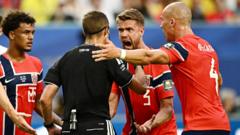
Norway's run at the 2026 World Cup ended in a 2-1 quarter-final defeat by England in Miami, with the Norwegians left frustrated by the belief that Jude Bellingham's equaliser should have been ruled out. They argued the ball had struck one of the overhead spidercam wires in the build-up to the goal; had a touch been confirmed, the goal would have been disallowed and play restarted with a dropped ball. The dispute matters because it turned on new ball-sensor technology, and the margins in a knockout tie were, in Norway's view, decided against them.
The incident came in first-half stoppage time (45+2), with England trailing to Andreas Schjelderup's opener. Replays showed goalkeeper Orjan Nyland's goal kick passing close to the suspended cable before the ball fell to Elliot Anderson, who set up Anthony Gordon to feed Bellingham for the finish. Fifa said the sensor in the connected ball showed "no peak" in the "heartbeat of the ball", indicating no evidence of contact, and referee Clement Turpin received no signal; Norway coach Stale Solbakken accepted the explanation while maintaining the ball "dropped straight from heaven". Norway were also aggrieved that a second-half Torbjorn Heggem header was disallowed after VAR penalised Erling Haaland for shoving Anderson at a corner.
In short
- Norway lose World Cup quarter-final 2-1 to England in Miami.
- Fifa's ball sensor found no evidence it hit the spidercam wire.
- Norway also angry at Haaland foul ruling out a header.
Steelman: both sides, in good faith
The strongest fair case each way — we don't pick a winner.
The case for
The ball-sensor technology provides precise, objective measurement specifically designed for this purpose—detecting any impact as a distinctive signal in the ball's telemetry. No such signal registered, FIFA verified the data, and the referee received no alert. This represents the most reliable evidence available; trusting objective technology is preferable to relying on human perception or visual replay analysis, which are inherently subjective and prone to optical illusion.
The case against
Whilst the sensor technology is sophisticated, it remains relatively new and untested under the extreme pressure of knockout-stage football. Visual evidence shows the ball passing extraordinarily close to the cable, and when marginal calls carry absolute consequences—deciding a nation's entire tournament—the highest standard of certainty should apply. Perhaps clear visual confirmation, rather than reliance on sensor interpretation alone, should govern such pivotal decisions, particularly before the technology has a longer track record of reliability.
Explained simply
Norway's quarter-final campaign at the 2026 World Cup ended with a 2-1 defeat to England in Miami. The match was overshadowed by controversy over Jude Bellingham's goal that made the score 1-1 in the first-half stoppage time, which Norway claimed should have been disallowed because the ball struck one of the overhead camera wires.
If the ball had made contact with the camera wire, football rules would have required the goal to be disallowed and play to be restarted with a dropped ball. FIFA's investigation relied on new sensor technology built into the official ball, which showed no evidence of contact with the wire, and referee Clement Turpin received no alert from the system.
The significance of the dispute lies in the use of new sensor technology to determine outcomes at crucial moments in knockout football. Norway's frustration was compounded by a second-half incident when a header by Torbjorn Heggem was disallowed after VAR identified contact by Erling Haaland, leaving the Norwegians feeling that marginal decisions went against them.
Art Culture Elections Football Politics Sport UK World