World news and discussion on TalkFuse.
Federal worker faces charges over insider bets on Trump speeches
Developed over time first seen 4 months ago
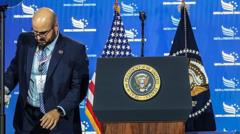
A federal employee who operated teleprompters at the White House, Gabriel Perez, was investigated after allegedly using his access to speech content to place bets worth nearly $100,000 on words President Donald Trump would use in major addresses, including the State of the Union. The wagers were placed on Kalshi, a prediction markets platform, whose analysts flagged unusual activity on "mention markets" – contracts betting on whether a speaker will use particular terms – and traced the account to the White House staffer. The case underlined concerns about insider access being exploited for financial gain on a platform where political speeches can move markets worth billions.
Kalshi froze more than $90,000 in Perez's account before it could be withdrawn and passed evidence to the Commodity Futures Trading Commission, which regulates the platform. Perez, who had worked at the White House since 2016, was placed on unpaid leave and subsequently left his post, with press secretary Karoline Leavitt confirming President Trump was aware of the case. Sources said Perez had been "fully cooperative" with investigators, and federal prosecutors in Manhattan declined to open a criminal case, while the CFTC would not confirm or deny any ongoing probe.
- Sources
- 2
- Outlets
- 2
- Left · Centre · Right
- 0 · 1 · 0
In short
- White House teleprompter operator bet on Trump's exact speech wording
- Kalshi froze over $90,000 and alerted the CFTC
- Perez left his post; prosecutors declined to bring criminal charges
How this story developed
- 4 months ago The White House confirmed for the first time, via press secretary Karoline Leavitt, that Perez would not return to his teleprompter role, adding detail to earlier reports of his unpaid leave and cooperation with investigators while the CFTC still declined to confirm or deny any ongoing probe.
- 4 months ago A White House teleprompter operator, Gabriel Perez, faced investigation over allegations he used advance knowledge of Trump's speeches to place nearly $100,000 in wagers on Kalshi's word-mention markets, prompting Kalshi to freeze over $90,000 and refer the matter to the CFTC, after which Perez went on unpaid leave and departed his job while Manhattan prosecutors opted not to pursue criminal charges.
Steelman: both sides, in good faith
The strongest fair case each way — we don't pick a winner.
The case for
This is a serious breach of fiduciary duty and represents insider trading in a new market context. A White House employee with privileged access to presidential speech content systematically exploited that non-public information to place nearly $100,000 in bets, gaining an unfair informational advantage. This violates fundamental principles of public service and market integrity. The fact that prediction markets are newer platforms doesn't diminish the misconduct—using government access for personal financial gain should face strong legal consequences to deter others and maintain public trust.
The case against
Whilst Perez's behaviour was ethically wrong, the actual legal violation remains debatable, and federal prosecutors with full knowledge of the facts declined to pursue criminal charges, suggesting the threshold for prosecution was not met. Prediction markets differ materially from traditional securities markets in purpose and function. Perez has already suffered real consequences—job loss and investigation—and was fully cooperative with authorities. Freezing his account and regulatory scrutiny may represent appropriate responses without escalating to criminal prosecution, which could be disproportionate given prosecutors' assessment that the case lacked sufficient legal merit.
Explained simply
Prediction markets allow people to buy and sell contracts based on whether a future event will happen. Kalshi is a US platform regulated by the Commodity Futures Trading Commission, where users can trade on questions including economic data, elections and the wording used in public speeches.
The White House prepares presidential addresses with input from speechwriters, policy officials and technical staff. Teleprompter operators may receive the final text before it is delivered, giving them advance knowledge that is not available to the public.
Rules on using non-public government information are intended to prevent officials from gaining financially through their work. The case raises questions about how those rules apply to prediction-market bets, particularly when the outcome depends on details known in advance by someone with official access.
Coverage · 2 sources
Read the full article at the source →
Originally published by BBC World as “White House teleprompter operator accused of making $100k off Trump speech bets”.