World news and discussion on TalkFuse.
Trump, Xi and Putin summit yields symbolism but few concrete steps
Developing story first seen 13 hours ago
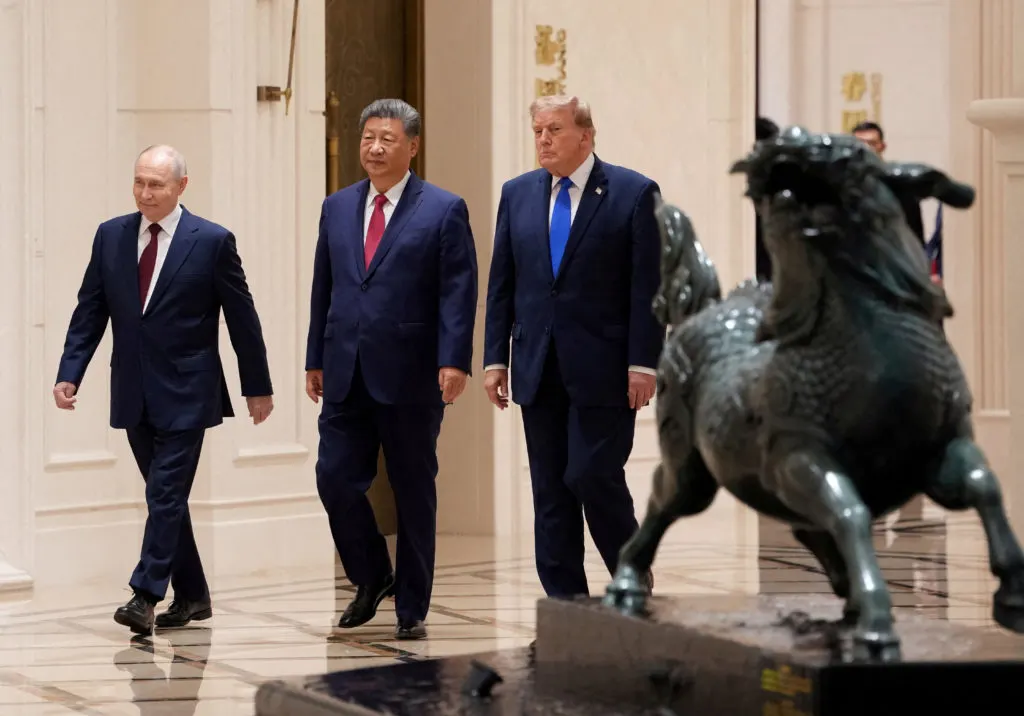
New coverage adds that Trump said he and Xi agreed Iran should reopen the Strait of Hormuz and should not acquire a nuclear weapon, but there was no sign Xi or Putin committed to helping resolve the conflict. The leaders’ first three-way summit was presented as a historic discussion about peace, yet its main outcome was symbolic rather than a set of concrete steps.
The talks lasted over an hour and produced a declaration backing unspecified United Nations reforms, increased oil supplies and reduced nuclear risks. It also opposed what the leaders called “jurisdiction abuse” by the International Criminal Court and supported immunity for state officials. The statement did not mention Russia’s war in Ukraine or the U.S.-led war in Iran; Xi gained diplomatic visibility by hosting, while Trump called the meeting a starting point for further dialogue.
- Sources
- 3
- Outlets
- 2
- Left · Centre · Right
- 1 · 2 · 0
In short
- Trump said Xi agreed Iran should reopen the Strait of Hormuz.
- No commitment from Xi or Putin to resolve the Iran conflict emerged.
- The summit’s declaration offered broad goals but few specifics.
How this story developed
- 3 hours ago Trump added that he and Xi agreed Iran should reopen the Strait of Hormuz and avoid obtaining nuclear weapons, though there was no indication Xi or Putin would help resolve the conflict.
- 3 hours ago Trump, Xi Jinping and Vladimir Putin held their first three-way summit, issuing a declaration on UN reform, oil supplies, nuclear risks and immunity for state officials, while omitting the wars in Ukraine and Iran.
Full account
The first formal meeting of the leaders of the United States, China and Russia brought Donald Trump, Xi Jinping and Vladimir Putin together in Shenzhen on Thursday. Its immediate achievement was diplomatic: three governments with deep disagreements issued a joint declaration after talks lasting a little over an hour. Each leader presented the encounter as a step towards greater cooperation, but the declaration left the most difficult questions unresolved.
The first takeaway is the gap between the meeting’s scale and the detail of its commitments. The three governments agreed to pursue talks on reducing nuclear risks and proliferation, increase oil supplies and support reform of the United Nations. They gave no timetable or measurable target for the nuclear discussions, and did not specify what UN changes they favoured. Their statement also criticised the use of International Criminal Court proceedings against state officials. It said nothing about Russia’s war in Ukraine or the US-led war in Iran, despite the leaders’ stated responsibility for international peace.
The second is the value of the summit’s image, particularly for its host. Xi was able to convene the American and Russian presidents in China and portray dialogue among major powers as a contribution to stability. Trump described the meeting as the start of a process and placed weight on the relationships it could build. Putin invoked the countries’ shared history as victors of the Second World War. Those messages gave each leader a way to claim progress, even though the declaration did not settle their competing interests. Taiwan, which China regards as a domestic matter, was absent from the joint agreement.
The third is that future talks will determine whether the encounter produces lasting results. A commitment to discuss nuclear risks could open a channel among the three powers, but an agreement to begin discussions is still some distance from an arms control deal. The same uncertainty applies to oil supplies and UN reform. For now, the summit has established a precedent for meeting together and a broad agenda for further contact. Its practical significance will depend on whether the governments turn that agenda into specific action.
Where outlets differ
From the full account, which is AI-written from the sources:
Associated Press stresses the limited substance of the declaration, its omissions on Ukraine, Iran and Taiwan, and the diplomatic advantage Xi gained by hosting. PBS NewsHour gives more attention to the summit’s imagery, the leaders’ interactions and the potential significance of formal nuclear talks. AP describes the meeting as lasting over an hour; PBS gives the more precise figure of just over 80 minutes.
Left-leaning outlets 1
Only here: hold, rare, talks, nuclear, risks
Centre outlets 2
- Trump, Xi and Putin summit yields symbolism but few concrete stepsPBS NewsHour
- Inside the historic summit between Trump, Xi and PutinPBS NewsHour
Only here: summit, yields, symbolism, concrete, steps
Every side used: trump, putin
Headline columns compared word for word; nothing in them is AI-written.
Steelman: both sides, in good faith
The strongest fair case each way — we don't pick a winner.
The case for
Supporters could see the summit as a useful opening: bringing the three leaders together signals that major powers are willing to talk about peace, nuclear risks and cooperation even amid serious disputes. Its declaration and promise of further dialogue may create space for later progress, while China’s hosting gives it a visible role in diplomacy.
The case against
Critics could argue that the summit’s symbolism was not matched by practical commitments: it set out no clear steps on the conflicts discussed and omitted both Ukraine and the Iran war. Without evidence of agreement on resolving those crises, talk of shared responsibility may mainly enhance the leaders’ diplomatic standing while leaving urgent problems untouched.
Explained simply
Donald Trump, the US president, Xi Jinping, China’s leader, and Vladimir Putin, Russia’s president, head three of the world’s most powerful countries. Their first summit together drew attention because decisions or tensions between them can affect international security, trade and diplomacy.
The United Nations is an organisation where countries discuss international issues, while the International Criminal Court prosecutes individuals accused of serious crimes. Disputes over the court’s authority and conflicts involving Russia, Ukraine, the US and Iran have been important points of tension in relations between major powers. Any agreement among these leaders could influence how countries approach those issues.
Coverage · 3 sources
Bias meters
From 3 rated sources.
Asia Europe Geopolitics Government Politics World
Read the full article at the source →
Originally published by PBS NewsHour as “3 takeaways from Trump, Xi and Putin’s historic summit”.