Culture news and discussion on TalkFuse.
After this World Cup, here’s what I feel: a kind of messy hope | Jonathan Liew
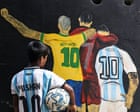
Jonathan Liew reflects in the Guardian on the 2026 World Cup, arguing that far from reinforcing nationalism, the tournament exposed how flimsy and fluid national allegiance has become. He notes that supporters worldwide adopted teams with no personal connection to them, treating national identity as something disposable rather than fixed, which challenges the long-held assumption that international football is the ultimate stage for patriotic fervour.
He cites examples such as Bangladesh's mass adoption of Argentina, central Asian friends in London backing Uzbekistan, and the Arab diaspora rallying behind Morocco and Egypt, alongside high-profile figures like Mike Tyson and Trevor Noah wearing rival kits at the MetLife Stadium final. The piece also highlights how squads themselves reflect globalisation and migration rather than clear-cut nationhood, noting that 40 of the 48 competing nations included overseas-born players, with only one member of Curaçao's squad actually born there and Cape Verde's team featuring several players born in Rotterdam.
In short
- Guardian column argues the World Cup showed national identity as flimsy, not fixed
- Fans worldwide adopted teams unconnected to their own nationality
- 40 of 48 squads featured players born overseas, reflecting migration and diaspora
Steelman: both sides, in good faith
The strongest fair case each way — we don't pick a winner.
The case for
The World Cup increasingly reveals how detached national allegiance has become from traditional notions of belonging and identity. When millions of people with no connection to a nation enthusiastically adopt its team, when diaspora communities choose teams based on heritage rather than residence, and when squads comprise players born across multiple continents, this suggests that national identity functions increasingly like consumer preference rather than fixed inheritance. These patterns point to a fundamental shift in how people relate to national identity through sport—less rooted in deep, automatic belonging and more constructed around narrative appeal and entertainment value.
The case against
These anecdotes, whilst interesting, likely represent peripheral phenomena that don't undermine the World Cup's enduring function as an expression of national identity and pride. The overwhelming majority of supporters remain passionately committed to their home nation, and those who adopt other teams for entertainment typically maintain stronger primary allegiance to their own. Squad diversity reflects talent markets and globalisation rather than a dilution of national representation, as these players still represent their nations and inspire genuine national pride—the tournament's core appeal remains firmly rooted in competition between countries.
Explained simply
International football has long been regarded as one of sport's greatest expressions of national pride and identity. The World Cup in particular has traditionally been a moment when supporters rally behind their country, and nations invest the tournament with deep patriotic meaning. This assumption rests on the idea that people have fixed, unbreakable loyalty to their birthplace.
The 2026 World Cup, however, suggested a different reality. Supporters across the globe adopted national teams with which they had no personal connection, from Bangladesh backing Argentina to Arab diaspora communities supporting Morocco and Egypt. Even at the final, high-profile figures wore rival nations' kits as casual fashion statements, treating national identity as something fluid and temporary rather than a deep commitment.
The globalisation of football reflected this shift. Most competing nations fielded squads with significant numbers of overseas-born players, with some teams including barely anyone born in their home country. This mismatch between the idea of nations and the reality of modern teams highlights how the traditional link between sport, territory and identity has become increasingly loose, suggesting national allegiance itself may be more chosen than inherited.