iPhone Duo marks Apple’s debut in foldable phones
Developed over time first seen 2 months ago
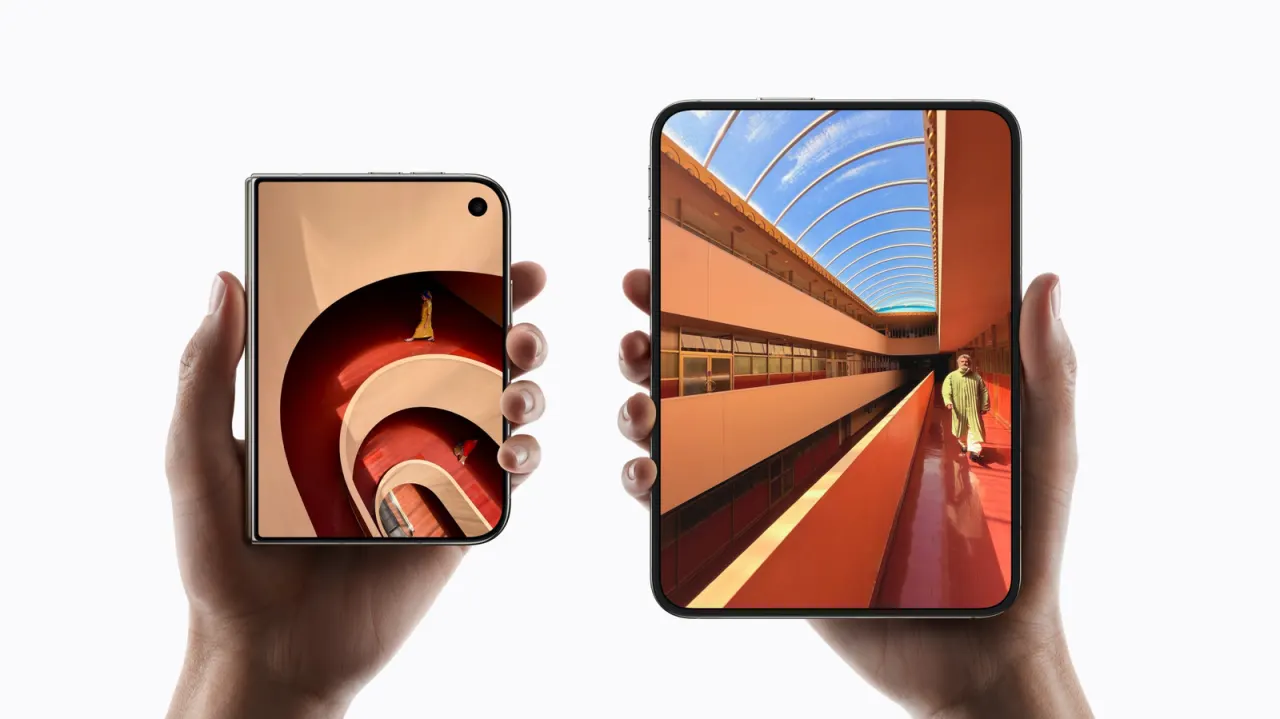
Apple has confirmed the iPhone Duo, its first foldable handset, unveiled at the company's September "Surprise and Shine" hardware event. The device marks Apple's entry into a foldable market long dominated by rivals such as Samsung's Galaxy Z Fold 8 and Google's Pixel 11 Pro Fold, and it takes a distinctive approach: rather than folding into a squarer shape, the Duo keeps the same 1.4:1 aspect ratio whether closed or open, which Apple says makes better use of the larger inner screen and avoids the letterboxing seen on competitors' displays.
Folded, the Duo has a 5.4-inch screen; unfolded, this expands to 7.6 inches, both using wide-angle OLED panels with 3,000-nit peak brightness and a "nano-texture" coating intended to minimise the visible crease, with Apple describing the unfolded device as its thinnest iPhone yet. It runs the same A20 Pro chip found in the iPhone 18 Pro, paired with vapor chamber cooling and a redesigned interface with controls shifted to the side of the screen. Notable features include an outer-screen photo preview for subjects, a child-attention animation for the camera, a "Duo FaceTime" mode using both screens for two-sided calls, a 48MP main camera without the Pro's physical aperture shutter, a 12MP under-display selfie camera, and Apple's claim of "all-day" battery life.
- Sources
- 5
- Outlets
- 4
- Left · Centre · Right
- 0 · 0 · 0
In short
- Apple unveiled its first foldable iPhone, the Duo, at its September event.
- Unlike rivals, it keeps the same 1.4:1 aspect ratio folded and unfolded.
- Features A20 Pro chip, 5.4in/7.6in OLED screens, and new dual-screen FaceTime mode.
How this story developed
- 2 months ago Fresh reporting has revealed pricing and design philosophy details, confirming the iPhone Duo will cost £1,600 and adopts a "passport-style" short-and-wide shape rather than the tall-and-narrow layout used by Samsung's Galaxy Z Fold 8, with commentators calling it Apple's boldest hardware move in nearly ten years.
- 2 months ago Apple has unveiled the iPhone Duo, its first foldable handset, alongside refreshed iPhone 18 Pro models and new smartwatches at an autumn hardware event marking John Ternus's debut as chief executive, with hands-on impressions describing a 5.4-inch outer screen, a 7.6-inch inner display, a titanium IP68-rated frame and a heavier, thicker build than Samsung's Galaxy Z Fold 8.
- TechCrunch Apple unveils foldable iPhone Duo, refreshed iPhone 18 Pro lineup
- Engadget iPhone Duo vs Samsung Galaxy Z Fold 8: here’s how they stack up
- IGN Apple Announces Foldable iPhone Duo
- Engadget Apple’s foldable iPhone Duo launches with two rear cameras
- The Register Apple unveils first foldable phone iPhone Duo at £1,600
Full account
Apple used its first autumn hardware event under new chief executive John Ternus, held on 9 September 2026 and billed as 'Surprise and Shine', to introduce its long-rumoured foldable handset, the iPhone Duo, alongside the iPhone 18 Pro and Pro Max, updated Apple Watch models and new AirPods. The Duo is Apple's inaugural entry into a foldable-phone category that rivals have occupied for years, pairing a 5.4-inch outer display with a 7.6-inch inner screen that Apple says draws inspiration from the iPad. The inner panel uses an under-display front camera to preserve an uninterrupted screen, while the rear carries a 48-megapixel main sensor and a 48-megapixel ultra-wide lens with 2x optical zoom. Apple quotes battery life of up to 31 hours of video playback from the inner screen and up to 44 hours from the outer one. The device starts at $1,999 for 256GB, comes in two finishes, opens for pre-order on 16 October and reaches shops a week later on 23 October.
Much of Apple's pitch centred on build quality and durability, areas where folding phones have traditionally struggled. The hinge, described as containing more than 100 precision-engineered parts, is built around a Grade 5 aluminium or titanium structure depending on the report, and the handset carries an IP68 dust and water-resistance rating, a notably higher standard than some rival folding phones currently achieve. The inner display uses a nano-texture, matte finish intended to cut reflections and disguise the crease along its centre, which reviewers who have handled the device describe as faint and more easily felt than seen. Practical touches include a side-mounted power button with Touch ID rather than Face ID, a dedicated camera button, a volume rocker positioned for use in both portrait and landscape orientations, and sensors that recognise partial folds to support tent and tabletop viewing modes. Apple has also reworked iOS for the wider unfolded canvas, shifting the dock and other navigation elements to one side of the screen to keep them within thumb's reach. Hands-on accounts note the phone is comparatively heavy and thick at roughly 254 grams and 11.3mm when folded.
Apple positioned the Duo explicitly against Samsung, whose Galaxy Z Fold 8 launched the previous month and adopts a similarly short, wide 'passport-style' shape rather than the tall, narrow form Samsung used in earlier generations. Ternus reportedly criticised other foldables as feeling like two phones joined together rather than a single purpose-built device, though some observers felt the Duo's execution did not fully bear that claim out. On paper the two phones are closely matched: both use 7.6-inch inner and roughly 5.4 to 5.5-inch outer OLED panels at 120Hz, both add titanium reinforcement beneath the folding layers, and Samsung, which also manufactures the folding OLED panels used in the Duo, supplies an anti-reflective coating comparable to the finish Apple describes as nano-texture. Samsung has said its Z Fold 8 and the larger Z Fold 8 Ultra are outselling last year's Fold 7 by around 30% in their opening month, a sign of renewed appetite in a category that analysts at Counterpoint Research say still accounts for only about 1.6% of global smartphone sales.
Coverage of the Pro-line and other announcements added further context to the event: the iPhone 18 Pro and Pro Max keep a familiar design but gain a variable-aperture 48-megapixel main camera with new manual photography controls, Dolby HDR Vision video and expanded 'Photographic Styles' editing, with the Pro Max priced $100 higher than its predecessor at $1,299 and both models arriving 18 September. Reaction to the Duo itself was broadly positive but not uncritical; one hands-on account praised the folding animation and hinge feel while wishing for a third rear camera, and reviewers cautioned that claims about hinge longevity and the IP68 rating should be treated cautiously until independent teardowns and long-term use confirm them, noting that Samsung's hinge remains a weak point even after eight generations. Given the roughly $1,999 starting price, several outlets suggested that an extended warranty or care plan would be a sensible addition for buyers.
Where outlets differ
From the full account, which is AI-written from the sources:
TechCrunch focused on cataloguing Apple's full announcement slate (Duo, iPhone 18 Pro/Pro Max, Apple Watch, AirPods) with less critical commentary, giving factual specs and pricing.
Engadget concentrated on a detailed spec-by-spec comparison with Samsung's Galaxy Z Fold 8, including screen resolutions, coatings and sales performance, framing the Duo primarily as competitive response to Samsung.
The third source (a tech/enterprise-oriented outlet) took a more sceptical, critical tone — questioning the 'Duo' name, comparing it to the iPad mini and Huawei's tri-fold, and casting doubt on durability and IP68 claims pending independent testing, while also detailing the iOS interface changes for the wider screen.
The fourth source was a first-hand hands-on impression piece emphasising build feel, weight/thickness versus the Z Fold 8, hinge animation, and personal usability notes (e.g. Touch ID preference, tent/tabletop modes), with a personal critique about wanting a third rear camera.
Sources differ slightly on hinge material description (Grade 5 aluminium vs titanium plate) and on which brand's screen coating idea came first, reflecting differing framing of Apple versus Samsung's respective innovations.
Explained simply
Foldable phones fold in half, packing a larger tablet-style screen into a pocket-sized device thanks to flexible display technology. Samsung has led this category for several years with its Galaxy Z Fold range, while Apple has so far stuck to conventional, non-folding iPhones. The iPhone Duo is Apple's first attempt to enter this market.
The device was shown alongside new iPhone 18 Pro models and updated smartwatches at Apple's autumn product event, the company's first under chief executive John Ternus. It has two screens, one on the outside and a larger folding one inside, and is built with a titanium frame designed to resist water and dust. Foldable phones remain a small part of the overall smartphone market, but are widely seen as a growth area that manufacturers are keen to establish a position in early.
Apple and Samsung are the main companies at the centre of this story, given their rivalry in premium smartphones. Comparisons between the iPhone Duo and Samsung's existing Galaxy Z Fold 8 matter because they help indicate whether Apple's first-generation device matches, falls short of, or improves on features its competitor has already refined over multiple releases.
Coverage · 5 sources
- TechCrunchApple unveils foldable iPhone Duo, refreshed iPhone 18 Pro lineup
- EngadgetiPhone Duo vs Samsung Galaxy Z Fold 8: here’s how they stack up
- The RegisterApple unveils first foldable phone iPhone Duo at £1,600
- EngadgetApple’s foldable iPhone Duo launches with two rear cameras
- IGNApple Announces Foldable iPhone Duo
Art Business Celebrity Companies Culture Entertainment Gadgets Technology