Apple’s new desktop computers are designed specifically for local AI development
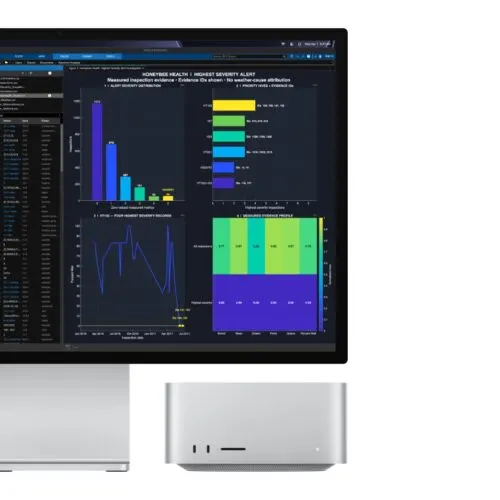
Apple has unveiled new versions of the Mac mini and Mac Studio, powered by two new chips – the M6 and the M5 Ultra – that are explicitly aimed at running AI workloads locally rather than in the cloud. While the hardware itself is largely an incremental "specs bump" rather than a fresh design, Apple's marketing and technical choices make clear it is chasing the growing trend of developers and hobbyists using Mac hardware, often chained together, to run large AI models on their own machines instead of relying on expensive cloud-based services.
The M6 is Apple's first 2nm chip and the first to combine three different core types, offering a 12-core CPU and 12-core GPU with claimed multi-threaded performance gains of up to 40 percent over the M4, though memory remains capped at 32GB. The more powerful M5 Ultra, destined for the Mac Studio, is essentially two M6 Max chips fused together, delivering 36 CPU cores, 80 GPU cores, up to 512GB of memory and bandwidth of up to 1.2TB per second. This surge in local AI capability follows macOS 26.2, which enabled fast Thunderbolt 5 connections between Macs for distributed AI inference using the MLX framework, allowing users to run open-weight models such as Qwen and DeepSeek locally as a cheaper alternative to cloud-hosted frontier models.
- Apple unveils new Mac mini and Mac Studio with M6 and M5 Ultra chips
- Chips are optimised for running AI models locally, not in the cloud
- M5 Ultra supports up to 512GB memory and 1.2TB/s bandwidth
New here? Start with this
AI development often depends on powerful computers to process large models, which can run on a company’s remote servers or directly on a user’s own machine. Running models locally can reduce reliance on paid cloud services and keep data on the computer, but it requires substantial processing power and memory.
Apple makes the Mac mini, a compact desktop, and the Mac Studio, a more powerful computer aimed at demanding work. Developers can also connect several Macs to share AI processing, using Apple’s MLX software framework and open-weight models such as Qwen and DeepSeek, whose underlying model files are available for people to run themselves.
The new chips target this kind of work, with the M5 Ultra offering far more memory than the M6. That capacity matters because large AI models need memory to load and process their data; the hardware’s limits therefore affect which models users can run and how quickly.
Both sides, in good faith
The strongest fair case each way — we don't pick a winner.
The case for
Privacy and autonomy are foundational values that justify local AI processing. Users should not have to transmit sensitive work or personal data to cloud providers, nor be subject to recurring costs and vendor lock-in for computing they could control themselves. As open-source models become capable, local inference offers a viable, cost-effective alternative that also protects against the concentration of computational power in a few corporations' hands.
The case against
Cloud-based AI remains more practical for most users in terms of cost, capability, and accessibility. Economies of scale mean cloud services are substantially cheaper per inference for typical users than distributed local hardware; most people prefer ease of use to marginal privacy gains, and cloud providers offer frontier models and expert support that individuals cannot replicate. Apple's focus here may reflect technology enthusiasm rather than mainstream demand.