Technology news and discussion on TalkFuse.
Astronomers witness companion star plunge into giant in Andromeda
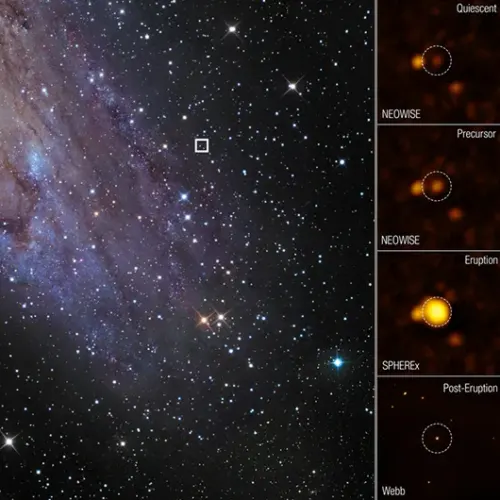
Astronomers have observed a star being engulfed by a giant companion in the Andromeda Galaxy, providing the first direct account of a process called common envelope evolution. The finding supports a leading explanation for how some pairs of stars end up in very tight orbits, or merge.
The giant, about seven times the Sun’s mass, was roughly 350 times the Sun’s width before it began brightening in 2018; its smaller companion was estimated at 0.7 solar masses. After years of gradual change, the system brightened about 100-fold in 25 days in October 2025, reaching the light of 1.5 million Suns, as the companion plunged into the giant’s core and the star expelled material. Researchers pieced together the sequence from observations by around a dozen telescopes and surveys, including records dating back to 1989.
In short
- Astronomers tracked a star engulfed by a giant in Andromeda.
- The system peaked at the light of 1.5 million Suns.
- The observations show how a close stellar pair can form.
Explained simply
Stars often form in pairs, orbiting a shared centre. When one grows into a giant, its outer layers can spread far enough to surround its smaller companion.
The smaller star then moves through the giant’s gas, losing orbital energy as it goes. This can draw the pair into a much tighter orbit, or bring them together in a merger.
Astronomers call this process common envelope evolution. It matters because it may help explain how some close pairs of stars form, including systems that can later produce dramatic stellar events.
Read the full article at the source →
Originally published by Ars Technica as “Astronomers watched a star spiral to its death inside a giant companion”.