At least eight killed in Israeli strikes on Gaza after Hamas agree disarmament deal
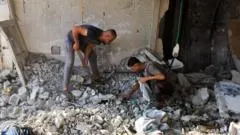
At least eight people have been killed in Israeli air strikes on Gaza City, Khan Younis and Deir el-Balah, in the second consecutive night of strikes on the territory. The attacks come just days after Hamas accepted a US-brokered disarmament plan under which it would hand over its weapons to President Trump's Board of Peace, raising fresh doubts over whether the fragile ceasefire process can hold. Israel has publicly voiced scepticism that Hamas will genuinely give up its arms or relinquish control of Gaza, with senior Israeli figures suggesting full Israeli control of the strip may be needed if disarmament does not proceed.
Gaza's Civil Defence Authority said the strikes hit residential buildings, killing a father, mother and their nine-year-old son in Khan Younis, a couple in Deir el-Balah, and two others including a child in Gaza City. The Israel Defense Forces said it had killed two Hamas commanders and a third militant, describing the strikes as targeting military operatives, while Israeli minister Eli Cohen said no deal existed to halt attacks on Gaza, now under roughly 70% Israeli control. The disarmament plan forms the second phase of a wider 20-point, US-brokered ceasefire framework unveiled last September, with a 15-point roadmap published on Friday setting out further implementation steps; more than 1,100 Palestinians have reportedly been killed since the ceasefire nominally began last October.
- Israeli strikes on Gaza kill at least eight amid disarmament deal
- Comes days after Hamas accepted plan to hand over weapons
- Israel remains sceptical Hamas will disarm or cede control
Both sides, in good faith
The strongest fair case each way — we don't pick a winner.
The case for
Supporters of Israel's continued strikes argue that a ceasefire cannot be allowed to become a shield for Hamas to regroup, and that until weapons are actually surrendered rather than merely promised, military operatives remain legitimate targets under the laws of armed conflict. They point to Hamas's history of reneging on prior commitments and argue that sustained pressure, including targeted strikes on commanders, is what forced Hamas to the table in the first place and is necessary to ensure genuine disarmament rather than a tactical pause. On this view, Israel has a duty to protect its citizens from a group it does not trust to relinquish its arsenal voluntarily, and pausing enforcement prematurely would only invite future attacks.
The case against
Critics argue that striking residential buildings and killing entire families, including young children, days after Hamas accepted a disarmament framework undermines the credibility of the peace process and calls into question whether Israel is negotiating in good faith. They contend that continuing large-scale strikes, with over 1,100 Palestinian deaths since the ceasefire nominally began, is disproportionate to any immediate military threat and risks collapsing a fragile agreement that Palestinian civilians desperately need to hold. For them, genuine commitment to the roadmap requires restraint and verifiable de-escalation, not unilateral military action that pre-empts negotiated implementation steps and inflicts civilian harm.