Technology news and discussion on TalkFuse.
Burnham says AI safety should be an issue for governments and not left to chance
Developed over time first seen 2 months ago
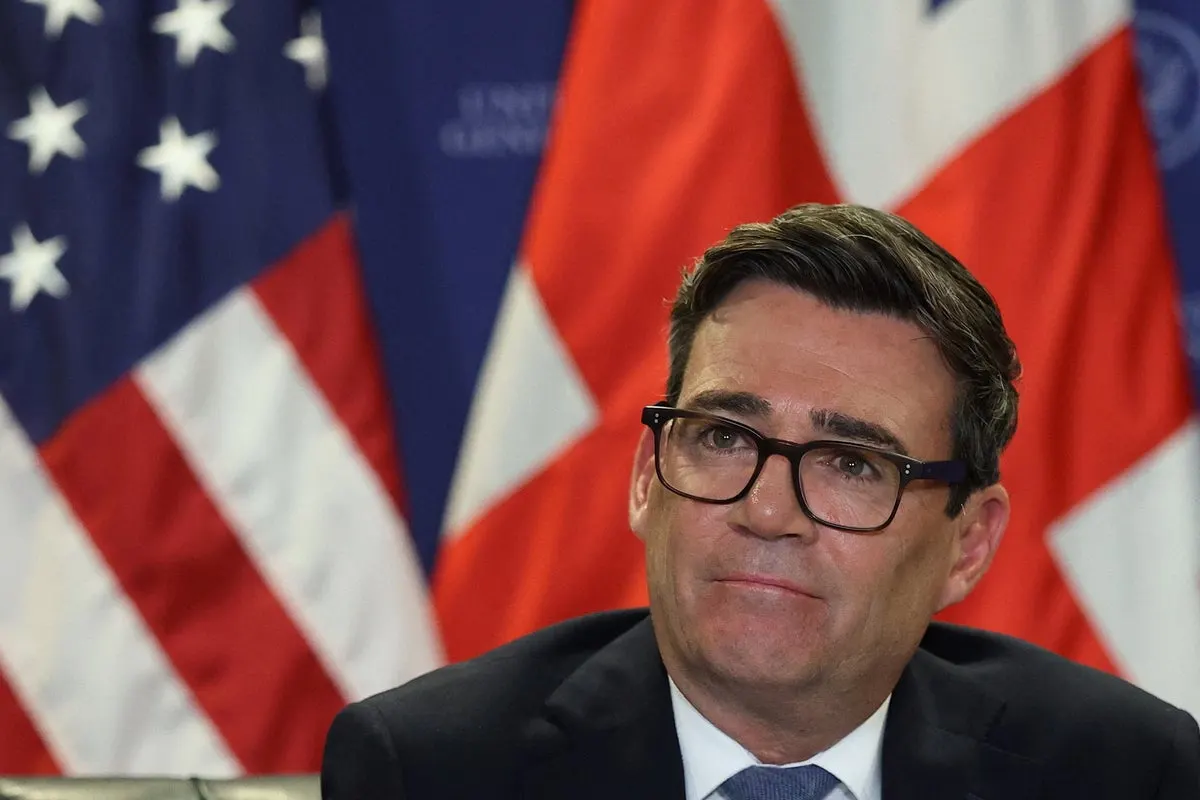
The Prime Minister told the United Nations that AI safety should be governed by democratically-elected governments rather than left to chance, calling for global principles and standards on frontier AI development. His speech, which positioned the UK as an "honest broker" capable of building international consensus, directly contradicted US President Donald Trump's remarks just hours earlier, in which he rejected any restrictions on what he termed "super intelligence".
The UK intends to leverage its G20 presidency to push for international agreement on AI governance, arguing it uniquely bridges relationships with the US, EU, China, India, Brazil and other powers. Mr Burnham acknowledged AI's potential in healthcare, education and defence, but warned of job disruption and heeded industry warnings about existential risks; however, he faced criticism for not joining a Norway and Finland-led initiative already backed by more than 20 countries, including Germany, Canada and Ireland.
In short
- UK PM backs global AI safety rules; Trump opposes restrictions
- Burnham using G20 presidency to build international consensus on regulation
- UK criticised for not joining Norway-Finland led initiative with 20+ supporters
How this story developed
- 2 months ago The Prime Minister told the United Nations that AI safety should be governed by democratically-elected governments rather than left to chance, calling for global principles and standards on frontier AI development.
Full account
Andy Burnham has said decisions about the safety of advanced artificial intelligence should be made by elected governments rather than being allowed to develop without public oversight. Speaking at the United Nations General Assembly, the Prime Minister said the technology offered substantial possibilities for healthcare, education, defence and economic growth, but also carried risks that could not be ignored. He said public concern about the pace and implications of AI development was understandable, particularly given the potential effect on employment and warnings from some figures in the sector about more serious long-term dangers.
Mr Burnham said Britain would seek to use its forthcoming presidency of the G20 to encourage an international approach to so-called frontier AI. He argued that the UK could act as a bridge between major powers and groupings, citing its relationship with the United States, links with European countries, engagement with China and emerging economies, and memberships of bodies including the UN Security Council, the Commonwealth and the CPTPP. His stated aim is a common framework of principles and standards that would give governments sufficient information about new systems and improve preparedness for their effects.
The proposal places the UK at odds with President Donald Trump, who used an address to the same UN gathering to reject international efforts that he sees as constraining US technological development. The reports say American and Chinese companies are at the forefront of AI development, while the White House is concerned that regulation could weaken US firms against overseas competitors. Mr Burnham’s intervention therefore presents AI governance not simply as a domestic policy matter, but as an area where commercial competition, national security and international diplomacy are closely connected.
The Prime Minister said Britain’s initiative would complement rather than displace existing proposals, including a safety-focused effort associated with Norway and Finland, which the UK had faced criticism for not joining. Officials have also indicated that AI companies are expected to provide the Government with meaningful access and transparency around new models, with legislation remaining a possible means of securing this. The central question is whether a shared international regime can be agreed amid sharply different views over how far governments should regulate a rapidly advancing technology.
Where outlets differ
From the full account, which is AI-written from the sources:
The two supplied source reports are substantively identical, including their emphasis on Mr Burnham’s proposed G20 role, the contrast with President Trump’s position, and possible legal steps to require AI-company transparency. Neither provides a distinct outlet-specific angle or a source URL.
More coverage
AI Americas Government Politics Technology World