World news and discussion on TalkFuse.
Magnitude 5.0 quake near California fault triggers 22 tremors
Developed over time first seen 2 days ago
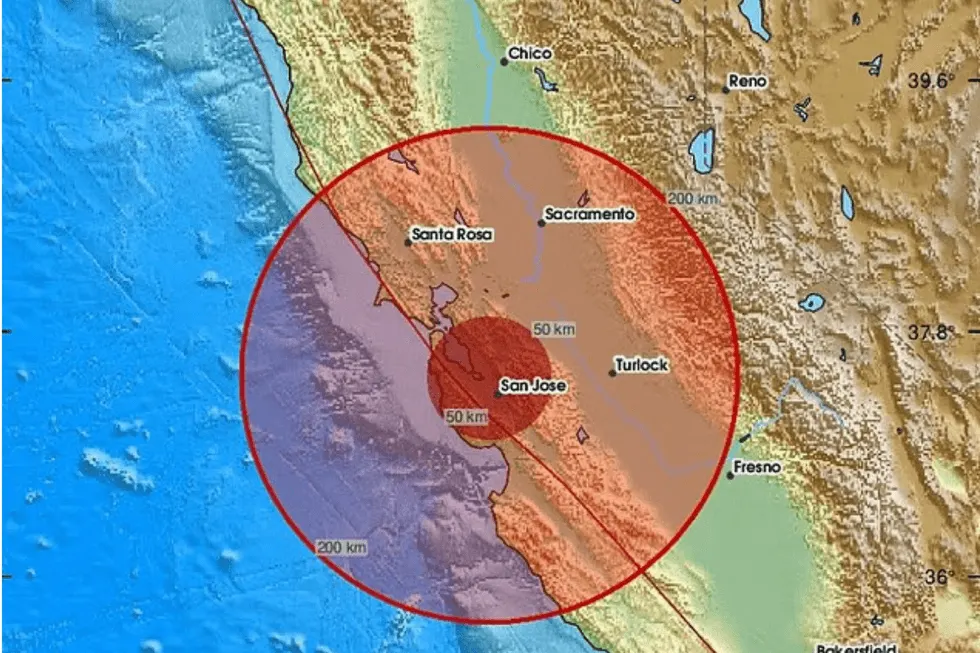
A magnitude 5.0 earthquake struck San Benito County, near California’s San Andreas Fault, about 100 miles south of San Francisco. It triggered a cluster of tremors and prompted early warnings, but officials reported no injuries, structural damage or tsunami danger.
The US Geological Survey detected 22 nearby earthquakes above magnitude 2.0, including five above magnitude 3.0. It estimated a 66 per cent chance of an aftershock of magnitude 3.0 or stronger in the following week, and a 54 per cent chance in the first 24 hours; the likelihood of another magnitude 5.0 was two per cent, while the chance of a magnitude 6.0 or greater was below one per cent.
- Sources
- 2
- Outlets
- 2
- Left · Centre · Right
- 0 · 0 · 2
In short
- A magnitude 5.0 quake struck near California’s San Andreas Fault.
- The USGS detected 22 nearby tremors.
- No injuries, damage or tsunami danger were reported.
How this story developed
- 1 day ago The latest USGS assessment put the chance of a magnitude 3.0 or stronger aftershock in the first 24 hours at 54 per cent, while the odds of another magnitude 5.0 remained two per cent and of a magnitude 6.0 or greater stayed below one per cent.
- 2 days ago By 3.45am ET, the US Geological Survey had counted 22 nearby quakes above magnitude 2.0, including five above magnitude 3.0, and estimated a 66 per cent chance of a magnitude 3.0 or stronger aftershock within a week.
- 2 days ago A magnitude 5.0 earthquake struck San Benito County, about 100 miles south of San Francisco, prompting early warnings as tremors followed, though officials reported no injuries, damage or tsunami threat.
Full account
A magnitude 5.0 earthquake struck San Benito County in central California at about 10.49pm local time on Thursday, roughly 100 miles south of San Francisco. Its epicentre was around 25 miles east of Salinas and less than 10 miles from the San Andreas Fault. The shaking was felt across a wide area, with reports from communities including San Diego, Los Angeles, San Francisco and Sacramento.
The quake was followed by a cluster of smaller tremors. By 3.45am Eastern Time, the US Geological Survey had counted 22 earthquakes of magnitude 2.0 or stronger in the vicinity; five exceeded magnitude 3.0. The main shock itself came after two smaller events, reported at magnitudes 3.1 and 3.3. The USGS found no evidence of landslides or soil liquefaction.
Warnings and monitoring systems responded, but officials reported no injuries or structural damage. ShakeAlert sent nearby residents guidance to drop, cover and hold on. Tsunami monitoring was activated in Northern California, while the National Tsunami Warning Centre said there was no tsunami threat and the National Weather Service reported no destructive waves.
The USGS said aftershocks were possible over the coming week. Its estimates put the chance of at least one aftershock of magnitude 3.0 or higher at 66 per cent, with a 17 per cent chance of a magnitude 4.0 or stronger quake. It assessed the likelihood of another magnitude 5.0 event at two per cent and of a magnitude 6.0 or larger at less than one per cent. For the first 24 hours, the estimated chance of a magnitude 3.0 or stronger aftershock was 54 per cent.
A separate earthquake was felt in Southern California several hours later. The second report says a magnitude 4.4 tremor near Commerce, east of Los Angeles, struck at about 3.25am local time on Friday and was felt across the LA Basin. The Los Angeles Fire Department began checks of critical infrastructure across the city; no damage had been reported at the time. The report places this quake about 285 miles south of the earlier Monterey County event.
Where outlets differ
From the full account, which is AI-written from the sources:
The reports give different initial and final magnitudes for the northern California quake: Source 1 describes it as magnitude 5.0, while Source 2 says it was first reported as 5.4 and later refers to it as 5.1. They also differ slightly on the epicentre distance from Soledad: Source 2 gives about 12 miles, while Source 1 locates it near Salinas.
Source 1 focuses on the sequence of 22 tremors, aftershock probabilities, tsunami checks and broader earthquake preparedness. Source 2 centres on the later Los Angeles area quake and the fire department's infrastructure survey, while describing the northern event as background to it.
Explained simply
California’s San Andreas Fault marks the boundary between two large sections of the Earth’s crust, which move slowly against one another. Pressure can build along the fault and be released in earthquakes, followed by aftershocks as the surrounding rock adjusts.
The US Geological Survey monitors earthquakes and estimates the likelihood of further tremors after a quake. Aftershocks are usually smaller than the first earthquake, but can still be felt and may sometimes cause damage.
San Benito County lies south of San Francisco, in a region where earthquakes are a known risk. Forecasts describe probabilities over a set period; they do not predict exactly when or where another tremor will happen.
Coverage · 2 sources
Bias meters
From 2 rated sources.
Read the full article at the source →
Originally published by GB News as “California earthquake sparks 22 tremors as fears grow of major aftershock”.