China’s Moonshot AI claims Kimi K3 can rival OpenAI and Anthropic
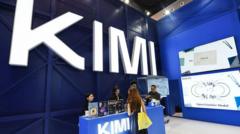
Chinese artificial intelligence company Moonshot has announced Kimi K3, a new generative AI model with 2.8 trillion parameters that it claims matches the capabilities of leading American competitors. The company plans to release the system as an open-source model available for free download and modification on 27 July, making it the world's first publicly available model at the three-trillion-parameter scale. According to independent third-party evaluations, Kimi K3 demonstrates performance levels comparable to established American systems such as OpenAI's GPT and Anthropic's Claude, with some benchmarks ranking it first in certain web interface and engineering tasks.
The announcement reflects China's narrowing competitive gap with American AI developers and arrives amid heightened government scrutiny of advanced artificial intelligence as national infrastructure. Unlike proprietary systems from major American firms, Kimi K3's open-source nature allows global developers to freely customise and deploy the technology, potentially disrupting Silicon Valley's commercial models. The release follows recent US government restrictions on certain American AI exports citing security concerns, yet Moonshot's progress demonstrates that Chinese companies continue advancing their capabilities independently despite American hardware export controls.
In short
- Chinese AI firm Moonshot unveiled Kimi K3 with 2.8 trillion parameters, claiming parity with OpenAI and Anthropic, with open-source release planned for 27 July
- Third-party benchmarks show performance comparable to leading American models; open-source release could disrupt Silicon Valley's commercial AI business models
Steelman: both sides, in good faith
The strongest fair case each way — we don't pick a winner.
The case for
Competition in artificial intelligence benefits global innovation and technological progress. Open-source models democratise access to advanced technology, enabling researchers, startups and developers worldwide to build upon cutting-edge work without requiring the resources of Silicon Valley corporations. Export restrictions are ultimately counterproductive—they merely encourage independent development elsewhere whilst hindering legitimate scientific collaboration. A diverse ecosystem where multiple nations contribute to AI development is healthier and more resilient than concentration in any single region, and powerful technology should serve humanity broadly rather than being controlled exclusively by wealthy Western firms pursuing commercial advantage.
The case against
Advanced AI systems have genuine security and strategic implications that warrant careful oversight. China's integration of government influence within private technology companies raises legitimate concerns about how such capabilities might be deployed. Open-sourcing cutting-edge models at scale amplifies risks—powerful systems can enable disinformation, surveillance, and cyberattacks, and unrestricted global access removes the safety safeguards that responsible developers implement. American export controls reflect justified national security interests in maintaining technological advantage, not mere protectionism, and undermining incentive structures for innovation through unlimited free distribution may ultimately disadvantage the entire field.
Explained simply
Generative artificial intelligence is technology that can generate text, images, code and other content based on user prompts. The race to develop the most capable AI systems has become intensely competitive, with American companies such as OpenAI and Anthropic leading the field thus far. Chinese companies are working to compete in this space.
Moonshot is a Chinese artificial intelligence company that has announced a new model called Kimi K3. The company claims it performs as well as leading American systems and will make it freely available for anyone to download and modify, unlike the proprietary American systems that remain tightly controlled by their creators.
The announcement matters because it suggests the technological gap between Chinese and American AI developers is narrowing. It also reflects broader geopolitical tensions around artificial intelligence, as governments increasingly view advanced AI as strategically important and seek to control which companies can access the most powerful technology.
AI Art Asia Business Companies Culture Space Technology World