Claude’s memory now works across both chats and Cowork sessions
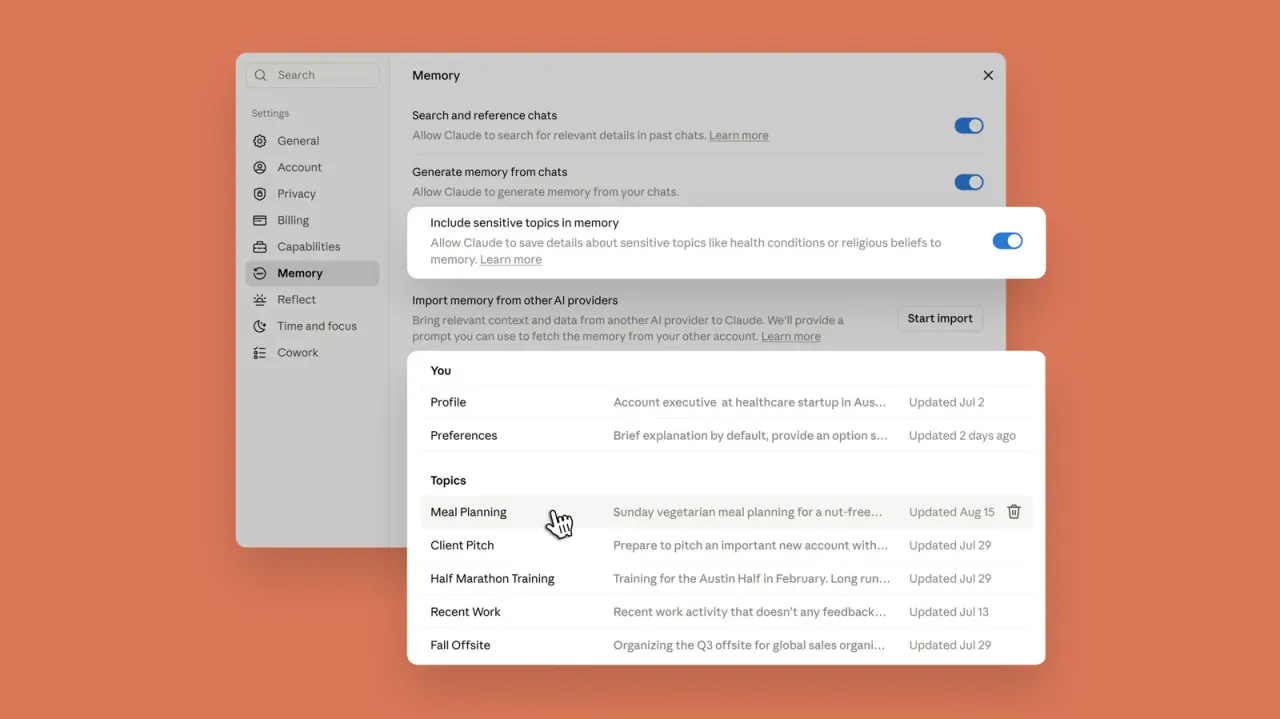
Anthropic has updated Claude's memory feature so that recollections carry over seamlessly between the standard chatbot and Claude Cowork, its computer-use agent for automating repetitive tasks. Previously, memory was often fragmented across the two, but now context from regular chats is available when Cowork runs a task in the cloud, and vice versa, reducing the need for users to repeat instructions. This builds on a recent update that brought Cowork functionality to the Claude for Chrome browser extension, meaning side-panel conversations there also now feed into a user's overall memory history.
Alongside this, Anthropic is giving users greater control over what Claude remembers, including a new "include sensitive topics in memory" toggle. By default, Claude avoids storing information on subjects such as health, race, religion, politics and gender identity, but users can now opt in to let it retain these too, with a notification shown each time it does so. The feature does not apply retroactively, can be switched off at any time, and certain data — including social security numbers, criminal history and immigration status — will never be saved regardless of settings. Memory is enabled by default across Free, Pro and Max accounts, with the updates rolling out via the latest Android and iOS apps.
- Claude memory now syncs between chats and Cowork sessions
- New toggle lets users allow storage of sensitive topics
- Certain data, like SSNs, is never saved regardless of settings
New here? Start with this
Anthropic's Claude is an AI chatbot, and Cowork is a related feature that lets Claude take control of a computer to carry out multi-step tasks on a user's behalf, such as automating repetitive work. Both tools can draw on "memory", meaning Claude retains details from past conversations so it does not need to be reminded of context each time.
Until now, this memory was kept separate depending on which tool was being used, so information shared in a normal chat might not be available to Cowork, and vice versa. Anthropic is the company behind Claude, and it is now merging these memory systems, while also adding new settings that let users decide whether sensitive personal topics, such as health or religion, can be remembered at all.
This matters because AI memory features raise questions about convenience versus privacy, since retaining more information across sessions can make an assistant more useful but also increases the amount of personal data being stored and the choices users need to make about controlling it.
Both sides, in good faith
The strongest fair case each way — we don't pick a winner.
The case for
Advocates for expanded, unified memory argue this is a straightforward usability win: users no longer need to repeat context between a chat and an agent carrying out tasks on their behalf, which makes Claude more genuinely useful for sustained projects. They would emphasise that Anthropic has built in meaningful safeguards – sensitive topics are excluded by default, opting in requires an explicit toggle with a per-instance notification, the change is not retroactive, and categories such as social security numbers or immigration status are hard-excluded regardless of settings. On this view, giving users granular, reversible control over what is remembered respects autonomy rather than undermining it, and is preferable to either blanket forgetfulness or opaque data retention.
The case against
Sceptics would counter that unifying memory across ordinary chats, a cloud-based computer-use agent, and a browser extension substantially widens the scope of personal data an AI system holds and can act upon, and that convenience gains do not obviously outweigh this expanded exposure. They would point out that even opt-in retention of health, political, religious or gender-identity information carries risks users may not fully weigh in the moment – such as data being drawn on unexpectedly by an autonomous agent, exposure in a breach, or subtle consent fatigue as notifications become routine. From this perspective, the more prudent design would keep memory scoped narrowly by default and require more deliberate, friction-filled consent before sensitive personal data persists across an increasingly agentic and autonomous system.