World news and discussion on TalkFuse.
Country town of Maitland, NSW erupts as artist Osvaldo Budet labels statue of African-American boy on main street for 150 years as racist – with the local council staging a dramatic vote
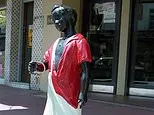
An artwork by Osvaldo Budet has reignited debate in Maitland, New South Wales, over ‘Jocko’, a cast-iron statue of a Black American boy that has stood on High Street for about 150 years. Budet argues that the figure reinforces a racist, servile stereotype, while supporters regard it as a longstanding local landmark; the dispute has raised broader questions about how communities interpret contested public heritage.
The 84cm statue originated as a 19th-century tobacconist’s promotional fixture and was also used as a horse-hitching post. It is linked to an unverified story about Jocko Graves, said to have died while helping George Washington’s forces; critics note its resemblance to American lawn-jockey figures. Maitland Council held a vote backing the mayor’s handling of a disclaimer attached to Budet’s exhibition, rather than voting to remove the statue.
In short
- Maitland’s historic ‘Jocko’ statue has sparked a renewed racism and heritage debate.
- Artist Osvaldo Budet says the statue depicts Black servitude.
- Council’s vote concerned exhibition signage, not the statue’s removal.
Steelman: both sides, in good faith
The strongest fair case each way — we don't pick a winner.
The case for
The statue's origins as a commercial fixture and horse-hitching post, combined with its striking resemblance to racist American lawn-jockey figures, suggest it embodies dehumanizing stereotypes regardless of the Jocko Graves legend. Public monuments communicate community values and priorities; displaying such imagery without critical intervention risks normalising racist representation and causing harm to those who recognise in it a lineage of their own objectification and exploitation. Even if well-intentioned community members have seen it as innocent local heritage, the responsibility to address racist iconography—particularly when so clearly documented in historical scholarship—outweighs appeals to tradition.
The case against
Maitland's 150-year relationship with this statue as a civic landmark represents genuine local identity and continuity that deserves respect, especially when residents see no malicious intent in its presence. The council's approach of adding contextual information through disclaimer rather than erasure allows the community to preserve its heritage whilst acknowledging historical complexity, educating future generations without destroying evidence. Removing objects because of problematic origins, even when those origins can be questioned or reinterpreted, sets a precedent that threatens any heritage item with a contestable past, and may serve to erase rather than illuminate history for those who wish to learn from it.
Explained simply
Jocko is a small cast-iron figure of a Black boy that has stood on High Street in Maitland, New South Wales, for around 150 years. It began as advertising outside a tobacconist’s shop and was also used to tie up horses.
The statue is sometimes linked to a story about Jocko Graves, who is said to have died helping George Washington’s forces, but that account has not been verified. Its pose and appearance resemble American lawn-jockey figures, which critics say draw on racist images of Black people in servile roles.
Artist Osvaldo Budet has challenged how the statue is understood, while others see it as part of Maitland’s local history. The debate raises questions about how communities explain contested objects in public spaces and whose views shape that interpretation.
Africa Americas Art Culture Elections Entertainment Music Politics World