Data centers become “killer application” for new power transformer tech
Developed over time first seen 2 months ago
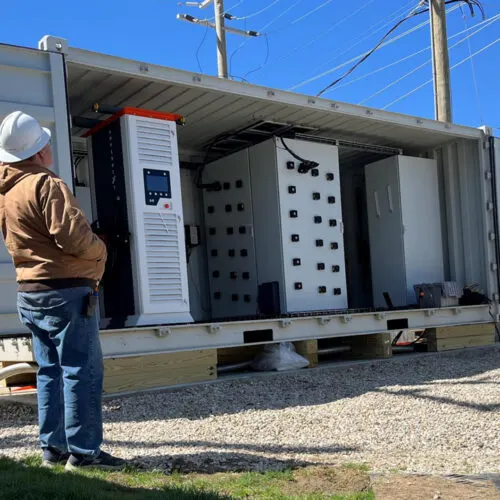
Solid-state power transformers, a modern alternative to the hand-wound transformer technology that has changed little since the 1880s, are attracting a surge of investment as AI data centres emerge as their "killer application". Conventional transformers are custom-built by hand for individual substations and can take years to deliver, a bottleneck that hampers both grid expansion and the replacement of ageing equipment across the US. Solid-state versions, built from semiconductor materials such as silicon carbide, can instead be mass-manufactured, making them smaller, lighter, modular and far quicker to produce, which could also help ease the wider supply-chain shortage affecting power transformers generally.
Demand is being driven in particular by AI data centres adopting direct current (DC) power architectures for their energy-hungry server racks; solid-state transformers can convert grid AC power straight to DC in a single "magic box", removing extra equipment and simplifying control, according to North Carolina State University professor Srdjan Lukic. US firms including Amperesand, Heron Power and DG Matrix have collectively raised more than $280 million over the past year to commercialise the technology, which also promises to cut copper use and free up physical space on data centre sites. Lukic noted the shift could open transformer manufacturing to a far wider range of companies, with the same benefits expected eventually to extend to electric vehicle charging and, potentially, household power use.
- AI data centres are driving investment in solid-state power transformers
- New tech is smaller, faster to build than 1880s-era designs
- US firms have raised over $280 million to commercialise it
New here? Start with this
Data centres are the huge warehouses of computer servers that power things like AI, cloud storage and streaming. They need enormous, constant supplies of electricity, and getting that power from the grid into the building relies on transformers, devices that convert electricity between different voltages. Most transformers in use today are built the same basic way they were in the 1880s: hand-wound, custom-made for each site, and slow to produce, often taking years to deliver.
A newer type, called a solid-state transformer, is made from semiconductor materials rather than wound copper coils, so it can be mass-produced like a computer chip rather than built to order. This makes it smaller, lighter and quicker to manufacture, and it can also convert power more directly into the format modern AI servers actually use. Several US companies are racing to bring this technology to market and have attracted significant investment over the past year.
This matters beyond data centres because transformers are also needed to expand and repair the wider electricity grid, and to support things like electric vehicle charging. A shortage of traditional transformers has been slowing all of this down, so a faster, cheaper alternative could have knock-on effects well beyond the tech industry.
Full account
Data centres built to train and run artificial intelligence models have become the single biggest source of new electricity demand in the United States, and that surge is now reshaping investment in the humble power transformer, a device whose basic design has barely changed since the 1880s. Conventional transformers are hand-wound, custom-built for each electrical substation, and increasingly hard to obtain quickly: utilities and other buyers can wait several years for delivery, a bottleneck that slows both grid expansion and the replacement of ageing equipment. That shortage, combined with the scale of AI-driven demand, has drawn fresh money into solid-state transformers, a semiconductor-based alternative that its backers argue could ease the strain not just for data centres but eventually for electric vehicle charging and homes too.
Rather than relying on copper coils wound around a steel core to shift voltage, solid-state transformers use high-frequency switching built from materials such as silicon carbide, allowing them to be mass-produced rather than custom-assembled. They are also smaller, lighter and modular, meaning components can be swapped or upgraded more easily than with traditional units. The appeal for AI data centres is particularly direct: many are moving towards direct-current power architectures to feed racks of power-hungry chips, and solid-state transformers can convert incoming alternating current straight into the direct current the servers need, removing a separate conversion step. Srdjan Lukic, an electrical engineering professor at North Carolina State University, described the technology as effectively a single unit that strips out much of the surrounding infrastructure and resolves conflicts between components that would otherwise compete to regulate power within a data centre, calling data centres the current "killer application" for the technology. Several American firms working in the space, including Amperesand, Heron Power and DG Matrix, have collectively attracted significant investment, reflecting how seriously the industry is taking the shift.
The transformer story sits alongside a parallel and, in the near term, far larger response to data centre demand: a rapid build-out of natural gas power generation. Research from Global Energy Monitor shows the pipeline of US gas projects earmarked specifically for data centres has grown enormously, from around 4 gigawatts in early 2024 to 97 gigawatts by the end of 2025, and to more than 189 gigawatts by mid-2026, enough, in rough terms, to power well over 100 million homes. Analysts there describe US gas expansion as now inseparable from data centre construction, with developers increasingly turning to dedicated "behind-the-meter" plants that bypass slow grid connections and, potentially, shield ordinary ratepayers from some of the cost. That approach has been encouraged by the Trump administration, which has secured a voluntary pledge from major tech firms and some utilities and governors to supply their own power, even as the emissions consequences of building often-inefficient gas turbines draw criticism.
The two developments illustrate different, though related, responses to the same underlying pressure. Coverage of solid-state transformers frames the technology as a structural fix to a decades-old manufacturing constraint, offering longer-term efficiency and grid flexibility benefits that could extend well beyond AI infrastructure. Reporting on the gas build-out, by contrast, emphasises the more immediate and carbon-intensive route many developers are taking to secure power quickly, and draws a pointed contrast with China, where, according to Brookings Institution fellow Kyle Chan, data centre growth has leaned far more heavily on solar and hydropower, with only limited private gas generation. That comparison has added a geopolitical dimension to the US build-out, given the Trump administration's framing of AI infrastructure as a competitive race with Beijing. Taken together, the two strands suggest the industry is pursuing both a hardware overhaul of the grid's core equipment and a much faster, fossil-fuel-heavy expansion of generating capacity to meet demand that is arriving well before slower-moving solutions like solid-state transformers can scale.
Where outlets differ
Source 1 (Ars Technica) focuses on solid-state transformer technology itself — its engineering advantages over century-old designs and its appeal for DC-powered AI data centres — treating it as a hopeful long-term fix to manufacturing bottlenecks.
Source 2 (WIRED) focuses on the separate, more immediate response to data centre power demand: a huge build-out of natural gas plants, framed around Global Energy Monitor's tracking data and the climate and ratepayer implications.
Source 2 adds an international comparison (US vs China) and political context (Trump administration's 'bring your own power' pledge) that Source 1 does not address at all.
Source 1 quotes an academic (Srdjan Lukic) and names startups (Amperesand, Heron Power, DG Matrix) raising investment; Source 2 quotes a research analyst (Jenny Martos) and an academic fellow (Kyle Chan) discussing gas project pipelines rather than any specific company.