Dragonflies maneuver like fighter pilots
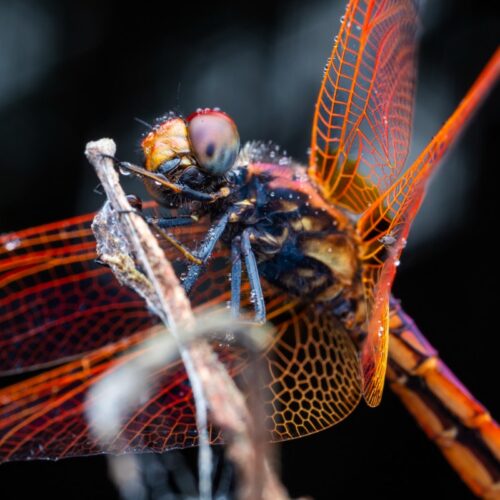
Male dragonflies engage in mid-air "dogfights" to defend their breeding territory, and a new paper in the Journal of the Royal Society Interface has found that this aerial combat is governed by relatively simple rules, chiefly the drive to maintain a tactical position behind an opponent. The researchers found the behaviour closely mirrors the tactics of human fighter pilots, who likewise compete to get behind their adversary — a phenomenon known as "chasing the tail". Beyond its biological interest, the work could inform the design of smarter drones able to navigate using simple, vision-based guidance rather than heavy computation.
The team studied the fiercely territorial, crimson-coloured Trithemis Aurora species, using a portable rig of two shutter-synchronised cameras to reconstruct 102 paired male-on-male flight trajectories in 3D, alongside nine prey-interception trajectories for comparison. They found that hunting dragonflies approached prey from below (silhouetting it against the sky), whereas dogfighting males flew far more convoluted paths against foliage or the ground, relying on loops, spirals and high-G turns of up to 6 Gs while repeatedly swapping "chaser" and "evader" roles. The insects favoured manoeuvrability over top speed and glided for at least a third of the time even in intense duels; unlike pilots, however, they did not trade altitude for airspeed, instead sitting slightly below opponents for a visual-tracking advantage.