Excavation set to begin on Trump administration’s 250-foot triumphal arch amid legal battle
Developed over time first seen 2 months ago
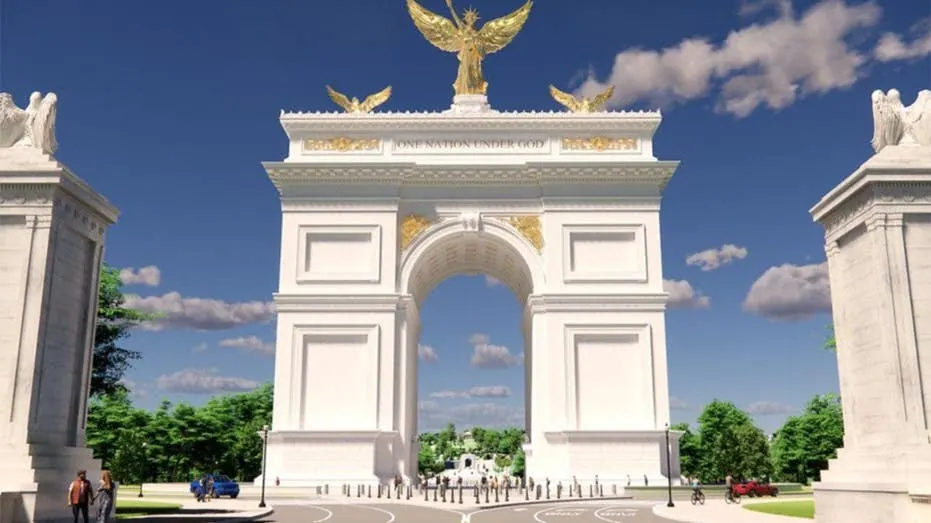
The Trump administration is set to begin excavation within a fortnight on the site of its planned 250-foot triumphal arch in Washington, D.C., after Interior Secretary Doug Burgum confirmed the move, even as a legal challenge to the project remained unresolved. The "Great Triumphal Arch and Military Observation Deck" is to stand on Columbia Island between the Lincoln Memorial and Arlington National Cemetery. The scheme mattered as a flashpoint over executive authority and heritage protection, with opponents, including three veterans and an architectural historian, arguing the administration lacked the congressional authorisation needed to proceed and that construction would damage historic sight lines; their lawyer said plaintiffs stood ready to ask a court to intervene.
Burgum shared mock-ups of a white and gold arch inscribed "ONE NATION UNDER GOD", featuring a winged Lady Liberty-style figure and eagle motifs, calling it fitting architecture for "the most powerful Capital in the World" and noting Washington was the only major Western capital without an arch. A National Park Service report backed the project but acknowledged "direct and indirect adverse effects" on nearby historic sight lines. The arch forms part of a wider Trump-era push to reshape the capital's landmarks, alongside the Kennedy Center renaming, a new White House ballroom and the Lincoln Memorial Reflecting Pool refurbishment, with the legal dispute over the arch left unresolved as excavation work proceeded.
- Excavation begins on Trump's planned 250-foot Washington D.C. triumphal arch
- Veterans and a historian are suing over authorisation and historic sight lines
- Burgum defends project; work proceeds despite unresolved legal challenge
New here? Start with this
Excavation is due to begin shortly on a huge triumphal arch that the Trump administration wants to build in Washington, D.C. The 250-foot structure, officially called the "Great Triumphal Arch and Military Observation Deck," would sit on Columbia Island, between the Lincoln Memorial and Arlington National Cemetery. Interior Secretary Doug Burgum is the administration's lead spokesperson on the project.
The plan is contested. A group that includes three military veterans and an architectural historian has mounted a legal challenge, arguing the administration does not have the congressional approval needed to go ahead and that the arch would harm important historic views in the area, and their lawyer has said they are ready to seek court intervention.
The arch is one part of a broader effort by the Trump administration to alter landmarks and public spaces in the capital, which has also included renaming the Kennedy Center, adding a new White House ballroom, and refurbishing the Lincoln Memorial Reflecting Pool.
Both sides, in good faith
The strongest fair case each way — we don't pick a winner.
The case for
Supporters of the arch see it as a fitting and overdue statement of national confidence, arguing that a capital as significant as Washington deserves grand civic architecture in the tradition of Paris, London and Rome, all of which mark their standing with monumental gateways. They point to the National Park Service's own assessment as evidence the project has passed credible planning scrutiny, and view the administration's willingness to invest in bold, symbolically rich public works, complete with patriotic and religious imagery, as a legitimate exercise of executive initiative to shape the capital's legacy for future generations. For them, proceeding with excavation reflects decisive leadership rather than presumption.
The case against
Opponents, including veterans and an architectural historian, argue this is fundamentally a question of process and respect: they contend the executive branch lacks the congressional authorisation legally required to alter such a sensitive stretch of federal land, and that proceeding regardless sets a troubling precedent for bypassing legislative oversight. They are equally concerned that a 250-foot structure would irrevocably intrude on the carefully preserved sight lines linking the Lincoln Memorial and Arlington National Cemetery, a landscape whose quiet solemnity honours the war dead, noting that even the report cited in support of the project concedes adverse effects on this historic setting. Their case rests on safeguarding both constitutional checks and the integrity of hallowed commemorative ground.