French Student Protests Over School Overcrowding Escalate Into Nationwide Unrest
Developing story first seen 1 hour ago
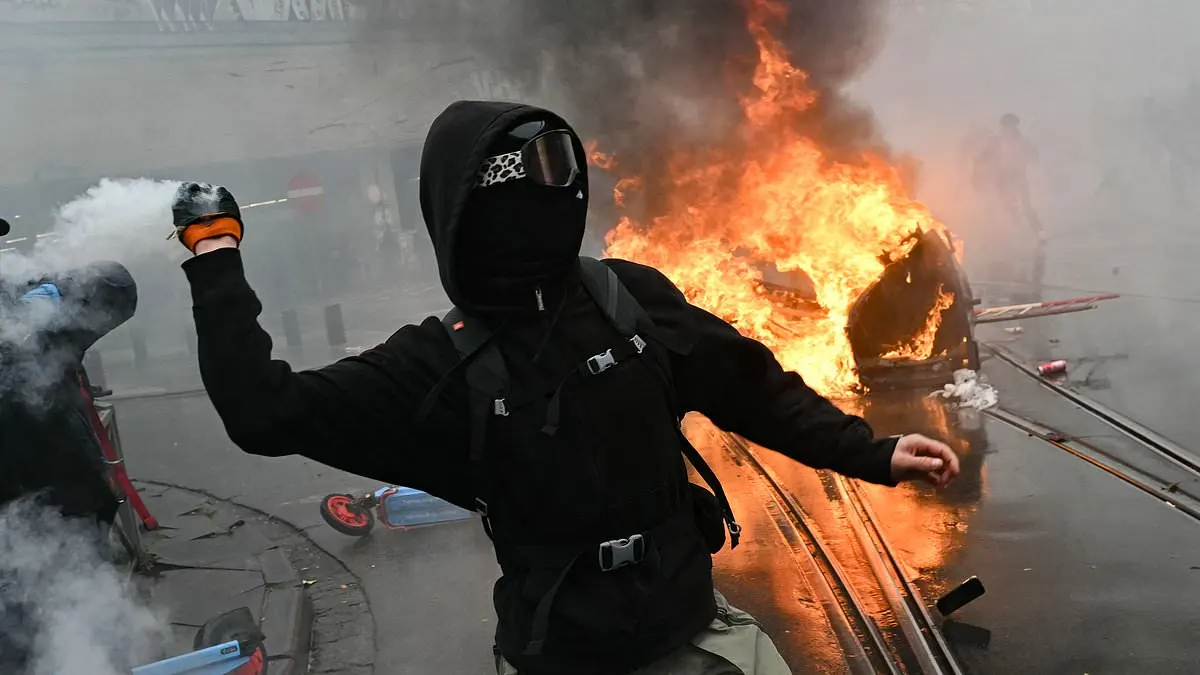
The French government has promised 3,000 extra supply teachers after hundreds of thousands of students and some teachers protested overcrowding, staff shortages and poor school facilities. The demonstrations continue despite the pledge, and have become a focus of political tensions ahead of a presidential election.
Students report broken toilets, mould, rats, crowded canteens and long, poorly scheduled school days. Teachers say classes typically contain 35 pupils, compared with fewer than 23 on average in England, making it difficult to give each student attention. The government says it will publish a response plan by the end of October; estimates of Tuesday’s march attendance ranged from 250,000, according to the government, to 500,000, according to trade unions.
- France has pledged 3,000 extra supply teachers.
- Student protests over school conditions are continuing.
- Attendance estimates for Tuesday’s march reached 500,000.
New here? Start with this
France's secondary schools have been struggling with chronic staff shortages, overcrowded classrooms and poor facilities. Student frustration about these conditions ignited protests in late September, which rapidly spread from high schools to universities, drawing hundreds of thousands of participants.
The movement has expanded to include not just students but also workers, suggesting concerns about public services extend across French society. The protests have attracted attention from political groups across the spectrum, indicating these issues resonate regardless of political affiliation.
The protests show how concerns in one sector can spark broader questions about public services. The movement has become entangled with wider political debates about how public institutions are resourced and prioritised.
Both sides, in good faith
The strongest fair case each way — we don't pick a winner.
The case for
Students and supporters of the protests argue that France's education system faces genuinely documented crises—overcrowding, staff shortages, and inadequate facilities that directly harm learning outcomes. When peaceful advocacy has failed to prompt adequate government response, escalated protest becomes a justified means of demanding accountability from policymakers who have neglected public education investment. The nationwide expansion involving hundreds of thousands reflects widespread recognition that these systemic failures demand urgent action that existing channels have failed to deliver.
The case against
Critics contend that whilst education challenges deserve serious attention, violent escalation and resulting injuries cannot be morally justified or strategically sound. Established democratic mechanisms—elections, parliamentary debate, ministerial engagement—exist precisely to address policy grievances without resorting to confrontation that alienates public support and provokes defensive governmental positions. Escalated violence disproportionately harms ordinary citizens uninvolved in policymaking, and permits political actors to exploit unrest for factional advantage rather than genuine education reform.
Full account
Weeks of student-led unrest across France have snowballed into a substantial crisis affecting educational provision throughout the nation. Beginning in late September from an initial flashpoint in the Paris suburbs, the movement has since expanded to encompass secondary schools, universities and workplaces in cities ranging from southern coastal areas to the north-eastern regions. The disruption has been extensive, with nearly a quarter of France's secondary schools experiencing closures, relocations or operational interruptions, whilst broader assessments suggest up to 1,800 institutions have been affected to varying degrees. On the most intense day of demonstrations, official figures recorded hundreds of thousands of participants taking to streets nationwide, though differing accounts of precise numbers emerged from government and labour union sources.
The catalyst for the movement centres on deteriorating conditions within secondary education. Student accounts detail fundamental deficiencies in school infrastructure and facilities. Many report inadequate furnishings and seating arrangements requiring them to source chairs before lessons commence. Canteen operations function under impossible constraints, with thousands of pupils needing to consume meals within brief windows. Chronic staff vacancies create disrupted timetables with substantial gaps between lessons, resulting in school days stretching from early morning until evening. Classrooms operate at maximum capacity, heating systems fail to maintain comfort across seasons, and students express frustration with university entrance procedures deemed fundamentally unjust. Striking images circulated via social platforms depicted vermin infestations, structural deterioration and sanitation failures, crystallising broader perceptions of systemic institutional neglect.
The transformation from peaceful protest to violent confrontation has produced shocking incidents. In the city of Tours, a teenager sustained severe eye trauma from a police projectile, an incident that came to symbolise the conflict through associated demands for justice appearing as street graffiti at his school. Another injury in northern France resulted in a 15-year-old suffering permanent disability following police deployment of an explosive device. School buildings have sustained fire damage, crowds have thrown projectiles at officers and graffiti has marred numerous sites. Responsibility for these escalations remains contested—some contend that organised groups deliberately infiltrated genuine protests to provoke police responses, whilst demonstrators maintain that authorities deployed disproportionate tactics against initially peaceful assemblies. The physical toll included hundreds of law enforcement officers and teaching staff injured, thousands arrested and official investigations into alleged police misconduct.
The unrest has magnified tensions within France's existing political landscape. President Emmanuel Macron presides as a diminished chief executive approaching the scheduled national election. This instability has provided opportunity for opposition movements spanning from the far right to the far left to attempt capitalising on the demonstrations. The government has offered concessions, yet protesters have continued mobilising rather than demobilising. Student participants have articulated their movement's basis in popular legitimacy and collective strength, contending that numerical support outweighs the institutional advantages possessed by the state. Teachers have also joined demonstrations, adding professional grievances to student complaints about working conditions and resource constraints.
Where outlets differ
Reported attendance figures for major demonstrations vary substantially: one source cites 266,000 national demonstrators with 56,000 in Paris, whilst the other indicates government claims of 250,000 with trade union estimates of approximately 500,000.
Sources diverge significantly in emphasis: one prioritises violent incidents, law enforcement responses and resulting injuries, whilst the other foregrounds the educational conditions motivating protests and incorporates extended student testimony regarding daily school experiences.
Regarding causation of violence: one source identifies external provocateurs deliberately orchestrating escalation through social media coordination, whereas the other does not address this aspect.
Political context: one source emphasises Macron's weakened authority and approaching election as central to understanding the crisis, whilst the other mentions these factors peripherally.
Coverage
- Daily Mail — How hundreds of school protests across France are being infiltrated and inflamed by far-Left anarchists hellbent on ‘overthrowing the bourgeois state’ in a new French revolution: SUE REID
- BBC World — ‘Everyone hates the police’ – what France’s school protests reveal about a divided nation