German company becomes first in Europe to launch fully commercial orbital rocket
Developed over time first seen 2 months ago
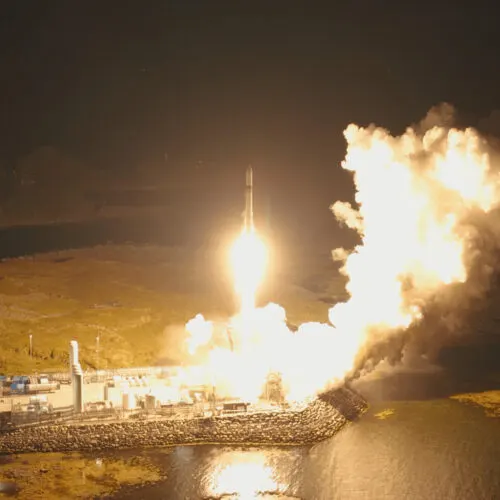
German startup Isar Aerospace has become the first company to launch a fully commercial orbital rocket from continental Europe, marking a significant milestone for the continent's space industry. The success positions the Munich-founded firm as the clear leader among a wave of European launch startups seeking to break the near-monopoly of state-subsidised incumbents Arianespace and Avio, whose Ariane 6 and Vega-C rockets have relied on billions of euros in government funding under a "geo-return" model tying contracts to where components are built. European space officials hope Isar's privately-funded approach will finally inject genuine competition into a launch market widely seen as stagnant.
The two-stage Spectrum rocket lifted off from Andøya Spaceport in Arctic Norway on Saturday evening and reached orbit within seven minutes. Isar was founded in 2018 by three Technical University of Munich students, Daniel Metzler, Josef Fleischmann and Markus Brandl, who began as campus tinkerers before building a serious rocket venture; it took eight years to reach orbit, during which the company raised roughly $1 billion in private funding and grew to nearly 500 employees, making it Europe's best-capitalised private launch firm. Metzler said the achievement gives "Europe sovereign access to space" and that the company will now focus on scaling production to meet its order pipeline.
- Sources
- 2
- Outlets
- 2
- Left · Centre · Right
- 0 · 0 · 0
In short
- Isar Aerospace's Spectrum rocket reached orbit from Norway on Saturday
- First fully commercial orbital launch from continental Europe
- Munich startup raised ~$1bn since its 2018 founding by three students
How this story developed
- 2 months ago New detail has emerged on why Isar Aerospace's orbital launch matters to Europe's wider space industry: the European Space Agency and national governments are looking to the German firm's success to break their reliance on costly, subsidy-dependent incumbents.
- 2 months ago German startup Isar Aerospace has become the first European company to launch a fully commercial rocket into orbit, marking a significant milestone for the continent's space industry.
- 2 months ago German startup Isar Aerospace has become the first company to launch a fully commercial orbital rocket from continental Europe, marking a significant milestone for the continent's space industry.
Full account
A German start-up has become the first company to send a fully commercial rocket into orbit from European soil, in a launch hailed as a turning point for the continent's space ambitions. Isar Aerospace's two-stage Spectrum rocket lifted off on Saturday evening from the Andøya Spaceport in Arctic Norway, reaching low Earth orbit roughly seven minutes after launch. The 28-metre vehicle departed as the last light faded from the northern sky, marking the first time a privately developed European rocket has completed an orbital flight without direct state ownership of the launch vehicle.
Isar Aerospace was founded in 2018 by three students at the Technical University of Munich — Daniel Metzler, Josef Fleischmann and Markus Brandl — who had begun experimenting with rocket components in a university workshop before deciding to turn the project into a business. It took the company roughly eight years to reach orbit, a period during which it raised close to a billion dollars in private funding and grew to a workforce of around 500, making it comfortably the best-funded rocket company in Europe. Saturday's flight followed an unsuccessful first attempt in March, when an earlier Spectrum vehicle lost control and came down in the sea within half a minute of lift-off.
Speaking after the launch, chief executive Daniel Metzler said the achievement gave Europe 'sovereign access to space' and opened a 'true alternative' to existing providers for both commercial and government customers, describing it as the start of 'a new chapter' for European spaceflight. He argued that the company had compressed into a few years progress that had previously taken the wider European space sector decades, and pushed back on early scepticism that a continental rival to established launch providers could ever get off the ground.
The flight is being read as significant well beyond the technical milestone. Europe's launch capability has long rested on state-backed operators such as Arianespace and Italy's Avio, and the sector has faced added strain since Russia's invasion of Ukraine cut off access to Soyuz rockets, while shifting transatlantic politics have fed concern in some European capitals about reliance on American providers. Isar's success also chimes with the European Space Agency's push to favour European-built launch capacity. Having outpaced several rival European launch start-ups also chasing orbital flight, Isar says its focus now turns to scaling up production and working through its order backlog to meet what it describes as surging global demand.
Where outlets differ
From the full account, which is AI-written from the sources:
Source 1 (Ars Technica) gives far more detail on the company's founding story, the TU Munich origins, the specific funding and staff figures, and extended direct quotations from Metzler's press conference, framing the story around Isar's rapid corporate rise.
Source 2 (a shorter tech news item) foregrounds the failed March launch attempt in more graphic terms and spends more space on the geopolitical backdrop — reliance on Arianespace/Avio, the Soyuz cut-off after Russia's invasion of Ukraine, doubts about US reliability, and ESA's 'buy European' stance — rather than company history.
Only Source 1 gives precise technical details such as launch time, rocket height and time-to-orbit; Source 2 omits these entirely.
Steelman: both sides, in good faith
The strongest fair case each way — we don't pick a winner.
The case for
Advocates of opening the market to firms like Isar argue that decades of subsidy-dependent, geo-return-based contracting have left Europe with costly, inflexible launch capacity that struggles to compete on price with the likes of SpaceX. They contend that privately-funded competitors, disciplined by investors and customers rather than political horse-trading over where components are built, are more likely to drive down costs, accelerate innovation and give Europe a resilient, diversified launch base rather than reliance on one or two national champions.
The case against
Defenders of the current state-backed model argue that space launch is strategic infrastructure, not an ordinary commodity market, and that guaranteed sovereign access to orbit for defence, navigation and communications cannot be left to the whims of private investors or a young company's balance sheet. They contend that the geo-return principle, whatever its inefficiencies, has secured broad political buy-in and a distributed industrial base across ESA's member states, and that abandoning proven programmes like Ariane 6 in favour of unproven newcomers risks Europe's autonomy if a private venture falters or is bought out by foreign interests.
Explained simply
Isar Aerospace is a private German rocket company, founded in 2018 by three university graduates, that has spent years developing an orbital launch vehicle called Spectrum. Until now, sending satellites into orbit from European soil has relied almost entirely on state-backed operators such as Arianespace, which runs the Ariane 6 rocket, and Italy's Avio, which runs Vega-C, both of which depend heavily on government subsidies.
The wider significance lies in Europe's efforts to build a more competitive, privately funded space industry, similar to how companies like SpaceX have reshaped the market in the United States. European space agencies and governments have been keen to see new entrants succeed, hoping this could reduce reliance on costly public funding and long-standing arrangements that tie contracts to where rocket parts are manufactured.
Isar Aerospace has raised around $1 billion from private investors and grown to nearly 500 employees, making it one of the best-funded rocket start-ups in Europe. Its progress is being closely watched as a test of whether Europe can develop commercially viable, competitively priced launch capabilities of its own.
Coverage · 2 sources
Business Companies Europe Space Technology World