World news and discussion on TalkFuse.
Gillian Anderson Makes Teenage Sex and Death at Camp Miasma a Delicious Mindfuck: Review
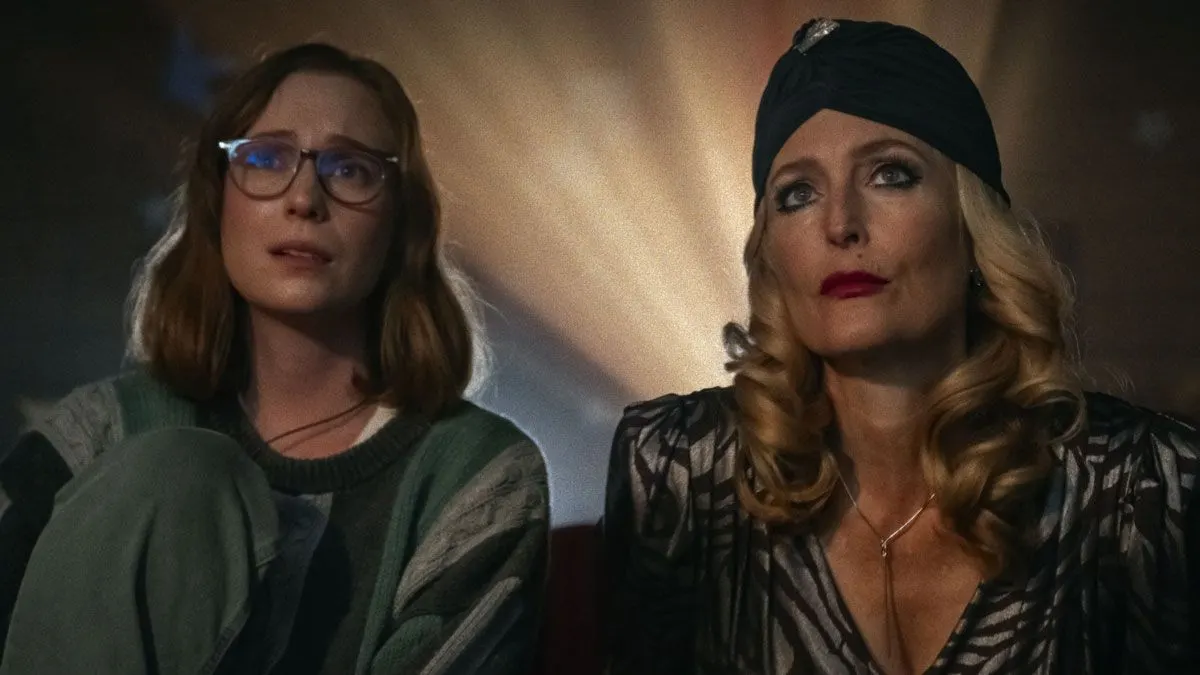
Jane Schoenbrun’s Teenage Sex and Death at Camp Miasma is reviewed as an ambitious, deliberately elusive film that combines horror, sexuality and personal identity. The review argues that Gillian Anderson and Hannah Einbinder’s committed performances give emotional coherence to a story whose allegory and relationships remain intentionally ambiguous.
Einbinder plays Kris, a 29-year-old independent filmmaker hired to revive the fictional Camp Miasma slasher franchise with a new origin story. She travels to the snow-covered camp to meet Anderson’s Billy, the original film’s reclusive star, who has withdrawn from acting; over several days, Kris confronts sexual confusion while Billy faces the reasons for her isolation. The reviewer gives the MUBI release an A- and highlights its use of slasher imagery, including the killer Little Death, to connect sex, death, bodies and bodily fluids.
In short
- Schoenbrun’s new horror film is praised as emotionally resonant but intentionally cryptic.
- Einbinder’s filmmaker meets Anderson’s reclusive former slasher star at a remote camp.
- The review awards the film an A-.
Steelman: both sides, in good faith
The strongest fair case each way — we don't pick a winner.
The case for
Ambitious contemporary cinema that trusts audiences to grapple with complex themes rather than spell them out reflects how people actually experience identity, desire, and trauma—not as clear narratives but as fragmented, ambiguous journeys. Schoenbrun's deliberate elusiveness about Billy's character, Kris's sexuality, and the film's meanings invites active participation in interpretation rather than passive consumption of predetermined ideas. Anderson and Einbinder's committed performances anchor this thematic abstraction in genuine emotional stakes, demonstrating that strong character work can sustain a film even when narrative remains intentionally opaque.
The case against
Deliberate elusiveness can mask unclear storytelling rather than represent artistic sophistication, leaving audiences alienated rather than intellectually engaged. Slasher imagery and meta-genre references may become self-referential without offering substantive insight into human experience, privileging obscurity over meaningful complexity. Strong performances from talented actors cannot fully compensate for a film that fails to communicate a coherent vision or uses ambiguity as a substitute for authentic thematic development and genuine character clarity.
Explained simply
Teenage Sex and Death at Camp Miasma is a horror film directed by Jane Schoenbrun. It centres on Kris, a 29-year-old independent filmmaker asked to make a new origin story for a fictional slasher film series, and Billy, the reclusive actor who starred in its original instalment.
Kris travels to the snowy camp where the films are set to meet Billy. As they spend time together, Kris grapples with sexual uncertainty, while Billy’s retreat from public life raises questions about her past and isolation. The film uses familiar slasher images to explore sexuality, identity and the body.