Gemini adds tag-free item location logging to Find Hub
Developed over time first seen 2 months ago
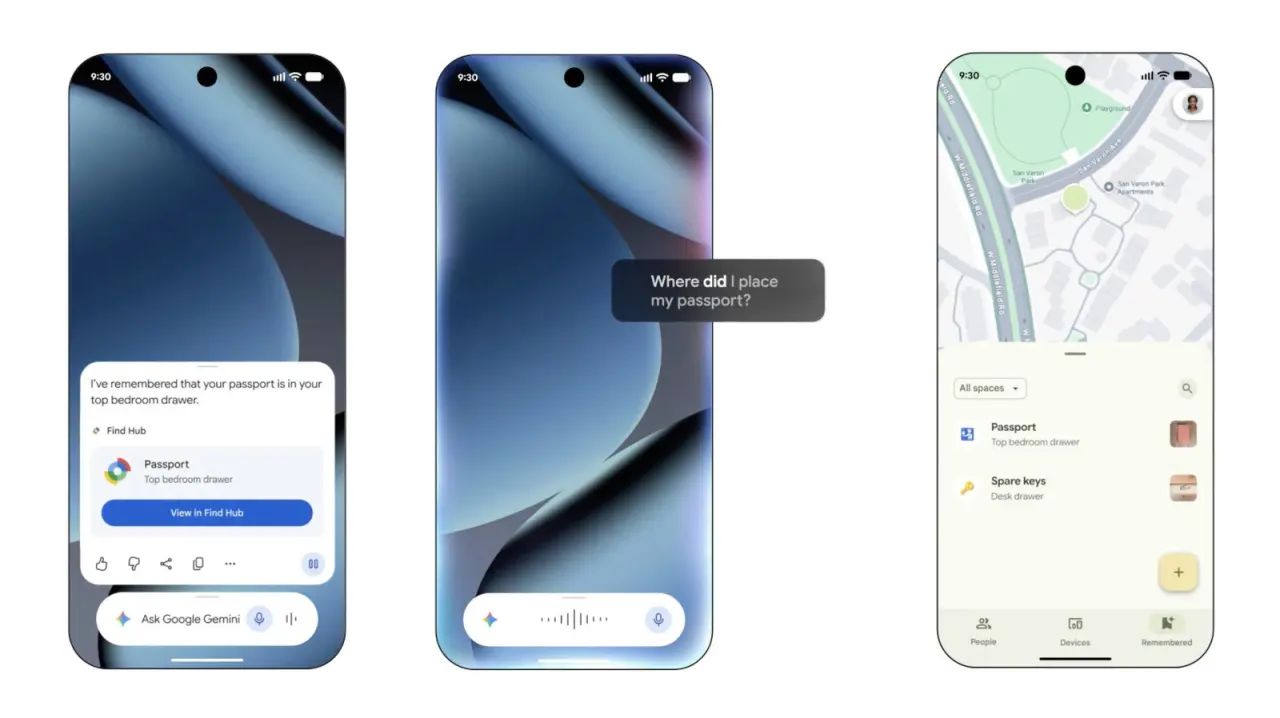
Google has rolled out its September Android Feature Drop, adding several Gemini-powered and general improvements across the Android ecosystem. The centrepiece is an expansion of Find Hub, previously used only to locate phones, earbuds and tracker tags, so that users on Android 16 or higher can now ask Gemini to log the location of everyday items that have no tracker attached, simply by describing where they put something and optionally adding a photo, then later asking Gemini or checking Find Hub to recall it.
The update also introduces Guided Vision, a Gemini Live feature that interprets a phone's camera feed to help locate objects or read text such as a menu in poor lighting, and even judge how far a user's hand is from a target item; it works from Android 9 onwards via accessibility shortcuts or the TalkBack menu. Google Messages gains Google Keep integration, letting users create and share notes directly within a conversation, plus customisable per-thread chat themes based on wallpapers or photos. Motion Assist, floating dots designed to ease motion sickness in moving vehicles that began appearing last week, is now an official Android 17 feature, though it remains limited to a narrower set of devices. Google says the features will reach phones "soon", with full rollout expected to take days to weeks.
- Gemini can now log locations of untagged items in Find Hub
- Guided Vision uses the camera to help find objects, read text
- Messages gets Google Keep notes and custom chat themes
New here? Start with this
Google has begun rolling out its September Android Feature Drop, a periodic bundle of new features Google adds to Android phones outside the usual big annual updates. This particular drop centres on Find Hub, the app Android uses to help people locate lost devices and accessories, and Gemini, Google's AI assistant, which is being woven into more everyday phone tasks.
The key change lets people log where they have put an everyday item, such as keys or a passport, by simply telling Gemini, without needing a physical tracker tag attached to it. This builds on Find Hub's existing role, which previously covered phones, earbuds and dedicated tracker accessories. The drop also brings smaller additions across Google Messages and general accessibility tools, reflecting Google's ongoing push to fold Gemini into more parts of the Android operating system.
This matters because it signals how Google is positioning AI as a practical, everyday utility rather than a novelty, and because such features do not arrive for all users at once. Availability depends on a phone's Android version and manufacturer, so the rollout will reach different users at different times, with Google itself describing the timeline only as "soon".
Full account
Google has begun rolling out its September Android feature drop, with a headline addition allowing Gemini to log the whereabouts of everyday belongings inside Find Hub without requiring a physical tracker or tag. Users can simply tell the assistant, for example, where they have stored a passport or other rarely used item, optionally attaching a photograph, and Gemini will record that location for later retrieval. When the item is needed again, users can either ask Gemini directly or check a dedicated list of remembered items within the Find Hub app. The feature is being made available on devices running Android 16 or later, in regions where both Gemini and Find Hub already operate.
This tag-free memory tool sits alongside several other updates in the same rollout. Motion Assist, a feature designed to ease motion sickness during car journeys, overlays moving dots or bubbles on the screen that track a vehicle's movements, intended to reduce the mismatch between what the eyes see and what the body feels; users can adjust the shape, colour and transparency of the overlay, or set it to activate automatically. Also included is Guided Vision (referred to by one outlet as a 'visual assistant'), an accessibility-focused tool within Gemini Live that uses the phone's camera to describe surroundings, read out labels or menus, and help locate specific objects, including guidance on how far away an item is. It can be triggered from the Accessibility shortcuts or the TalkBack menu and is being made available far more broadly, reaching devices as far back as Android 9.
Beyond the AI-driven additions, Google Messages is gaining two further updates. A Google Keep integration lets anyone in a conversation create and jointly edit shared notes, such as shopping or packing lists, directly from within a chat via the app's attachment menu, without needing to leave the conversation. Messages threads are also gaining customisable chat themes, letting users set a background image or wallpaper for individual conversations, with message bubbles automatically coloured to match, or set manually.
Coverage of the update was broadly consistent on the core details but varied in framing and emphasis. One outlet centred its report on the Find Hub memory feature, noting it could particularly help people with poor memory or attention difficulties, and treated Guided Vision as a new 'visual assistant' capability. Another placed equal weight on Motion Assist and the Find Hub expansion as the two headline features, and pointed out that Motion Assist is Android's answer to Apple's existing Motion Cues tool. A third took a more critical, evaluative tone towards Google's recent feature drops generally, noting that because this is an Android-wide drop rather than one limited to Pixel devices, the changes reach a wider range of phones, and clarified that Motion Assist had already begun appearing on some handsets the previous week before being formalised as an official Android 17 feature.
Where outlets differ
One report frames the Find Hub update mainly as a memory aid for forgetful or ADHD users, while another focuses more neutrally on its practicality for rarely-used items like passports.
Only one source explicitly notes that Motion Assist is Android's equivalent to Apple's Motion Cues feature.
One outlet distinguishes this as an 'Android feature drop' (available across many devices) rather than a Pixel-exclusive drop, and notes Motion Assist had already been appearing on some phones before this official rollout, a detail the other two omit.
Sources differ on device/version specifics: one ties Motion Assist to Android 17 specifically, while accounts of Guided Vision's minimum OS requirement (Android 9) and Find Hub's (Android 16) are consistent across sources.
One source refers to Guided Vision as a 'visual assistant,' while the others use the 'Guided Vision' name throughout.
Coverage
- Engadget — A new Android Find Hub feature will help you remember where you put important things
- The Verge — Google Find Hub will soon help you locate things without a tracker
- Ars Technica — New Android Drop adds remembered items in Find Hub, makes anti-nausea dots official
AI Americas Art Celebrity Culture Entertainment Gadgets Software Technology World