Guinea rubbish landfill collapse kills 30
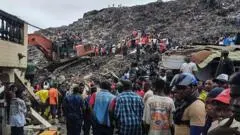
At least 30 people have been killed after a mound of rubbish at a major waste site collapsed onto nearby homes in the Dar-es-Salam area of Conakry, Guinea's capital, the government has confirmed. The collapse, which followed heavy overnight rain, has prompted a large-scale rescue operation involving military personnel, though officials fear the death toll may rise further as people remain buried under the debris.
The disaster struck at around 02:00 local time, injuring another 22 people, six of them seriously. Rescuers have since been using excavators to search through the scattered rubbish, watched by local residents, while Prime Minister Mamadou Oury Bah visited the site to oversee the response. A neighbourhood leader said 18 bodies had already been recovered and taken to the morgue, and one woman told local media that all five of her children had died. It is not the first such tragedy at the site — a similar landslide there killed 10 people in 2017.
- Rubbish mound collapse in Conakry, Guinea kills at least 30 people
- Heavy overnight rain triggered the landslide onto nearby homes
- Military-backed rescue under way; similar collapse killed 10 in 2017
New here? Start with this
Guinea is one of the world's poorest countries, and Conakry, its capital, struggles with formal waste management for its large and fast-growing population. Much of the city's rubbish ends up at large open landfill sites, with informal settlements often built close to or around them due to a shortage of housing.
These landfills can become unstable, especially after heavy rain, when built-up mounds of waste can shift or collapse, similar to a landslide. This danger has been known for some time, as a smaller collapse at the same site in 2017 also caused deaths, raising long-standing questions about safety standards and urban planning around such facilities.
The scale of this collapse, and the fact that it struck homes in a residential area, has drawn national attention, with the government and prime minister directly involved in the emergency response.