Haiku OS rises / Beta 6 sails open web / Virtual winds fly fast
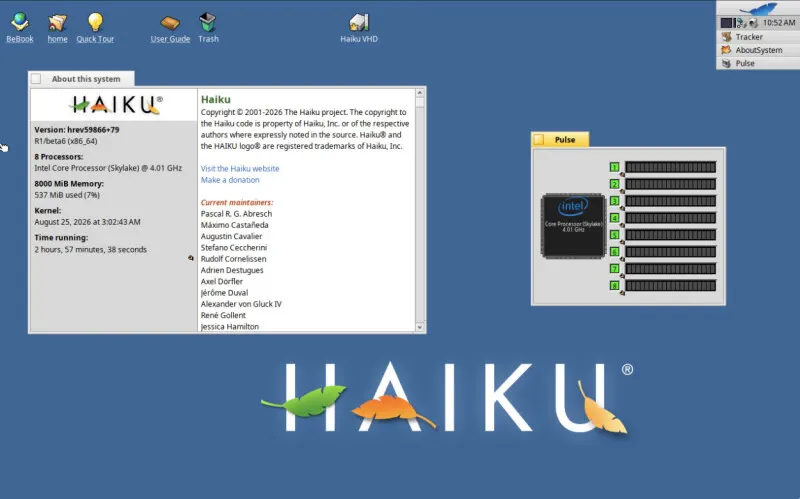
Haiku OS, the open-source homage to the classic BeOS, has released its sixth beta, arriving a week after the project's 25th anniversary. The update brings a significantly upgraded built-in browser, a wider choice of alternative browsers, and a working hardware-accelerated hypervisor, making the niche operating system a more practical option for everyday use, particularly on older or low-spec hardware.
The bundled WebPositive browser now uses the WebKit engine, allowing it to properly run demanding web apps like Gmail, while users can also install a fully Mozilla-branded Firefox (already updated to version 155), along with Waterfox, LibreWolf, Floorp and email clients such as IceDove and Claws. Beta 6 also adds hardware-accelerated virtual machines via a ported NVMM hypervisor, letting QEMU use native Intel and AMD virtualisation, though this and Firefox are limited to the 64-bit x86 build. The OS remains notably lightweight, running well on decade-old ThinkPads with just 8GB of RAM, and is also available for 32-bit x86, RISC-V, Arm64 and an experimental PowerPC port; the project has taken a firm stance against AI-generated code contributions, prompting one Arm64 developer to abandon work upstream.
In short
- Haiku OS beta 6 released a week after its 25th birthday
- Adds WebKit-based browser, Firefox port, and other browser options
- New hardware-accelerated hypervisor enables faster QEMU virtualisation
Steelman: both sides, in good faith
The strongest fair case each way — we don't pick a winner.
The case for
Beta 6 makes Haiku more useful for people who value a lightweight, open-source system, especially on older hardware: a modern browser, more browser choices and accelerated virtual machines address practical limits that can keep niche operating systems from everyday use. Its broad architecture support and refusal of AI-generated code may also appeal to users who prioritise portability and human-reviewed contributions.
The case against
The new capabilities remain uneven: Firefox and hardware-accelerated virtual machines are limited to 64-bit x86, while the project’s anti-AI contribution rule has already led an Arm64 developer to leave upstream work. For people seeking a dependable everyday system across different devices, those constraints and the effort needed to maintain a smaller software ecosystem may outweigh the benefits of its low resource use.
Explained simply
Haiku is a small, open-source computer operating system inspired by BeOS, a system developed in the 1990s. It is maintained by a community project and is designed to run on personal computers, including some older machines.
An operating system manages a computer’s hardware and lets people run applications. Haiku’s built-in browser and support for other browsers and email programmes affect how easily people can use everyday online services with it.
The project supports several types of computer processors, though some features are available only on 64-bit x86 machines, commonly used in desktop PCs. Its approach to accepting code contributions has also become part of the discussion around how open-source projects are maintained.