World news and discussion on TalkFuse.
Here Are the First Images of the Crater Left on the Moon by SpaceX’s Rocket
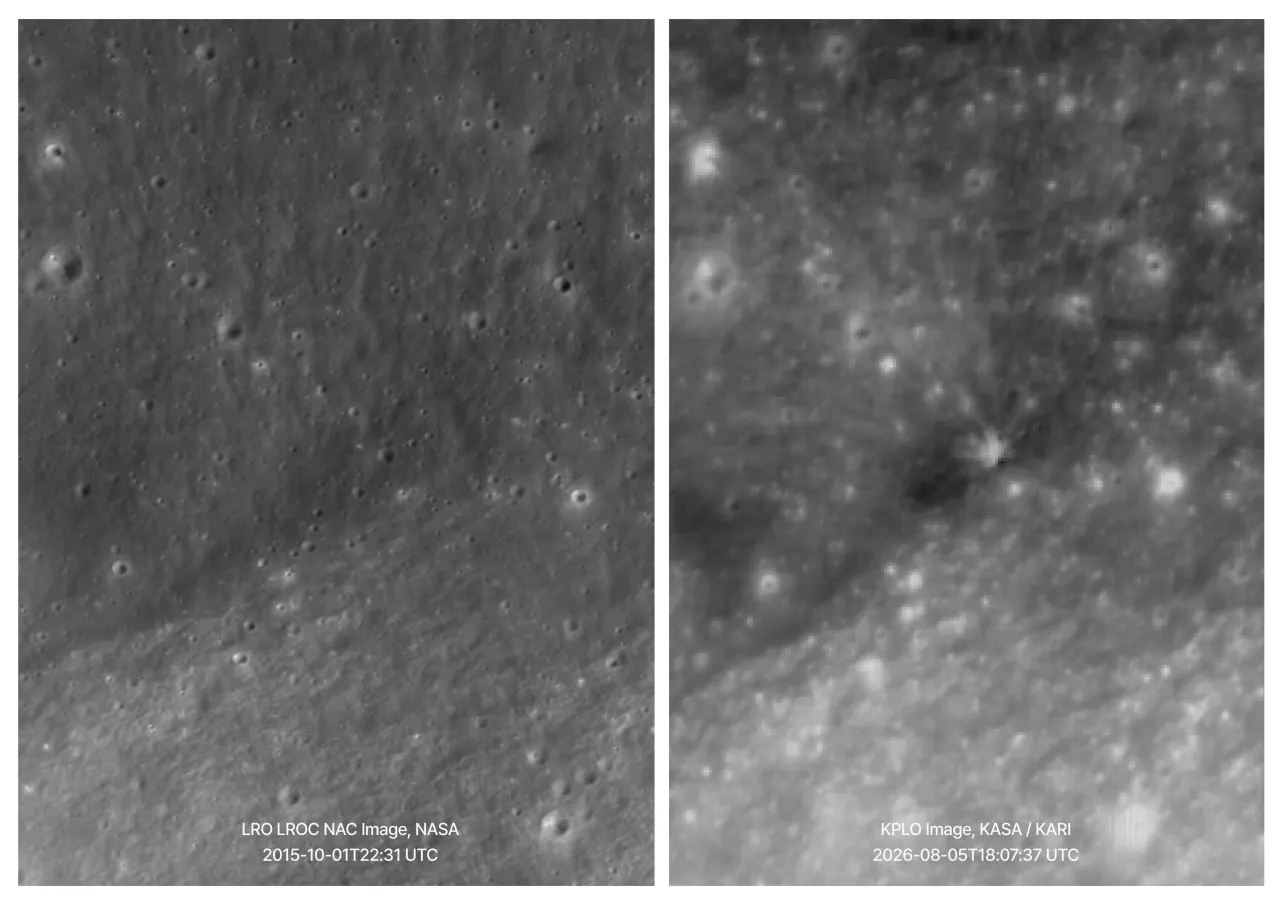
South Korea’s Danuri lunar orbiter has taken the first images of the crater created when a fragment of a SpaceX Falcon 9 rocket struck the Moon. The photographs provide direct visual evidence of the impact, adding to telescope observations of material thrown from the surface, and illustrate the challenges of tracking and disposing of space hardware on lunar-bound missions.
The rocket stage launched in January 2025 to deliver lunar landers and remained in an unstable orbit for more than a year before Earth, lunar and solar gravity diverted it into the Moon. Astronomers had predicted the location and timing of the collision; the crater was expected to be dozens of feet across and nearly 3.6 metres deep, though the available images show how small it is against the Moon’s 2,160-mile diameter. SpaceX said controlled ocean re-entry is not always possible for high-energy lunar missions and that it is working with NASA on disposal options.
In short
- Danuri photographed a crater from a Falcon 9 fragment’s lunar impact.
- The rocket stage drifted into the Moon after more than a year.
- SpaceX says lunar missions can prevent controlled deorbiting.
Explained simply
Danuri is South Korea’s spacecraft orbiting the Moon, where it takes images and gathers data. The crater was made by part of a Falcon 9 rocket, a vehicle built by SpaceX to carry payloads into space.
The rocket stage had been left orbiting the Sun after a 2025 launch, and the pull of Earth, the Moon and the Sun eventually sent it towards the lunar surface. Astronomers had worked out where and when it was likely to hit; Danuri’s images now show the resulting mark.
The impact highlights the challenge of disposing of rocket hardware after missions that travel towards the Moon. A spent stage may not be able to return to Earth for a controlled ocean landing, so SpaceX says it is working with NASA on other disposal options.