How fruit flies chase invisible ribbons of smell to get to their source
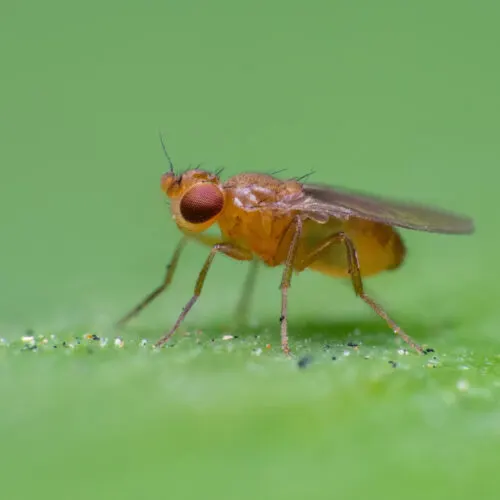
Researchers at Rockefeller University found that fruit flies do not simply fly upwind and sweep side to side when they lose a scent, as the long-standing “surge and cast” model suggests. Instead, experiments indicate that they track the edges of odour plumes, repeatedly crossing into the scent, looping through clean air and returning to the boundary, a strategy that may help them locate food or mates in turbulent conditions.
The team tethered flies above a ball acting as a miniature treadmill in darkness, while a steerable airflow delivered controlled pulses of apple cider vinegar. In a virtual 50-millimetre-wide scent corridor, flies spent most of their time outside the plume but made most progress towards its source during brief entries into it; they also followed edges rather than the centre of the corridor. The setup let researchers precisely simulate shifting plumes and scent gradients, offering a clearer view of how small insect brains process unreliable chemical signals.
In short
- Fruit flies appear to navigate smells by tracking plume edges.
- This challenges the traditional “surge and cast” explanation.
- A virtual odour environment enabled precise behavioural testing.
Explained simply
Fruit flies use smell to find food and mates, but outdoor air currents break scents into shifting plumes rather than carrying them in a steady stream. A fly may therefore lose and regain a smell as it moves through the air.
Scientists have often described flies as flying upwind and sweeping from side to side when a scent disappears. Researchers at Rockefeller University studied how flies respond to controlled vinegar scents in a dark laboratory setup, where the flies walked on a small ball while airflow carried the odour.
Understanding how flies follow scent in turbulent air could help explain how their brains make sense of unreliable signals. It may also inform research into how other animals navigate by smell.