World news and discussion on TalkFuse.
Hung parliament forecast deepens political uncertainty as Burnham pursues Chagos revival amid legitimacy questions
Developed over time first seen 2 months ago
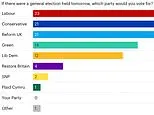
Electoral forecasts suggest a snap general election would produce a hung parliament, with Labour polling at 23 per cent and lacking an outright majority. The government would need to negotiate coalition arrangements with the Liberal Democrats, Greens and potentially the Scottish National Party to maintain parliamentary viability, reflecting ongoing fragmentation in the political landscape.
The Prime Minister has committed to reviving a stalled agreement to transfer Chagos Islands sovereignty to Mauritius ahead of negotiations with President Trump, despite Washington's prior opposition centring on the Diego Garcia military base. Compounding these pressures, public figures including actor Danny Dyer have publicly questioned Burnham's electoral mandate, voicing scepticism about who voted him into office and undermining confidence in the government's public backing.
- Sources
- 3
- Outlets
- 1
- Left · Centre · Right
- 0 · 0 · 3
In short
- Poll predicts hung parliament with Labour at 23%, necessitating coalition talks with smaller parties
- PM revives disputed Chagos Islands sovereignty transfer agreement ahead of Trump talks
- Public criticism raises doubts over Burnham's democratic legitimacy and government stability
How this story developed
- 2 months ago Electoral forecasts suggest a snap general election would produce a hung parliament, with Labour polling at 23 per cent and lacking an outright majority.
- Daily Mail Poll projects hung Parliament as Burnham faces coalition talks
- Daily Mail ‘Anyone vote for him? I didn’t vote for him’: Ex-EastEnders star Danny Dyer says he ‘doesn’t know’ who’s PM in withering putdown of Burnham’s coup
- Daily Mail Burnham seeks to revive Chagos sovereignty transfer before Trump talks
Full account
The political landscape facing Prime Minister Andy Burnham has grown markedly more precarious following fresh polling data and developments spanning foreign policy and domestic legitimacy. A YouGov survey released today indicates that public backing for his administration has plateaued, whilst strategic questions mount regarding both his electoral prospects and his right to remain in office without seeking a fresh public mandate. These pressures arrive as Burnham attempts to navigate the treacherous terrain of reviving negotiations over the Chagos Islands transfer to Mauritius, a proposal that has encountered substantial internal resistance within his own party ranks.
Polling suggests a hung parliament would emerge should Burnham call a snap election, contrary to earlier expectations that repositioning himself with a personal mandate might strengthen Labour's hand. The YouGov figures place Labour at 23 per cent, with the Conservatives and Reform United both commanding 21 per cent support, whilst the Green Party registers 14 per cent and the Liberal Democrats 12 per cent. Electoral modelling by Electoral Calculus projects a Commons consisting of 221 Labour MPs, 148 Conservative MPs, 120 Reform representatives, 70 Liberal Democrats, and 34 each for both the Greens and Scottish National Party. Such an outcome would necessitate an intricate coalition arrangement, most likely uniting Labour with the Liberal Democrats, Greens and potentially the SNP, an alignment that would grant smaller partners considerable negotiating leverage over contentious policy areas including Scottish independence referendums and electoral reform. Burnham has publicly ruled out an early election campaign, though Westminster remains rife with speculation regarding his appetite for such a gamble, particularly given substantial cost-of-living pressures confronting voters, including energy price forecasts and interest rate uncertainty.
Simultaneously, Burnham is pursuing efforts to resurrect negotiations surrounding the British Indian Ocean Territory's transfer to Mauritius, a proposal that has languished since April following American opposition. During discussions with Mauritian counterpart Navin Ramgoolam, the Prime Minister signalled his commitment to facilitating the arrangement, conversations that precede scheduled bilateral meetings with United States President Donald Trump. The initiative has provoked considerable discontent within Labour's parliamentary ranks, with senior backbenchers branding the proposal ruinous and warning of cascading implications for other British territories, particularly the Falkland Islands. Conservative opposition leader Kemi Badenoch has questioned the scheme's prioritisation at a time when domestic resources remain scarce.
Burnham's pathway to office, meanwhile, continues attracting scrutiny regarding his democratic legitimacy. The Prime Minister assumed the position in July following a contest for Labour leadership among Westminster MPs in which no alternative candidate emerged, circumventing a ballot of the party's membership base. Actor Danny Dyer amplified these concerns at a recent public demonstration, articulating doubts about Burnham's authority to govern and characterising successive prime ministers in disparaging terms, comments that garnered substantial public endorsement via social media platforms. The criticism carries particular weight given Burnham's historical demands that the Conservatives seek a fresh popular mandate when they previously changed leaders whilst in government—a principle he has subsequently declined to apply to himself.
Where outlets differ
From the full account, which is AI-written from the sources:
Source 1 emphasises polling mathematics and coalition scenarios; Source 2 focuses on diplomatic dimensions and internal party opposition; Source 3 highlights democratic legitimacy questions and how Burnham secured office without membership ballot.
Source 2 contains a notable discrepancy: Downing Street's readout of Burnham's call with Ramgoolam stated he 'underlined commitment' to working with Mauritius, whilst the Mauritian PM's office readout explicitly stated Burnham vowed to do 'everything possible' to secure treaty ratification—a material difference in framing commitment levels.
Sources 1 and 3 both address Burnham's reluctance to call an election, but from different angles: Source 1 presents it as a risky gamble given economic pressures; Source 3 frames it as hypocritical given his previous demands that Conservative leaders do precisely that.
Steelman: both sides, in good faith
The strongest fair case each way — we don't pick a winner.
The case for
The return of the Chagos Islands to Mauritius represents a matter of historical justice rooted in decolonisation principles and international law—the islands were separated from Mauritius through contested British colonial decisions. A government's democratic legitimacy in Westminster derives not from individual vote-share but from commanding a parliamentary majority; even a coalition-dependent majority is constitutionally legitimate. Coalition governments are a normal and workable feature of Westminster democracy, and pressing forward with longstanding foreign policy objectives need not be paralysed by electoral forecasts. Negotiating with the Trump administration, despite historical US resistance centred on Diego Garcia, may represent an unexpectedly viable path to resolving a decades-long dispute.
The case against
Pursuing a significant and historically fraught sovereignty transfer whilst facing electoral forecasts of merely 23 per cent and a hung parliament introduces unnecessary political risk. The government already confronts public legitimacy questions, and launching contentious foreign policy initiatives when public confidence is fragile courts further erosion of authority. The Chagos arrangement is complex—success requires sustained political consensus and coalition stability, both of which are vulnerable. Deploying political capital on this issue diverts focus from the careful coalition management needed to sustain the government itself, whilst the involvement of US military interests and Trump administration unpredictability compound difficulty.
Explained simply
Britain's political system typically produces a single party with enough MPs to govern alone, but forecasts suggest the next election would leave no party with this outright majority, known as a hung parliament. Labour is currently polling at 23 per cent, meaning the Prime Minister Andy Burnham would need to negotiate deals with other parties such as the Liberal Democrats, Greens and Scottish National Party to pass laws and stay in power. This kind of arrangement is less stable and makes governing more difficult.
A key issue for the government is reviving an agreement to hand over the Chagos Islands to Mauritius, a deal that was previously stalled. The Chagos Islands are a British overseas territory that houses a strategically important American military base called Diego Garcia, which the United States has opposed handing over because it values the base for its defence capabilities. Burnham is pursuing this transfer as he seeks to negotiate with incoming President Trump over other matters.
The government is also facing questions about its democratic legitimacy, with public figures including actor Danny Dyer openly questioning whether Burnham has genuine public backing and whether people voted him into power. These concerns about the Prime Minister's mandate add to the pressure on a government that already faces the prospect of having to negotiate constantly just to maintain a working majority in parliament.
Coverage · 3 sources
Bias meters
From 3 rated sources.
- Daily MailRightPoll projects hung Parliament as Burnham faces coalition talks
- Daily MailRightBurnham seeks to revive Chagos sovereignty transfer before Trump talks
- Daily MailRight‘Anyone vote for him? I didn’t vote for him’: Ex-EastEnders star Danny Dyer says he ‘doesn’t know’ who’s PM in withering putdown of Burnham’s coup
Americas Art Business Celebrity Culture Elections Entertainment Government Markets Politics UK World