IBM says super-chill boxes that connect through ‘cryogenic tunnels’ will get quantum computers scaling
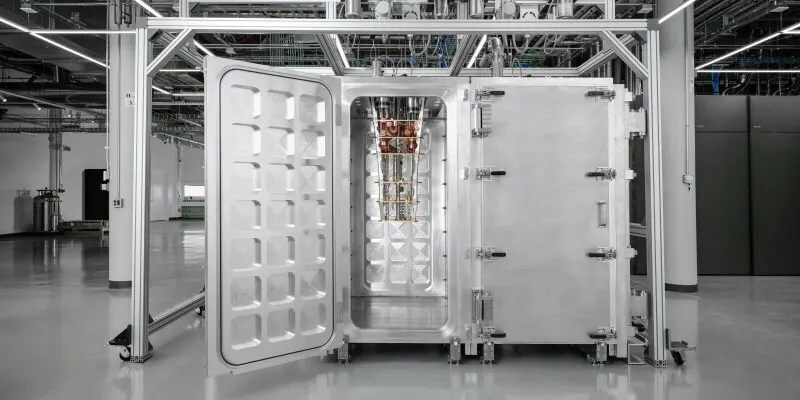
IBM has unveiled new modular cryogenic cooling cabinets designed to help its quantum computers scale beyond current limits. Quantum chips must operate at temperatures near absolute zero, and IBM's existing cylindrical fridges are large and require long, noisy connections between processors, which introduces interference that can disrupt delicate quantum calculations. The new rectangular design is intended to be reusable across future hardware generations and to allow multiple cooling units to be linked together, addressing the fact that IBM has hit practical limits on how many qubits it can fit onto a single chip.
The new cabinets, revealed on Wednesday, are about three times the size of a domestic fridge, built from solid aluminium panels, and offer roughly 0.53 square metres of wiring space and 2.75 cubic metres of vacuum chamber volume, enough for larger processors and denser configurations. Crucially, they include openings that let "quantum cables" run through shielded, ultra-cold "cryogenic tunnels" connecting separate systems, keeping connections short and noise-free so processors can share work on a single job. IBM hopes the design will make quantum machines less exotic and cheaper to build and run as it pursues larger-scale quantum computing.
- IBM unveils modular, rectangular cryogenic cooling boxes for quantum chips
- Boxes link via shielded "cryogenic tunnels" to cut noise between processors
- Design aims to make scaling quantum computers cheaper and easier
New here? Start with this
Quantum computers process information using quantum bits, or qubits, which can represent more than just 0 or 1. Qubits are highly sensitive to heat and interference, so IBM’s machines keep their chips near absolute zero inside vacuum-sealed cooling systems.
As more qubits are added, a single chip can become difficult to build and control. Linking several processors could let them share a computation, but the connections must preserve the fragile quantum states and avoid introducing interference.
IBM’s cooling cabinets are designed to house larger processors and connect separate systems through shielded, ultra-cold passages. The approach matters because practical, larger quantum computers will depend not only on more qubits, but also on reliable ways to keep them connected and operating together.
Both sides, in good faith
The strongest fair case each way — we don't pick a winner.
The case for
Supporters of IBM's modular design believe it provides sound engineering for quantum scaling. By connecting separate cryogenic systems through shielded, ultra-cold tunnels, this approach avoids noise interference that degrades quantum states whilst preserving modularity and reusability across hardware generations. The standardised rectangular design offers better economics than monolithic systems, potentially making quantum computing more accessible and practical for broader deployment.
The case against
Sceptics of the distributed approach argue it introduces unnecessary complexity by requiring multiple cryogenic systems to communicate, creating potential failure points that more integrated alternatives avoid. They contend a single, optimised cryogenic system with superior error correction might achieve greater reliability and qubit density than attempting to maintain quantum coherence across distributed processors. Moreover, the cost benefits remain uncertain when fully accounting for operating multiple isolated systems, whilst alternative approaches—such as room-temperature systems or topological qubits—might ultimately prove simpler and more economical.