Crowds across southern England watch partial solar eclipse
Developed over time first seen 2 months ago
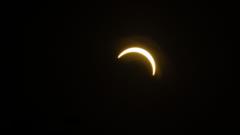
Crowds across southern England gathered at beaches, parks, observatories and high viewpoints to watch a partial solar eclipse, during which the Moon obscured around 90% of the Sun. The event drew widespread public interest because the next partial eclipse visible from the UK is not expected until 2050, while a total solar eclipse is not due until 2090.
In Kent, Surrey and Sussex, people attended organised viewing parties, picnics, workshops and talks, including gatherings near Beachy Head, Goring-by-Sea, Tunbridge Wells and Hersmonceaux Observatory. Many used solar viewing glasses, while others improvised with household items such as colanders to project and observe the eclipse safely.
- Southern England watched about 90% of the Sun become obscured.
- Crowds gathered at coasts, parks and observatories.
- The next UK-visible partial eclipse is expected in 2050.
New here? Start with this
A solar eclipse happens when the Moon passes between the Earth and the Sun, blocking some or all of the Sun’s light for people in particular parts of the world. In a partial eclipse, the Moon covers only part of the Sun’s disc, so daylight is reduced but does not disappear.
How much of the Sun is covered depends on where a viewer is standing. Southern England was among the UK areas with the clearest view, while a total eclipse requires being in the narrow path where the Moon completely covers the Sun.
Looking directly at the Sun can seriously damage eyesight, even during an eclipse, so viewers use specially made eclipse glasses or indirect viewing methods. Eclipses attract large public gatherings because they are unusual, visible natural events whose timing and location can be predicted precisely.
More coverage
Art Culture Geopolitics Politics Science Space Technology
Read the full article at the source →
Originally published by BBC Science as “In pictures: Sky watchers gather for solar eclipse”.