Lawless youths torch field of cars in warped tribute to victim of A66 crash: As hundreds of extra police are drafted into Middlesbrough amid fears of gang carnage, masked thugs show what they think of crackdown
Developed over time first seen 2 months ago
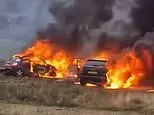
A gathering held to commemorate Michael Cahill, one of five men killed in the A66 crash, descended into disorder in a field near Haswell, County Durham, where youths allegedly drove vehicles erratically, set cars alight and launched fireworks. The incident matters because it comes amid heightened concern about violence in nearby Middlesbrough and Teesside, which police and local representatives believe may be connected to the crash and organised crime.
At least five cars were burned during the event, which included a balloon release spelling “Michael”, blue smoke flares and groups of masked or hooded young people filming the scenes. Cahill’s mother had invited people with cars, bikes, jeeps and quad bikes to attend, while local reports said horses in the field were distressed; afterwards, burnt-out vehicles remained on scorched grass. More than 200 additional officers were reportedly being brought in to support Cleveland Police, as MPs and council leaders said residents were worried about safety.
- Memorial gathering ended with several cars being burned.
- Disorder follows wider fears of violence across Teesside.
- More than 200 extra officers are supporting local policing.
Both sides, in good faith
The strongest fair case each way — we don't pick a winner.
The case for
Supporters of a robust police response would argue that the alleged arson, dangerous driving and fireworks use show an urgent need to enforce the law and protect residents, animals and property. They may contend that, where authorities reasonably fear links between serious violence and organised crime, deploying additional officers can deter retaliation, reassure communities and prevent a memorial from becoming a setting for further harm.
The case against
Those wary of framing the gathering chiefly as a policing or gang-security issue would argue that people grieving a young man’s death should not be collectively judged by the actions of some attendees or by unproven associations. They may favour a targeted, evidence-led response to any offences, alongside support for the bereaved and engagement with local young people, warning that broad suspicion and inflammatory language can deepen mistrust without improving safety.
Full account
A gathering held in County Durham for Michael Cahill, 23, one of five young men killed in the A66 collision, ended with cars being driven around a field and then set on fire, according to the reports. Video posted online appeared to show fireworks, smoke flares and blue balloons released during the event near Haswell/Peterlee, about 15 miles from Middlesbrough. The reports say that at least five vehicles were burned and that the site was a horse field, with local people later raising concerns about the effect on animals nearby.
Cahill was among the occupants of a vehicle involved in a wrong-way collision with a police car on the A66. The crash also killed PCs Matthew Blades and Tom Clough. His mother had reportedly used social media earlier that day to invite people with cars, bikes, jeeps and quad bikes to a balloon release. Footage of the later disturbance was captioned with tributes to Cahill, though the reports do not establish who organised the vehicle fires or whether all those present were involved.
The incident came as Cleveland Police received more than 200 additional officers from other forces amid a series of serious incidents in and around Middlesbrough. Police had made 17 arrests in connection with their investigation into the circumstances leading up to the A66 crash, on allegations including involvement in an organised crime group. The force was also examining other attacks, including vehicles being driven into properties, and had not confirmed links between all of the incidents.
A separate investigation followed a house fire in Grangetown in which seven-year-old Valentina Foster and her aunt, Natalie McDonald, 34, died. Two men were arrested on suspicion of murder, while police said they were considering possible organised-crime links but had not established a connection to the wider violence. Andy McDonald, MP for Middlesbrough and Thornaby East, said residents felt unsafe and described the situation as terrorism; former mayor Andy Preston said the town was under severe strain. Those descriptions were political reactions rather than formal police classifications.
Where outlets differ
Source 1 concentrates on the memorial gathering, the social-media invitation, the alleged disturbance in the field and the pressure on Cleveland Police. Source 2 places that event within a broader account of arrests, suspected organised-crime activity, ram attacks and the Grangetown fire.
Source 2 gives fuller detail of the two murder arrests and quotes MP Andy McDonald’s description of the violence as terrorism. Source 1 instead foregrounds former mayor Andy Preston’s warning that gang feuds could worsen.
Both reports state that police were investigating possible wider organised-crime connections, but neither says that investigators had confirmed a link between the A66 crash, the fire, the property attacks and the field incident.