Business news and discussion on TalkFuse.
Organic eggs have worse impact on climate than eggs from caged chickens
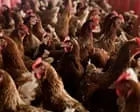
A new study suggests that organic, free-range eggs have a greater climate impact than eggs from caged hens, as free-range systems require more birds to produce the same number of eggs, since caged hens are more efficient producers. This challenges the common assumption that higher-welfare farming methods are automatically better for the environment, and researchers say egg production has received less scrutiny than meat and dairy in sustainability debates despite laying hens being the largest group of caged animals worldwide.
The Oxford University-led research, published in Royal Society Open Science, found that switching all UK egg production to organic free-range methods would generate greenhouse gas emissions equivalent to 2,316,000 tonnes of CO2, compared with 1,184,000 tonnes under a fully caged system; the current mixed system emits an estimated 1,439,000 tonnes. Organic free-range farming also scored worst for water eutrophication, acidification, land use and chicken mortality. However, the study relied on 2009-2010 data and did not account for factors such as pesticide use or biodiversity, and critics, including the Soil Association, argued it presents an incomplete picture of overall environmental impact.
In short
- Organic free-range eggs emit roughly twice the CO2 of caged-hen eggs, study finds
- Free-range systems need more chickens, cutting efficiency and raising emissions
- Study used outdated 2009-2010 data and excluded pesticides, biodiversity impacts
Steelman: both sides, in good faith
The strongest fair case each way — we don't pick a winner.
The case for
The research provides quantifiable evidence that caged systems produce eggs with significantly lower greenhouse gas emissions—roughly half that of free-range systems—and perform better across multiple measured environmental metrics including water eutrophication, acidification, and land use. If environmental sustainability is the primary concern, particularly regarding climate change, the data suggests that caged systems achieve greater efficiency in converting feed to protein, meaning fewer animals and resources are needed to meet egg demand. Prioritising measurable environmental outcomes ensures that well-intentioned welfare improvements do not inadvertently harm the planet through increased emissions.
The case against
The study's reliance on 2009-2010 data misses crucial developments in modern free-range farming practices and fails to assess pesticide use, soil health, and biodiversity impacts—all significant environmental considerations that favour less intensive systems. Optimising purely for greenhouse gas and land use metrics presents an incomplete environmental picture, as it ignores how caged systems concentrate waste and pollution whilst overlooking the ecosystem benefits of free-range farming. A truly sustainable system should balance multiple environmental factors alongside the legitimate ethical concerns about intensive animal confinement, rather than reducing environmental stewardship to a single climate metric.
Explained simply
The debate is about how different ways of raising hens for eggs affect the climate and the environment. A new study questions the assumption that systems where hens have more space are necessarily better for the planet.
Researchers from Oxford University found that switching all UK egg production to organic free-range systems, where hens have space to move around, would produce roughly twice as much greenhouse gas as fully caged systems. The reason is that free-range hens produce fewer eggs each, so farms would need more birds to make the same number of eggs.
This challenges a common belief that farming methods considered more animal-friendly are automatically more environmentally friendly. Critics, including the Soil Association, argue the study paints an incomplete picture, as it did not account for pesticide use or biodiversity, and relied on data from over fifteen years ago.
Business Climate Research Science UK World