Science news and discussion on TalkFuse.
Scientists discover potentially massive dwarf planet candidate hiding beyond Pluto
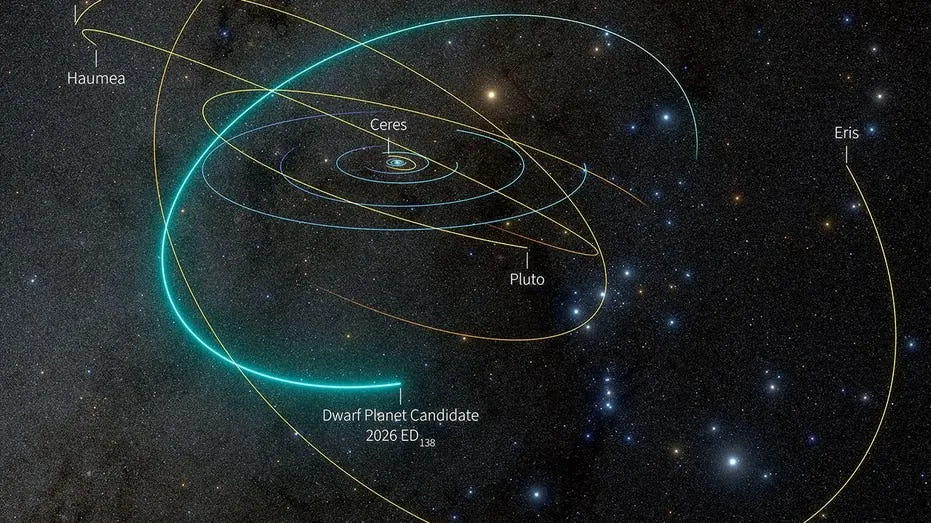
The Vera C. Rubin Observatory has helped scientists identify 2026 ED138, a distant object that may be one of the largest dwarf planets found beyond Neptune. Its discovery matters because it suggests that repeated, wide-sky surveys could reveal sizeable objects missed by earlier searches.
Astronomers estimate ED138 is between 370 and 930 miles across and about 4.3 billion miles from the Sun, farther away than Pluto. It was spotted in data by Matthew Holman using software developed with Kevin Napier; a crowded patch of sky near the Milky Way had made it difficult to see. Further observations are needed to establish its size and whether it meets the definition of a dwarf planet. Rubin Observatory plans to survey the southern sky repeatedly over a ten-year period.
In short
- Scientists found a large object beyond Pluto.
- ED138 may be 370 to 930 miles wide.
- More observations will determine whether it is a dwarf planet.
Explained simply
Beyond Neptune lies the Kuiper Belt, a region of icy bodies left over from the formation of the Solar System. Pluto is one of its best-known residents and is classed as a dwarf planet: it orbits the Sun and is round, but has not cleared other objects from its orbital path.
Astronomers estimate that 2026 ED138 is hundreds of miles wide, though its true size is not yet known. Matthew Holman identified it in observations from the Vera C. Rubin Observatory, using software developed with Kevin Napier; its position against a crowded star field had made it hard to spot.
More observations are needed to determine ED138’s size and whether it qualifies as a dwarf planet. The Rubin Observatory is designed to repeatedly survey the southern sky over ten years, which could help astronomers find other distant objects that earlier searches missed.