Small-town Iowa council meeting is opened by resident praying to Satan before stunned members scramble to ‘reverse the curse’
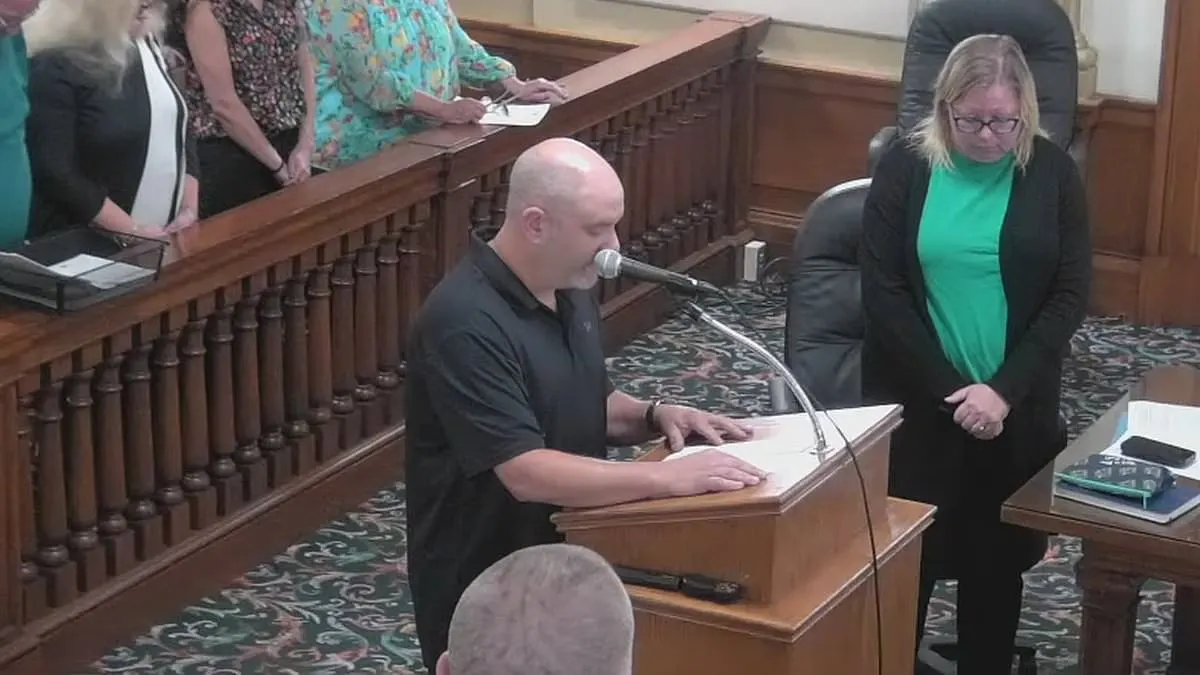
Matthew Dalbey, a member of The Satanic Temple in Iowa, delivered a Satanic invocation at the opening of an Ottumwa city council meeting last Tuesday, shocking residents with references to the 'dark father' and ending with 'Hail Satan.' The unexpected prayer sparked immediate concern from a local pastor who called to 'reverse the curse,' prompting the mayor to call a 30-second moment of silence before the meeting could proceed. The incident highlights ongoing tensions over religious expression in public spaces.
Dalbey, a former council member, is part of The Satanic Temple, a non-theistic religious organisation headquartered in Salem, Massachusetts that advocates for freedom of religion and various social causes. The Temple's Iowa congregation recently filed a lawsuit through the American Civil Liberties Union (ACLU) seeking the right to hold a holiday event at the Iowa Capitol in December, arguing that when the state makes public spaces available for religious observances like Christmas or Hanukkah, it cannot deny the same right to other religious groups.
- Iowa council meeting opened with Satanic invocation from temple member
- Local pastor called to reverse the curse, mayor paused meeting for silence
- Part of broader fight for equal religious representation in public spaces
New here? Start with this
The Satanic Temple is a non-theistic religious organisation in the United States that advocates for freedom of religion and challenges what it views as preferential treatment of Christianity in public institutions. Despite its name, the Temple does not worship the Devil; it uses religious symbolism to raise points about religious equality and freedom. The organisation has become increasingly active in pursuing legal cases around access to public spaces.
In America, there has been a tradition of Christian prayers and religious observances at official government events and in publicly funded spaces. The Satanic Temple argues that if governments allow one religion to use public facilities, all religions must be granted equal access. This principle of equal treatment underpins several ongoing legal disputes involving the organisation.
The Satanic Temple's Iowa congregation has filed a lawsuit, supported by the American Civil Liberties Union, seeking the right to hold a religious holiday event at the state capitol in December. The case challenges what the Temple views as discriminatory denial of public space access based on religious identity. Such cases test whether government must treat all religions equally when making public facilities available for religious purposes.
Both sides, in good faith
The strongest fair case each way — we don't pick a winner.
The case for
Religious freedom requires equal treatment under law. If municipalities permit Christian prayers, Christmas displays, or other religious observances in public spaces, they cannot constitutionally exclude other faiths based on community discomfort. The Satanic Temple represents a legitimate religious perspective, and allowing some religions whilst barring others based on their unpopularity creates a hierarchy the First Amendment forbids. Discomfort with minority religions does not justify their exclusion from equal civic participation.
The case against
Public council meetings serve a civic function and need not become venues for sectarian religious performance. There is legitimate distinction between acknowledging community traditions reflecting the populace's heritage and hosting deliberately provocative statements designed to shock. The invocation appears intended as political theatre rather than genuine spiritual reflection. Moreover, council chambers should remain neutral, unifying spaces focused on municipal business; protecting religious freedom does not require municipalities to amplify statements designed primarily to disrupt community harmony and undermine public trust in institutions.