Video games news, releases, esports and culture — all the biggest gaming stories in one place.
Someone has managed to run Zork on the Steam Controller’s internal hardware, but it’s risky business
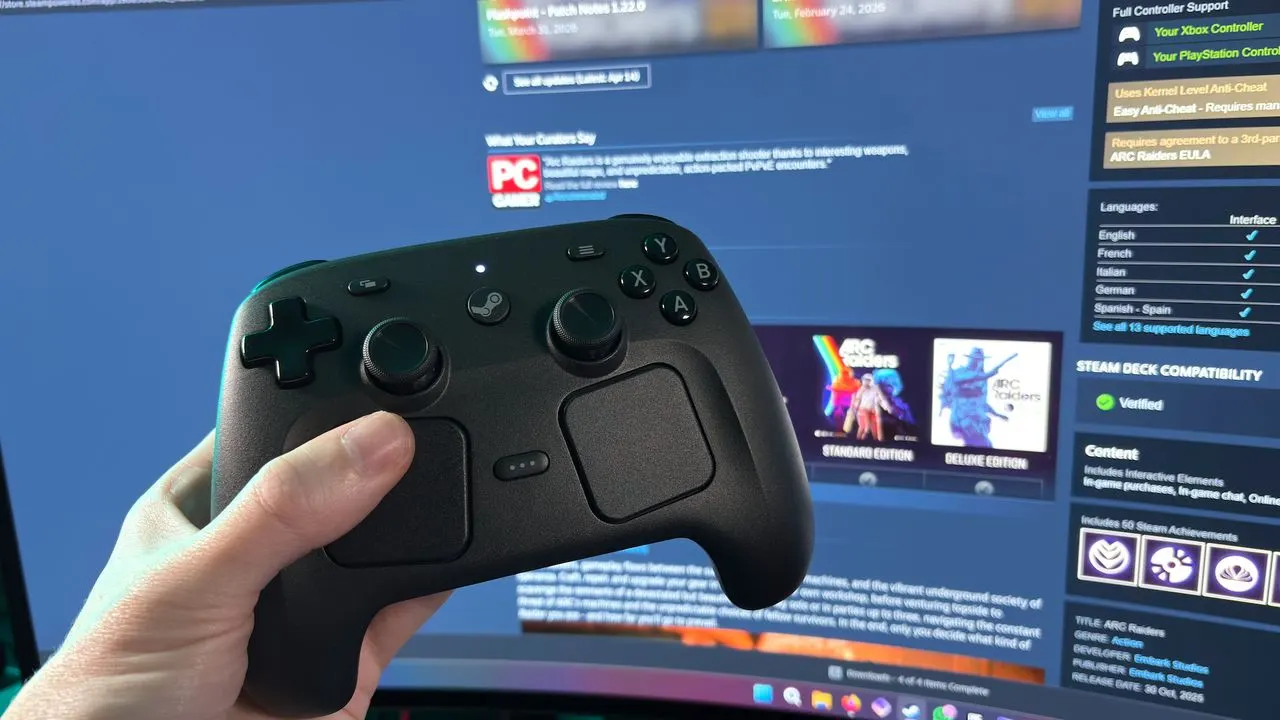
A hobbyist has succeeded in running the classic text adventure Zork directly on the 2026 Steam Controller’s internal processor, showing that Valve’s controller can be repurposed as a small programmable device rather than merely an input peripheral. The achievement matters because the controller’s firmware appears to lack cryptographic signing, potentially allowing enthusiasts to replace it with their own software.
The work relied on accessing Valve’s internal firmware-updating tools and flashing custom code to the controller’s Nordic nRF52833 chip. However, the experiment is risky: the developer previously bricked the controller and needed to open it, solder to debug pads and use a Raspberry Pi Pico to restore the original firmware; they also reported losing analogue controls after a full erase. The controller’s firmware image is roughly 350,672 bytes and uses a CRC-32 integrity check rather than encryption or a digital signature.
In short
- Zork now runs directly on a Steam Controller.
- Unsigned firmware enables custom software.
- Flashing it can permanently damage the controller.
Steelman: both sides, in good faith
The strongest fair case each way — we don't pick a winner.
The case for
Those who celebrate this achievement emphasise that users should have genuine ownership and control over hardware they've purchased. When Valve leaves firmware unsigned, it permits creative repurposing of devices into programmable platforms that enable accessibility improvements, experimental interfaces, and projects like running Zork. They argue that discovering this capability strengthens the repair and maker culture, encouraging companies to respect ownership rights and fostering innovation that manufacturers themselves might never pursue.
The case against
Those who raise concerns about this development point to genuine security and safety risks to both individual devices and Valve's broader platform. Users can easily brick their controllers through experimentation, a consequence requiring solder work and specialised tools to reverse, creating real support burdens and safety hazards. If controllers can run arbitrary code, it also opens pathways for cheating in competitive games, data theft, or malicious modifications that users unknowingly install. Proper firmware signing exists to ensure devices function safely and maintain the integrity of the gaming ecosystem.
Explained simply
The Steam Controller is a game controller made by Valve, the company behind the Steam gaming platform. Like many modern devices, it contains a small processor that runs firmware: the basic software controlling its hardware. Zork is a text adventure from the late 1970s, in which players explore and solve puzzles by reading descriptions and typing commands.
A hobbyist used Valve’s firmware tools to put custom software on the controller’s processor and run Zork there. The chip can be reprogrammed because the firmware appears to use a checksum to detect errors rather than a digital signature to verify who made the software.
Changing firmware can stop a device working properly. In this case, restoring the controller after it stopped working required opening it and connecting equipment to its circuit board, and a full erase reportedly affected its analogue controls.