Video games news, releases, esports and culture — all the biggest gaming stories in one place.
Streamer builds a battery powered PC with over 100 AAs, uses Hannah Montana Linux to benchmark their abomination
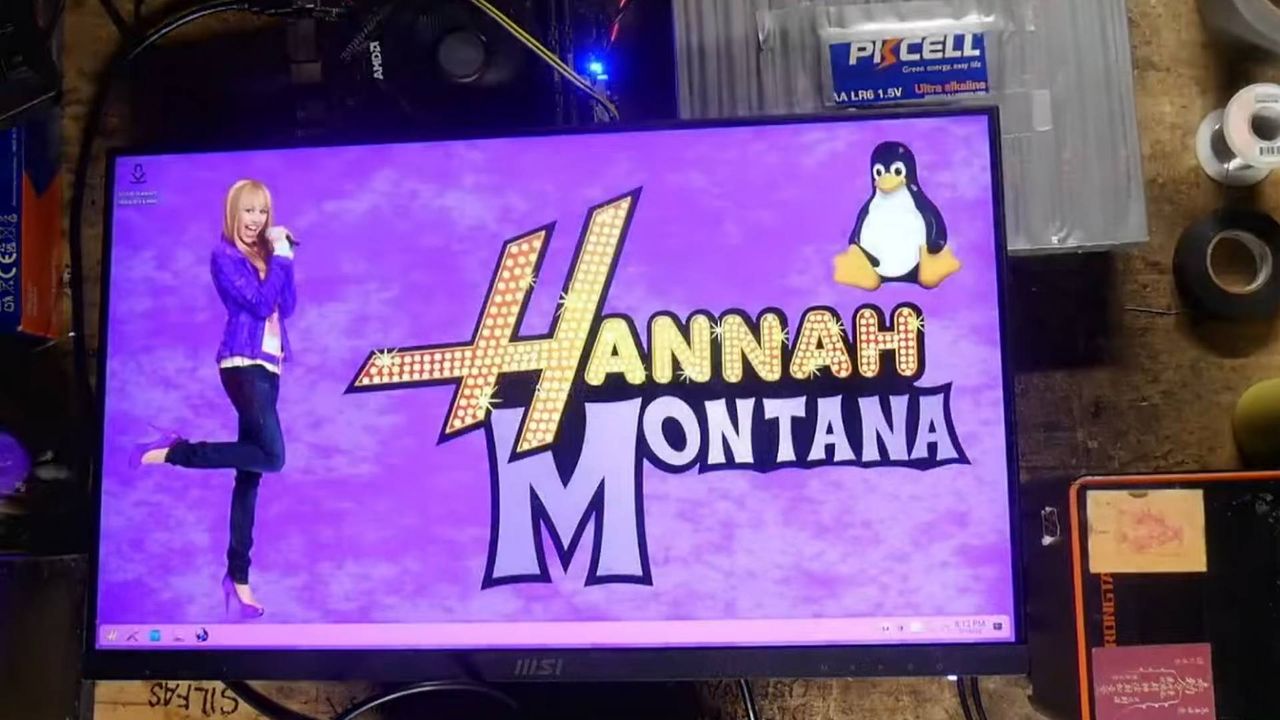
Streamer Uwos Lab built a desktop PC powered solely by alkaline AA batteries during a five-hour livestream, then ran it from a USB drive using Hannah Montana Linux. The experiment demonstrates that a low-power desktop can temporarily operate from a large battery array, though it is an impractical and highly improvised alternative to conventional power supplies.
The streamer initially estimated needing 400 batteries but connected 192, arranged in three laser-cut wooden boxes containing 64 cells each. Eight batteries were wired in series to provide 12 volts, with 50 such banks intended to run in parallel for higher current through a DC-to-ATX power supply. The AM4-based system had no separate graphics card or internal storage, reached 98% CPU use during a stress test and stream playback, and ran for about 30 minutes.
In short
- A streamer powered a desktop PC with 192 alkaline AA batteries.
- The PC booted Hannah Montana Linux from a USB drive.
- The improvised system ran for roughly 30 minutes.
Explained simply
A streamer named Uwos Lab conducted an experiment to power a desktop computer using only AA batteries instead of a conventional power supply. The experiment took place during a five-hour livestream and highlights an unconventional approach to computing that, whilst technically possible, would not be practical for everyday use.
The system used 192 alkaline AA batteries arranged in three wooden boxes and wired together to provide sufficient voltage and electrical current. The batteries were connected to a specialised power converter designed to feed electricity to standard PC components, whilst the operating system ran from a removable storage drive rather than an internal hard drive.
Such experiments demonstrate the flexibility of modern computer hardware and how various components can theoretically operate under unusual power conditions. Streamer experiments like this are typically done to test the limits of technology and entertain viewers rather than to create a viable alternative to standard power supplies.