The Chinese robot army transforming the UK’s retail industry
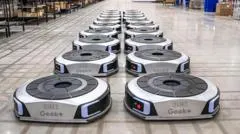
Chinese robotics firm Geek+ has become the world's largest supplier of autonomous mobile warehouse robots, with more than 2,000 of its units already deployed across 10 UK sites via its partner MotionTech. Major British retailers including Tesco, Asda and Next now use the technology, which sees squat floor robots glide beneath storage racks and carry shelves to human workers, speeding up picking, improving storage efficiency and reducing errors. This matters because the UK has suffered weak productivity growth for over a decade, and analysts see robotics adoption as key to reversing that trend, particularly amid persistent labour shortages.
Unlike traditional warehouse automation, which needs fixed conveyor systems, Geek+'s robots can be deployed using only QR code floor markers and safety fencing, making them faster and cheaper to install. Geek+ listed in Hong Kong in 2025 in one of the year's biggest robotics share sales, and Britain is now its largest European market. The OECD's 2026 report on SME technology adoption called the UK's low uptake of robotics "surprising" given its manufacturing heritage, noting firms lag in this area despite embracing other digital tools. The TUC, representing almost six million workers, has urged that automation be used to boost productivity and improve jobs rather than simply cut costs, calling for worker involvement and retraining investment.
In short
- Chinese firm Geek+ has deployed 2,000+ warehouse robots across 10 UK sites
- Tesco, Asda and Next use the autonomous robots to speed up order picking
- OECD says UK lags in robotics uptake; TUC urges worker-focused automation
Steelman: both sides, in good faith
The strongest fair case each way — we don't pick a winner.
The case for
Advocates of rapid automation argue that Britain's decade-long productivity slump and chronic warehouse labour shortages demand exactly this kind of investment, and that Geek+'s flexible, QR-code-based robots offer a rare chance to modernise logistics quickly and cheaply without the huge capital costs of fixed conveyor systems. They point to the OECD's own concern that UK firms have lagged in robotics adoption despite a strong manufacturing heritage, suggesting that retailers embracing this technology are simply catching up with international competitors. For this view, faster picking, fewer errors and better storage efficiency ultimately benefit consumers through lower costs and more reliable supply chains, while freeing workers from repetitive, physically demanding tasks.
The case against
Sceptics, including voices like the TUC representing millions of workers, argue that automation of this scale should not be adopted uncritically, warning that productivity gains risk being captured solely as cost savings unless there is genuine worker involvement, retraining investment and job protection built into the transition. They caution that relying heavily on a single dominant foreign supplier for critical warehouse infrastructure raises legitimate questions about resilience, competition and long-term strategic dependence. For this view, the priority should be ensuring that automation improves the quality and security of jobs for the human workers who remain, rather than treating efficiency gains as an end in themselves.
Explained simply
Chinese robotics firm Geek+ has introduced squat floor robots into British warehouses that work by gliding under storage racks, lifting them, and carrying them to human workers. The technology is now in use at major retailers including Tesco, Asda and Next across ten UK sites, deployed by partner company MotionTech. It speeds up the process of collecting items from shelves, improves how space is used, and cuts down on mistakes.
This matters because Britain has experienced weak productivity growth for more than a decade, and experts view robots as essential to reversing this decline. The UK also faces persistent shortages of warehouse workers, making automation increasingly attractive to retailers seeking to maintain efficiency. Geek+ has become the world's largest supplier of these robots and listed on the Hong Kong stock exchange in 2025; Britain is now its biggest European market.
The robots can be set up quickly using only floor markings and safety barriers, rather than requiring expensive fixed conveyor systems. However, the TUC, which represents almost six million workers, has warned that automation should be used to improve jobs and productivity rather than simply reduce staff costs, and called for investment in retraining workers. An OECD report in 2026 noted it was surprising that UK firms have been slow to adopt this technology given the country's manufacturing heritage.