The critical tech staying safe by going underground
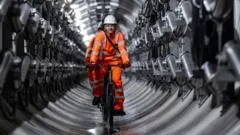
Engineering firms are reporting rising demand for burying critical infrastructure underground, driven partly by lessons from Russia's war in Ukraine, which exposed how vulnerable above-ground facilities are to drone attacks. New technologies are making this cheaper and faster: California firm EarthGrid has tested a rock-melting tunnel-boring machine that uses plasma torches reaching 27,000C to bore through solid granite, while data centre operators are increasingly siting servers in disused mines and caverns for both security and cooling benefits.
In a January test, EarthGrid's cigar-shaped machine cut through three metres of granite, using a vortex effect to clear debris, and founder Troy Helming hopes for commercial deployment as early as next year, with potential uses including power and fibre-optic cabling, pipelines, and underground freight tunnels. Separately, Italy's Trentino DataMine has built a data centre 100m underground in the Dolomite Mountains, within caverns previously used to store wine, apples and cheese; its chief executive says 90 million cubic metres of surrounding rock offer natural protection against physical intrusion, electromagnetic interference, seismic events and flooding that cannot be matched above ground.
- Firms see rising demand to bury infrastructure, partly due to drone threats
- EarthGrid tests plasma tunnel-boring machine reaching 27,000C
- Italy's Trentino DataMine houses a data centre 100m underground
New here? Start with this
Critical infrastructure includes systems people rely on, such as electricity and communications networks, pipelines and data centres. Much of it is built above ground, where equipment can be exposed to attack or damage; Russia’s war in Ukraine has drawn attention to the risks from drones and other threats.
Underground sites can offer physical protection and cooler, more stable conditions, which may help data centres run their servers. Some operators are adapting existing mines and caverns, while engineering companies are developing machines to create new tunnels for cables, pipes and other infrastructure.
The key players include infrastructure operators deciding where to put essential equipment and firms such as California-based EarthGrid, which is developing a tunnel-boring machine. The choices matter because reliable power, communications and data services depend on infrastructure that can withstand disruption.
Both sides, in good faith
The strongest fair case each way — we don't pick a winner.
The case for
Advocates argue that the war in Ukraine has starkly demonstrated how exposed above-ground power lines, data centres and communication hubs are to missile strikes, sabotage and drone attacks, and that burying critical infrastructure is a prudent, forward-looking investment in national resilience. They contend that as hybrid warfare and infrastructure sabotage become more common even outside active conflict zones, the extra upfront cost is justified by the far greater expense and human cost of prolonged blackouts or communications collapse during a crisis, and that protecting hospitals, grids and networks is a basic duty of a responsible state.
The case against
Sceptics counter that undergrounding is enormously expensive and slow to implement, diverting funds from other pressing needs, and that no single measure can fully insulate a country from a determined, well-resourced attacker who could target substations, cables' endpoints, or the underground infrastructure itself once located. They argue that resources might be better spent on redundancy, rapid-repair capability and diversified supply, and that overstating the protection offered by burying assets risks a false sense of security while normalising a war-footing mentality for infrastructure planning in countries not directly at risk of invasion.