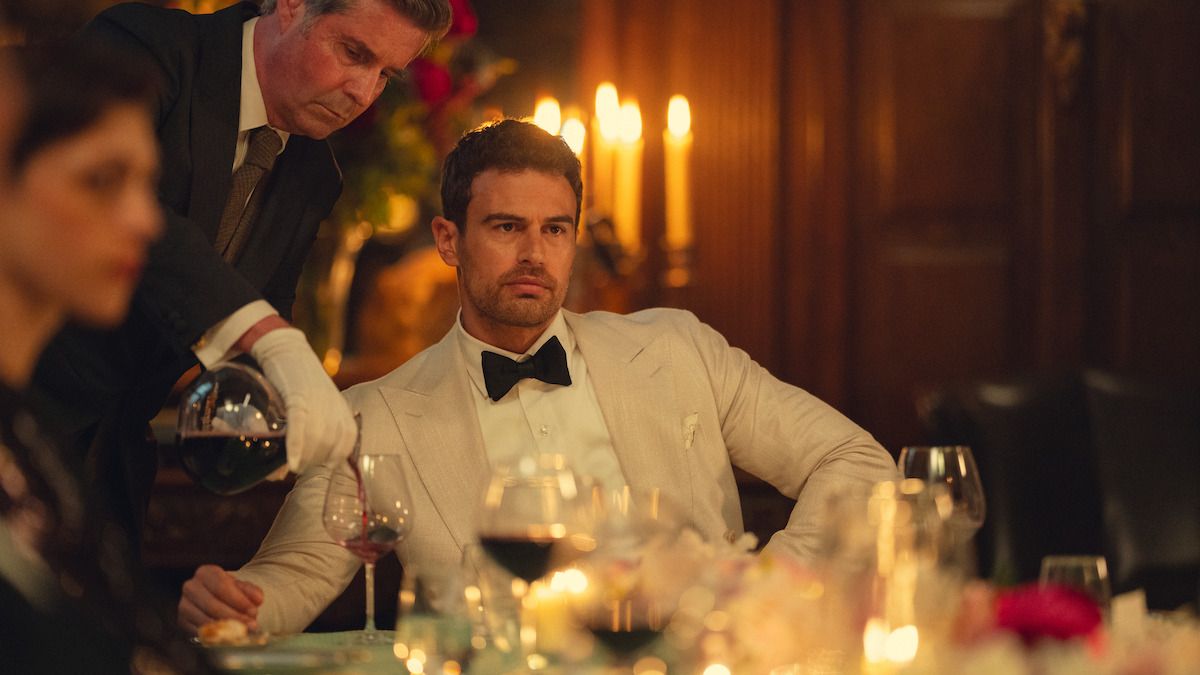
The Gentlemen Season 2 Forsakes Comedy for Godfather-Style Crime Drama as Theo James Transforms Into a Ruthless Gangster
Developed over time first seen 7 days ago
Netflix's second season of Guy Ritchie's crime drama The Gentlemen significantly broadens its scope, pulling in the Italian mafia, Peruvian cartels and the British House of Lords, and largely abandoning the comic tone that defined the first run in favour of a darker, Godfather-influenced style. Edward Horniman (Theo James), the Duke of Halstead, is portrayed moving from reluctant newcomer to genuine criminal kingpin, attempting to secure a seat in the House of Lords to block a bill decriminalising marijuana while expanding Bobby Glass's (Ray Winstone) drug empire into Italy, a move that draws him and Susie (Kaya Scodelario) into direct conflict with mafia boss Marco Moretti (Sergio Castellitto).
The expanded international setting, compared to Ritchie's more sombre series MobLand, raises the stakes with bigger action sequences and more consequential betrayals, while the core partnership between Eddie and Susie remains central despite each pursuing new romantic interests. Supporting characters are given greater depth too, including a superstitious turn for Winstone's Bobby Glass and a standout action sequence for Vinnie Jones's Geoff, alongside his ongoing romance with Joely Richardson's Lady Sabrina.
- The Gentlemen Season 2 drops comedy for a darker Godfather-style crime drama.
- Eddie expands into Italy, clashing with mafia boss Marco Moretti.
- Eddie-Susie partnership and supporting cast get deeper development.
New here? Start with this
The Gentlemen is a Netflix crime series created by Guy Ritchie, following a British aristocratic family who find themselves entangled in the criminal underworld after inheriting a vast estate secretly built on a cannabis empire. Season one, released in 2024, mixed violence with sharp comedy as newly-minted Duke Edward "Eddie" Horniman, played by Theo James, tried to extricate his family from the drug business run by associates including Bobby Glass, played by Ray Winstone, and his enforcer daughter Susie, played by Kaya Scodelario.
Season two picks up with Eddie no longer resisting that world but rising within it, as the story widens beyond Britain to include the Italian mafia and South American cartels, alongside political manoeuvring in the House of Lords. New and returning characters, including mafia boss Marco Moretti and countess Bella, expand the web of alliances and rivalries around Eddie, Susie and Bobby Glass.
This matters because it marks a deliberate shift in tone and ambition for the show, moving away from the knockabout humour that defined its first outing towards a more serious, sprawling crime saga in the vein of films like The Godfather, reflecting how streaming series often evolve once established to broaden their audience and raise the stakes.
Full account
Netflix's crime drama The Gentlemen has returned for a second season that marks a deliberate change of direction from its predecessor, trading much of the first run's comic energy for a darker, more overtly Godfather-influenced tone. Created by Guy Ritchie and based on his 2019 film of the same name, the series follows Eddie Horniman (Theo James), the 13th Duke of Halstead and former Army captain who inherited his family's stately estate only to discover it doubled as the base for a vast cannabis operation. Where the opening season eased Eddie, and viewers, into this criminal world with a light, often farcical touch, the follow-up pushes him towards becoming a hardened underworld figure in his own right, with James's performance shifting accordingly towards something colder and more troubled.
The new episodes widen the story's canvas considerably. Eddie is no longer content simply managing the enterprise built by jailed cannabis boss Bobby Glass (Ray Winstone) and his daughter Susie (Kaya Scodelario); he is now working to expand it into Italy while also manoeuvring to secure a seat in the House of Lords, partly to help block a parliamentary bill that would decriminalise marijuana and undercut the value of the family's illicit trade. That ambition draws in a host of new players, among them Italian mafia boss Marco Moretti (Sergio Castellitto) and his volatile enforcer Cico Maldini (Michele Morrone), alongside fresh complications closer to home involving Bobby's increasingly erratic, spiritually preoccupied leadership and his son Jack's (Harry Goodwins) usefulness in winning over a peer of the realm. Eddie's chaotic brother Freddy (Daniel Ings), last seen reeling at being passed over for the dukedom, is meanwhile packed off to rehab as the family's troubles multiply.
At the heart of the season remains the charged partnership between Eddie and Susie, whose chemistry continues to anchor the show even as the pair are pulled in different directions, both professionally and romantically. Eddie becomes involved with an Italian countess, Bella (Benedetta Porcaroli), while Susie reconnects with a former flame, Joe (Tyler Conti), who complicates matters further by offering her an alternative path in the drugs trade. As the empire stretches beyond Britain's borders, the fragile balance the pair struck by the end of the first season unravels, with betrayals, violence and shifting loyalties testing their bond and forcing Eddie to assert himself as a leader rather than a reluctant recruit.
Critical reaction to the tonal overhaul has been mixed. Some reviewers regard the pivot towards a bleaker, more prestige-drama register as a natural and successful evolution, arguing that the larger scale and higher stakes suit a story that was always fundamentally about class, power and the corrupting pull of criminal ambition. Others are less convinced, suggesting that in chasing the grandeur of The Godfather the series loses the eccentric humour and supporting characters that distinguished it the first time round, and that Eddie's suffering feels engineered rather than earned, with setbacks that rarely leave any lasting mark by the time the credits roll. What is not in dispute is that Theo James has been asked to do something markedly different this year, swapping affable bewilderment for a harder, more calculating presence as the Duke embraces the family business in earnest.
Where outlets differ
One outlet takes a notably critical stance, arguing the season loses the humour and quirky supporting characters that made season one distinctive, and that its Godfather homage feels hollow because Eddie's losses lack real weight; the other two outlets are considerably more positive, describing the season as having 'hit its stride' and evolved 'organically'.
Accounts differ on how much time has passed since season one — one source says roughly two years, another says two and a half years.
Plot emphasis varies: one outlet highlights the parliamentary vote-trading subplot involving Lord Hawthorne in detail, another foregrounds the introduction of Peruvian cartels and mystical/mythical elements alongside the Italian mafia storyline, while the critical review focuses more on tone and pacing than on plot specifics.
The negative review singles out sidelined comic characters (such as Jimmy Chang) and a diminished role for Susie as weaknesses; the more favourable pieces instead emphasise the expanded scale, new romantic subplots and the Eddie–Susie relationship as strengths.
Coverage
- Polygon — Guy Ritchie’s Netflix Crime Thriller Just Got Even More Ambitious
- Variety — Theo James Steps Into His Michael Corleone Era for a Darker, More Sinister ‘The Gentlemen’ Season 2: TV Review
- Collider — The Gentlemen shifts into darker crime drama for season two