Technology news and discussion on TalkFuse.
The James Webb Telescope Is Changing Astronomers’ Understanding of the Ancient Cosmos
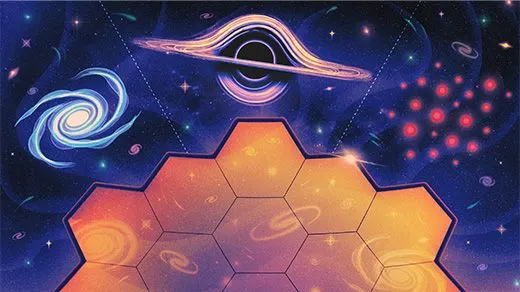
The James Webb Space Telescope (JWST) has been overturning astronomers' assumptions about the early universe, revealing objects and phenomena that established theories struggle to explain. Since coming online in 2022, JWST has spotted "little red dots," black holes far larger than expected for their age, and ancient galaxies that don't fit models of the universe's first billion years, prompting researchers worldwide to develop new theories to make sense of the observations.
Little red dots, discovered by the hundreds, began appearing in significant numbers roughly 650 million years after the Big Bang and were never observed before JWST. One leading hypothesis, explored by astrophysicist Charlotte Mason of the Cosmic Dawn Center in Copenhagen, suggests they may be black holes enveloped in thick, possibly clumpy gas that emits light like a stellar atmosphere—a potential new class of object dubbed a "black hole star." Separately, astrophysicist Jenny Greene of Princeton University highlighted the puzzle of billion-solar-mass black holes found growing just a few hundred million years after the Big Bang, far too massive and fast-growing to fit current models of how black holes form from collapsing stars.
In short
- JWST keeps finding early-universe objects that defy current astrophysics theories
- "Little red dots" may be black holes wrapped in thick gas clouds
- Ancient black holes appear far too massive to fit existing formation models
Explained simply
The Big Bang marks the beginning of the universe, around 13.8 billion years ago. In its first billion years, the first stars, galaxies and black holes formed, but astronomers have had limited evidence about how quickly these objects appeared and grew.
The James Webb Space Telescope, which began operating in 2022, observes faint light from very distant objects, letting astronomers study the young universe. Its discoveries include “little red dots” and very massive black holes; researchers are investigating what these objects are and how they could have formed so early.
Black holes are regions where gravity is so strong that even light cannot escape, and existing models often describe them forming when massive stars collapse. The early black holes seen by Webb appear to have grown faster than those models predict, while one proposal is that some little red dots are black holes surrounded by dense gas.