Trump gets hero’s welcome by rowdy MAGA partiers as he kicks off first-ever GOP midterm convention… with several glaring absences
Developed over time first seen 4 weeks ago
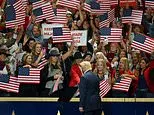
Donald Trump kicked off the Republican Party's first-ever midterm convention in Dallas by promising a $5,000 "Trump Dividend" for every American adult if the GOP holds both chambers of Congress in November, framing the estimated $1 trillion payout as a shareholder-style reward for economic success, provided recipients spend it domestically. He urged supporters to treat the midterms as a referendum on himself despite not being on the ballot, reflecting how closely the party's fortunes remain tied to his standing as Democrats look to exploit his weak approval ratings. The event nonetheless exposed strains within the GOP, with notable absences suggesting a less than unified front heading into the elections.
More than 20,000 people attended the opening night at the American Airlines Center, with Trump repeating his false claim to have won the 2020 election and mocking Democrats over voter ID policy, while also praising embattled Texas Senate candidate Ken Paxton. Senate Majority Leader John Thune skipped the convention amid reported friction with Trump over stalled legislation, and vulnerable Republicans including Maine's Susan Collins, Iowa's Ashley Hinson and New Hampshire's John E. Sununu also stayed away from the main stage. The build-up was further marred by a lobbyist describing the "very bad" vibes, attendees queuing in 95-degree heat, and Trump's arrival being delayed after an emergency slide deployed on his Air Force One, though the crowd still gave him an enthusiastic reception once he took the stage.
- Trump pledges $5,000 "dividend" to all Americans if GOP holds Congress
- Senate leader Thune and several vulnerable Republicans skipped the convention
- Trump's arrival was delayed after an Air Force One emergency slide deployed
New here? Start with this
Trump's midterm convention marks the first time a US president's party has held a dedicated national gathering midway through a term, rather than waiting for the next presidential race. Republicans currently control both the House and Senate by narrow margins, and this November's elections will decide whether they keep that grip or lose ground to the Democrats, who need to flip only a handful of seats to take back one or both chambers.
Although Trump is not up for election himself, midterm results are traditionally read as a verdict on the sitting president, which is why he has been framing the vote as being about him personally. Key Senate contests to watch include Maine, Ohio, Michigan and Alaska, where vulnerable Republican incumbents are trying to hold their seats, alongside a competitive Texas race featuring Ken Paxton, the state's attorney general.
The event has also exposed friction inside the Republican Party. Senior figures such as Senate Majority Leader John Thune and several senators facing tough re-election fights have kept their distance from the convention stage, a sign of the balancing act elected Republicans face between showing loyalty to Trump and protecting their own standing with voters back home.
Both sides, in good faith
The strongest fair case each way — we don't pick a winner.
The case for
Supporters would argue that Trump remains the single most energising figure in American politics, capable of filling arenas and driving turnout in a way no other Republican can match, and that leaning into his popularity with his base is simply sound electoral strategy in a midterm cycle where enthusiasm often decides close races. They would say bold pledges like a taxpayer dividend reflect a results-focused, unconventional style that resonated with voters in previous elections, and that his willingness to fight combatively on issues like voter ID reflects genuine conviction rather than mere provocation. From this view, the absence of a few establishment figures from the stage is a minor logistical footnote, not evidence of a party in crisis.
The case against
Critics, including some within the party, would argue that building an entire midterm convention around one man's persona risks nationalising local races and distracting from the practical concerns of swing voters, particularly when vulnerable incumbents in tight states may need distance rather than proximity to him to win. They would contend that repeating disputed claims about past elections and using coarse language toward opponents undermines the party's credibility with moderates and independents whose support is often decisive in close Senate contests. The visible absence of leaders like the Senate Majority Leader and several at-risk senators, in this view, signals a genuine and reasonable strategic calculation that some candidates' paths to victory run through demonstrating independence rather than loyalty to Trump.
Full account
President Donald Trump received a rapturous reception from thousands of supporters as he addressed the Republican Party's first-ever midterm convention, held in Dallas on Wednesday evening. Speaking to a crowd reported at more than 21,000 inside the American Airlines Center, Trump used the opening night of the two-day gathering to rally activists ahead of November's congressional elections, urging them to treat the vote as a personal verdict on his presidency even though he himself is not on the ballot. 'I'm asking you to pretend I'm on the ballot,' he told the audience, framing the midterms as a test of whether Republicans could break the historical pattern of the president's party losing seats.
In the speech's most striking moment, Trump pledged that every adult American would receive a $5,000 'dividend' should Republicans retain control of both the House and Senate. He compared the payout to a company distributing profits to shareholders, attributing it to what he described as unprecedented economic success under his administration, and suggested it should be known as the 'Trump dividend'. He also credited congressional Republicans with delivering large tax cuts, including the removal of tax on tips, overtime pay and Social Security income for pensioners, and warned supporters that a Democratic win would cost them their border security, tax relief and prosperity.
Elsewhere in his remarks, Trump repeated his unfounded claim to have won the 2020 election, telling the crowd 'we won the presidency three times', and gave a pointed endorsement to Texas Attorney General Ken Paxton, the party's embattled Senate nominee in a tight race against Democrat James Talarico, praising him despite conceding he 'may not dress right' or be conventionally polished. He also used coarse language to dismiss Democratic arguments against voter identification requirements. According to one account, the atmosphere shifted noticeably once Trump took the stage to Lee Greenwood's 'God Bless the USA', with the crowd's muted response to earlier speakers giving way to rapt attention once the president began speaking; he is due to address the convention again on its second night.
Despite the enthusiastic reception in the hall, the guest list for the convention drew attention for who was missing. Senate Majority Leader John Thune did not speak, a notable omission linked to friction with Trump over delayed elements of his legislative agenda, even as other congressional leaders were given prominent slots. Several candidates in competitive races also stayed away from the main stage, including Maine Senator Susan Collins, Iowa Senate hopeful Ashley Hinson and New Hampshire nominee John E. Sununu. Polling cited separately suggests Trump's political standing on economic issues remains weak, with a majority of voters disapproving of his handling of the economy and cost of living, underscoring the stakes behind his rallying cry to supporters.
Where outlets differ
The Daily Mail account foregrounds the convention's atmosphere and political undertones, highlighting the contrast between the muted crowd during earlier speakers and their enthusiasm for Trump, and gives significant attention to the list of prominent Republicans who avoided the main stage (Thune, Collins, Hinson, Sununu), framing this as a sign of Trump's uneven standing within the party.
The Fox News report focuses more heavily on the substance of Trump's economic message, quoting at length his claims of historic tax cuts and economic success, and frames the $5,000 dividend pledge as an unprecedented gesture rather than dwelling on stagecraft or crowd mood.
Only the Daily Mail account mentions Trump's repetition of the false 2020 election-victory claim, his endorsement of Ken Paxton, and his use of crude language regarding Democrats and voter ID; these details are absent from the Fox News excerpt.
The Fox News report includes polling data showing 65% of voters disapprove of Trump's handling of the economy, contextualising the dividend pledge against his underwater economic ratings — a data point not present in the Daily Mail excerpt.
Neither source excerpt provides full details on the size of the convention crowd's reaction to the dividend pledge itself, and the Daily Mail excerpt was cut off before detailing further absences it references.
More coverage
- The Hill — GOP midterm convention lives up to its 'Trump-a-Palooza' hype
- The Hill — Trump implores GOP to 'pretend' he's on November ballot at first night of midterm convention