Trump announces cash if Republicans achieve full control of Congress
Developed over time first seen 2 months ago
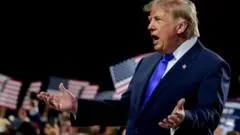
Donald Trump has told Republican supporters he will issue a $5,000 (£3,700) "Trump Dividend" to every adult American if the party wins full control of Congress in November's midterm elections, a pledge that would cost the government roughly $1.3 trillion given the US has nearly 270 million adults. He offered no detail on how the payments would be funded or monitored, stipulating only that recipients must spend the money inside the US rather than abroad, and Democrats have dismissed the promise as empty and legally questionable. The pledge, made at the Republican Party's first-ever mid-term convention in Dallas, Texas, comes as Americans face rising prices linked partly to the US-Israel conflict with Iran, which has disrupted oil flows through the Strait of Hormuz.
Vice-President JD Vance suggested the payments could be funded from tariff revenue, echoing an earlier Trump proposal for $2,000 tariff-funded cheques that never materialised, with no legislation passed and no federal dividend scheme currently in place; the Supreme Court ruled most of Trump's tariffs unlawful in February. Analysts noted the promise fits a pattern of pre-election pledges, coming as Trump also warned the Iran war and high oil prices would persist until after the midterms, and as the president's party historically tends to lose seats in such elections. A former Republican strategist called it an "extraordinary promise" without a clear funding source, framing it as a political gambit rather than a firm commitment.
- Sources
- 2
- Outlets
- 2
- Left · Centre · Right
- 0 · 1 · 0
In short
- Trump pledges $5,000 payout to all adults if Republicans sweep Congress
- No funding or monitoring details given; cost estimated at $1.3 trillion
- Democrats call it an empty, likely unfeasible election promise
How this story developed
- 2 months ago Fresh reporting added that Trump warned the Iran war and high oil prices will persist until after the midterms, while legal experts flagged that federal rules against vote-buying could be sidestepped if the payout is recast as a lawful tax-cut pledge.
- 2 months ago Donald Trump pledged a $5,000 "Trump Dividend" to every American adult if Republicans keep control of Congress in the midterms, a roughly $1.3 trillion promise made without funding details at the Dallas convention.
Full account
Donald Trump has pledged to send every American adult a $5,000 (£3,700) payment if the Republican Party retains control of both chambers of Congress after November's midterm elections. The president made the promise during a lengthy, freewheeling speech at the Republican National Committee's first-ever mid-term convention, held in Dallas, Texas. He told the crowd that should Republicans hold the House of Representatives and the Senate, he would "issue a dividend to every adult citizen" worth $5,000, adding that the pledge alone "should win the midterms". He offered no detail on the mechanics of the scheme, saying only that recipients would be expected to spend the money inside the United States rather than abroad.
The proposal would be extraordinarily costly. With the US adult population numbering in the region of 240 to 270 million, a flat $5,000 payout would cost somewhere between $1.2 trillion and $1.3 trillion, according to different calculations cited by the reports. That vastly exceeds the gross customs revenue the administration has collected from tariffs since the start of last year, and the shortfall would be still larger once tariff refunds are taken into account, after the Supreme Court ruled in February that Trump's use of emergency economic powers to impose the tariffs was unlawful. Meeting the pledge in full would therefore require Congress to approve well over a trillion dollars in additional spending, on top of the president's own budget request for the next fiscal year.
Democrats dismissed the offer as an empty promise, and commentators questioned both its financial feasibility and its legality. Sceptics also noted that this is not the first time Trump has floated a large cash payout without it materialising: he has previously talked of a $5,000 "DOGE dividend" and of $2,000 cheques funded by tariff revenue, neither of which has been delivered. The pledge was made against a backdrop of rising prices in the US, driven in part by the fallout from the conflict between the US, Israel and Iran that began earlier this year, which has disrupted oil and gas shipments through the Strait of Hormuz and unsettled global energy markets. Trump used the same appearance to warn that the war, and the higher oil prices that have come with it, would not be resolved until after the midterms, arguing the short-term pain was justified to stop Iran acquiring nuclear weapons.
The timing of the pledge reflects Republican anxiety about turnout in an election where Trump himself will not be on the ballot, with party strategists worried that enthusiasm among his base could fade without him heading the ticket. It is not the first time a big cash incentive has been dangled ahead of a pivotal vote: Democrats in Georgia made a similar promise of $2,000 relief payments if they won control of the Senate at the height of the Covid pandemic. Whether Trump's latest pledge is a serious policy proposal or simply a rallying tool aimed at energising supporters for November remains unclear, and reports note that many of the practical questions — how it would be funded, administered or monitored — were left unanswered in the speech itself.
Where outlets differ
From the full account, which is AI-written from the sources:
The BBC frames the story more around the geopolitical backdrop, giving substantial space to the Iran conflict, the closure of the Strait of Hormuz and rising oil prices, and notes Trump's comments that the war won't end until after the midterms.
Source 2 focuses more heavily on the financial arithmetic, citing specific figures from the University of Pennsylvania on gross customs revenue, the Supreme Court ruling on tariffs, and the scale of tariff refunds being paid out, to argue the plan is financially unworkable.
The two sources give slightly different estimates of the total cost ($1.3 trillion based on roughly 270 million adults per the BBC vs $1.2 trillion based on roughly 240 million adults per Source 2).
Source 2 places more emphasis on Republican turnout anxiety ahead of the midterms and draws a direct comparison to Trump's previous unfulfilled promises (the 'DOGE dividend' and tariff cheques), while the BBC mentions the Georgia Democrats' 2020/2021 precedent as its main historical comparison.
Steelman: both sides, in good faith
The strongest fair case each way — we don't pick a winner.
The case for
Supporters see the pledge as a legitimate, if bold, campaign promise in the same tradition as tax cuts or stimulus cheques that political leaders on both sides have long used to signal priorities to voters. They argue that tying relief to a Republican Congress is simply honest politics, since delivering such a policy would genuinely require legislative control, and that voters are entitled to weigh this promise, like any manifesto pledge, when deciding how to vote. Framed as a tax cut or dividend from economic gains, they contend it sits within ordinary political speech protected by the First Amendment, and that criticising it as improper risks setting an unworkable standard for what candidates may promise.
The case against
Critics argue the pledge blurs an important legal and ethical line by explicitly conditioning a large personal payment on a specific electoral outcome, which is precisely the kind of inducement federal law against paying people to vote is designed to guard against, whatever legal framing is later applied. They also point to the complete absence of any funding plan for a commitment costing over a trillion dollars, arguing it is fiscally reckless to make such a promise while Americans are already feeling the strain of high prices, and that a pattern of previous unfunded pledges going undelivered means voters are being asked to trust a promise with no mechanism for accountability.
Explained simply
Rising prices have become a major issue for American households, with the cost of fuel and everyday goods climbing partly because of the conflict between the US and Iran, which has disrupted oil shipments through the Strait of Hormuz. Against this backdrop, President Donald Trump has been rallying Republican supporters ahead of November's midterm elections, when all seats in the House of Representatives and a third of the Senate are up for grabs. Whichever party controls Congress after that vote will have significant power over legislation and spending for the rest of Trump's term.
Trump has a history of promising direct payments to Americans, including earlier proposed cheques funded by tariff revenue, and Democratic-led states have made similar pledges in the past, such as pandemic relief payments in Georgia. Federal law restricts payments designed to influence how people vote, which is relevant context for how any such pledge might be scrutinised, though supporters may present it differently, such as a tax cut.
The key players are Trump himself, the Republican Party seeking full control of both chambers of Congress, and the Democratic Party, which currently contests that control and has criticised the promise. Iran's nuclear programme and the wider regional conflict also form part of the backdrop, since Trump has linked the country's economic pressures to the ongoing confrontation with Tehran.
Coverage · 2 sources
Americas Art Culture Elections Government Politics World
Read the full article at the source →
Originally published by BBC World as “Trump pledges $5,000 to every adult American if Republicans win November elections”.