Trump’s comments on a united Ireland may have targeted audience across the Atlantic
Developed over time first seen 2 months ago
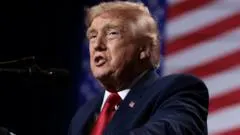
Donald Trump's remark that he would "love" to see a united Ireland during his two-day visit to the country appears to have been aimed at least partly at a domestic American audience, according to analysis of the trip, rather than signalling any change in US foreign policy. Former Trump envoy Mick Mulvaney and Democratic congressman Brendan Boyle both said the comment does not represent a shift, stressing continued bipartisan US commitment to the Good Friday Agreement, even while agreeing unification could happen "eventually".
Trump repeated the sentiment hours later in a speech to Irish and Irish-American business leaders at the US Ambassador's residence in Dublin, which had been billed at 20 minutes but ran to around 40 and ranged into domestic US topics including immigration, trade deals and defence production, alongside renewed criticism of the UK's response to his military action in Iran. Commentators suggested the remarks may have been targeted at Irish-American swing voters ahead of November's midterm elections, in which Republicans face a tough fight, though observers noted that Irish America and US politics more broadly have become far more polarised since Bill Clinton courted the same constituency during the peace process in the 1990s.
- Sources
- 4
- Outlets
- 2
- Left · Centre · Right
- 0 · 2 · 2
In short
- Trump said he'd "love" a united Ireland during his Dublin visit
- Officials insist this isn't a US policy shift, not a serious push for unification
- Analysts link the remark to courting Irish-American voters before US midterms
How this story developed
- 1 month ago New analysis of Donald Trump's remark that he would "love" to see a united Ireland suggests his comments were aimed as much at a domestic American audience as at observers in Ireland or Britain, with commentators pointing to November's midterm elections and Republican pressure as a likely motive.
- 1 month ago Fresh analysis of Donald Trump's remark that he would "love" to see a united Ireland now focuses on who he was really addressing, suggesting his comments were aimed more at a domestic American audience than at observers in Ireland or Britain.
- 1 month ago Donald Trump's remark that he would "love" to see a united Ireland during his two-day visit to the country appears to have been aimed at least partly at a domestic American audience, according to analysis of the trip, rather than signalling any change in US foreign policy.
- 1 month ago Further reaction to Donald Trump's remark that he would "love" to see a united Ireland has added more detail on how US officials are playing down any policy shift.
- 2 months ago New analysis suggests President Trump's remark that he would "love" to see a united Ireland, made during his two-day Irish visit, may have been aimed at an audience back in the United States rather than at Irish or British observers.
- 2 months ago US President Donald Trump sparked controversy during a two-day visit to Ireland by saying he would "love" to see the island reunified, remarks that reverberated across Ireland and Great Britain and left observers unsure whether they signalled a genuine shift in US policy or an unscripted aside.
- Daily Mail BIZARRE phrase that Trump used when he first dropped united Ireland bombshell on Catherine Connolly at Aras meeting – as senior aides reveal REAL reason 'hurt' US president decided to bring up thorny issue of Irish unity
- Daily Mail UK politicians including Kemi Badenoch tear into Trump over support for united Ireland – as even Farage says president is wrong
- BBC World Trump’s comments on a united Ireland may have targeted audience across the Atlantic
- BBC World Trump doubles down on united Ireland comments on day two of visit
Full account
US President Donald Trump's two-day visit to Ireland was overshadowed on its opening day by unscripted remarks suggesting he would welcome a united Ireland, comments that reverberated across Dublin, Belfast and London. Asked at a joint press appearance with Taoiseach Micheál Martin at Farmleigh House about his personal views on Irish unity, Trump said he would 'love' to see the North and South reunite. He returned to the theme shortly afterwards in a lengthy address to Irish and Irish-American business figures at the US ambassador's residence, this time raising it near the start of his speech, as though aware of the reaction his earlier comment had already provoked.
Reaction on both sides of the Atlantic focused less on whether Trump's underlying prediction was wrong than on what, if anything, it signalled about US policy. Mick Mulvaney, who served as the first Trump administration's special envoy to Northern Ireland, moved quickly to play down the remarks, insisting they did not amount to a change of course and that Washington remained fully behind the Good Friday Agreement. Democratic congressman Brendan Boyle offered a similar assessment, noting the enduring cross-party US backing for that settlement. Both men allowed that Trump might ultimately prove correct that unification would happen 'eventually', while stressing this was a far cry from any active American push in that direction.
Questions were also raised about who the comments were really aimed at. Trump's address to business leaders ran to roughly forty minutes, twice its billed length, and drifted well beyond Irish affairs into a recap of his domestic record on immigration enforcement, trade agreements and defence manufacturing, along with renewed criticism of what he regards as Britain's insufficient backing for his military action against Iran. Given that much of this was being broadcast to American viewers before dawn, and with the US midterm elections looming in November amid pressure on the Republican Party, some observers suggested the true target audience sat in the United States rather than in the room in Dublin, even though Irish-Americans do not vote as a single bloc.
A separate account, citing senior Irish government and US administration sources, offered a more pointed explanation for the episode. According to this reporting, Trump raised the subject of a 'merger' unprompted within minutes of a private meeting with President Catherine Connolly at Áras an Uachtaráin, though Connolly reportedly steered the conversation instead towards the actions of Israeli forces in Gaza rather than engaging on unification. Sources briefed on the visit characterised the president's later public comments as a deliberate, premeditated move rather than a spontaneous aside, describing it as calculated to inflict maximum political discomfort on the British government over its lukewarm support for the Iran strikes. Trump's Irish itinerary, which began with Air Force One's arrival in Dublin under heavy security shortly after 8am, was built around attending the Irish Open at his Doonbeg resort, making the unity remarks an unexpected diplomatic sideshow to what had been billed primarily as a golfing trip.
Where outlets differ
From the full account, which is AI-written from the sources:
Source 1 (broadcast-style account) frames the remarks as ambiguous in origin — possibly an off-the-cuff answer from a president who enjoys taking questions — and centres on US political reaction (Mulvaney, Boyle) and speculation about a domestic American audience ahead of the midterms.
Source 2 (Mail on Sunday) presents the remarks as deliberate and premeditated, citing government and administration sources who describe a 'well-planned diplomatic assault' intended to damage the UK over its stance on Iran, and adds new detail about an unprompted exchange on unification at the Áras an Uachtaráin meeting with President Connolly, who allegedly redirected the conversation to Gaza.
Source 2 also emphasises that the visit's primary purpose was the Irish Open at Trump's Doonbeg golf resort, with the political meetings framed as a brief prelude, whereas Source 1 treats the diplomatic engagements and speech as the main events of the day.
Centre outlets 2
- Trump’s comments on a united Ireland may have targeted audience across the AtlanticBBC World
- Trump doubles down on united Ireland comments on day two of visitBBC World
Only here: comments, targeted, audience, across, atlantic
Right-leaning outlets 2
- BIZARRE phrase that Trump used when he first dropped united Ireland bombshell on Catherine Connolly at Aras meeting – as senior aides reveal REAL reason 'hurt' US president decided to bring up thorny issue of Irish unityDaily Mail
- UK politicians including Kemi Badenoch tear into Trump over support for united Ireland – as even Farage says president is wrongDaily Mail
Only here: president, bizarre, phrase, used, dropped
Every side used: trump, united, ireland
Headline columns compared word for word; nothing in them is AI-written.
Steelman: both sides, in good faith
The strongest fair case each way — we don't pick a winner.
The case for
Those who find the domestic-audience theory persuasive point to the timing and packaging of the remark: delivered during a high-profile overseas trip weeks before consequential midterms, then repeated almost verbatim hours later to a room of American business leaders, fits a well-worn pattern of presidents using foreign stages to speak past their hosts to voters at home. They note the precedent of Bill Clinton's success in mobilising Irish-American sentiment during the peace process, and argue it is entirely reasonable for a beleaguered incumbent party to test emotionally resonant, low-cost language with a sizeable, historically persuadable demographic rather than assume such remarks were meant as serious diplomatic signalling towards Dublin, Belfast or London.
The case against
Those more sceptical of this reading argue it risks over-interpreting a single, largely symbolic aside into a calculated electoral strategy, when simpler explanations exist: Trump has a long-documented tendency towards expansive, off-the-cuff remarks on wide-ranging topics, as evidenced by the rambling, overrun speech that wandered into immigration, defence and criticism of the UK, and reading a coherent midterms strategy into that pattern may credit it with more discipline than it displayed. They point out that Irish America is no longer the unified bloc Clinton once courted, making it a questionable electoral target, and that officials from both sides of the aisle, including Mick Mulvaney and Brendan Boyle, have affirmed no change in US policy, suggesting the comment is better understood as a friendly, low-stakes pleasantry than a piece of domestic political engineering.
Explained simply
Trump made the comments about a united Ireland during a two-day visit to Ireland, at a time when he is also facing the run-up to America's midterm elections in November, where his Republican Party risks losing control of Congress. Commentators believe the remarks may have been designed less for his Irish or British hosts and more for Irish-American voters back home, a group that does not vote as a solid bloc and has historically been open to persuasion by either party. Around one in ten Americans identify as having Irish heritage, and Bill Clinton is often cited as the last president to court this group successfully, during the Northern Ireland peace process in the 1990s.
Northern Ireland's constitutional status, whether it remains part of the United Kingdom or joins with the Republic of Ireland in a united Ireland, has been a sensitive and long-contested issue, underpinned by the 1998 Good Friday Agreement that ended decades of violence. Any suggestion that a sitting US president favours unification carries weight given Washington's traditional role as a guarantor of that peace settlement, even if, as officials from both main US parties have stressed, it does not reflect a change in official policy.
Coverage · 4 sources
Bias meters
From 4 rated sources.
- BBC WorldCentreTrump’s comments on a united Ireland may have targeted audience across the Atlantic
- Daily MailRightBIZARRE phrase that Trump used when he first dropped united Ireland bombshell on Catherine Connolly at Aras meeting – as senior aides reveal REAL reason 'hurt' US president decided to bring up thorny issue of Irish unity
- Daily MailRightUK politicians including Kemi Badenoch tear into Trump over support for united Ireland – as even Farage says president is wrong
- BBC WorldCentreTrump doubles down on united Ireland comments on day two of visit