Iran and US trade strikes as Trump vows retaliation for troop deaths
Developed over time first seen 2 months ago
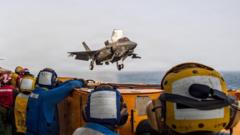
The US and Iran engaged in a night of severe escalation, with American forces launching a 10th consecutive night of strikes on Iranian military and maritime targets, and Iran responding by striking oil tankers in the Strait of Hormuz and hitting US-linked military assets in Bahrain, Kuwait and Jordan. President Trump vowed retaliation for the deaths of three US soldiers killed in a strike on a base in Jordan, while Iranian President Masoud Pezeshkian declared Iran was now fighting a "full-scale war" with the United States, marking a sharp deterioration from the earlier ceasefire.
US Central Command said its strikes hit Iranian command centres, missile and drone sites, and air defences, with explosions reported in Tabriz, Bandar Mahshahr, Bandar Imam Khomeini, Chabahar and Konarak; one death was reported in Tabriz. Iran's Revolutionary Guard claimed to have struck two tankers and destroyed an Amazon data centre in Bahrain, while Jordan, Bahrain and Kuwait all reported intercepting Iranian drones and missiles, with Kuwait saying power and desalination plants were hit. Traffic through the Strait of Hormuz fell to six vessels crossing on 20 July, down from eight the previous day, though Centcom insisted commercial shipping continued. Despite the fighting, Tehran said diplomatic messages were still being exchanged through intermediaries, and Trump said the US would strike Iran's Pickaxe Mountain site if evidence emerged that nuclear material had been moved there, while the Pentagon confirmed the identities of two of the three US soldiers killed, Pte Isabella Gonzales, 19, and Lt Tyler James Feehan, 25.
- US and Iran traded strikes for a 10th straight night, escalation sharpens
- Iran hit tankers, Bahrain, Kuwait and Jordan; one death in Tabriz
- Strait of Hormuz traffic fell; diplomatic contacts continued despite fighting
New here? Start with this
Iran and the United States have been locked in direct military confrontation, following the collapse of an earlier ceasefire between the two countries. Tensions have centred on Iran's nuclear programme and its influence in the Middle East, with the Strait of Hormuz, a narrow waterway through which much of the world's oil passes, seen as a key flashpoint given Iran's capacity to threaten shipping there. President Donald Trump has been ordering repeated rounds of US strikes on Iranian targets, framing them partly as retaliation for the deaths of American soldiers in the region.
Iran, under its president, has responded with its own attacks on sites linked to the US and its allies, including in Bahrain, Jordan and Syria, states that host American forces or are seen as aligned with Washington. Countries such as Jordan, Kuwait and Bahrain have found themselves caught up in the exchange of fire, intercepting missiles and drones passing through their airspace. This has raised concerns that a bilateral conflict could widen into a broader regional confrontation.
Despite the fighting, both sides have reportedly kept some lines of communication open through intermediaries, suggesting a diplomatic route has not been entirely closed off. The situation matters globally because of the risk to oil supplies and shipping through the Strait of Hormuz, the potential for other regional powers to be drawn in, and the wider implications for US foreign policy and Middle East stability.
Both sides, in good faith
The strongest fair case each way — we don't pick a winner.
The case for
Supporters of the strikes argue that a firm military response was unavoidable once American soldiers had been killed, and that failing to act decisively would invite further attacks on US forces and allies in the region. They contend that degrading Iran's capacity to threaten shipping through the Strait of Hormuz protects vital global trade routes and regional partners, and that sustained pressure is the only language Tehran responds to, given its history of proxy warfare. From this view, the strikes uphold deterrence and demonstrate that attacks on American personnel carry serious, credible consequences.
The case against
Critics of the campaign warn that ten consecutive nights of strikes risk tipping an already fragile situation into an uncontrollable regional war, drawing in Jordan, Bahrain, Kuwait and other states that had no wish to be combatants. They argue that military escalation undermines the diplomatic channels Tehran says remain open, closing off the possibility of a negotiated de-escalation and making civilian and military casualties on all sides more likely. For this camp, restraint, sustained diplomacy and multilateral pressure offer a more sustainable path than open-ended strikes whose endpoint and long-term consequences remain unclear.
More coverage
Read the full article at the source →
Originally published by BBC World as “US launches fresh strikes on Iran, as Trump warns of retaliation for death of soldiers”.