‘We’ll find way to save Jodrell Bank,’ Burnham says
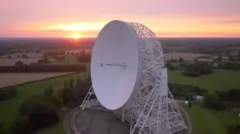
Prime Minister Andy Burnham has pledged to find a way to save the Jodrell Bank Observatory in Cheshire after UK Research and Innovation (UKRI) said in July that the site would not be prioritised for further funding once its current agreement ends in March 2028. Speaking in the House of Commons after being pressed by Congleton MP Sarah Russell, Burnham said Jodrell Bank was both a "heritage asset" and a "research asset" for the country and promised to hold a meeting with local MPs to address the funding gap.
The Lovell Telescope, the world's third-largest steerable radio telescope, has stood at the site since 1957 and is part of the e-Merlin array run by the University of Manchester. UKRI defended its decision as the outcome of "a comprehensive, evidence-based prioritisation process", but scientists have called it "heartbreaking" and "scientifically misguided", and more than 150 public figures — including Sir Brian May, Johnny Marr, Tim Peake and Brian Cox — have signed a letter urging the government to reverse it. Without alternative funding, all scientific observations at Jodrell Bank are expected to cease on 1 April 2028.
In short
- Burnham vows to save Jodrell Bank after UKRI cut its funding
- Lovell Telescope faces closure of research from April 2028
- 150+ public figures, including Brian May and Tim Peake, oppose the cut
Steelman: both sides, in good faith
The strongest fair case each way — we don't pick a winner.
The case for
Jodrell Bank combines historic importance with active scientific work, and losing its observations could weaken UK research capacity and disrupt studies that depend on the e-MERLIN array. Supporters can argue that public investment is justified by these national benefits and that Burnham’s pledge offers a chance to find a sustainable funding arrangement before the current agreement ends.
The case against
UKRI must allocate finite research funds across competing priorities, and its decision followed what it describes as a comprehensive, evidence-based assessment. Those defending that approach can argue that preserving a prominent heritage site does not by itself establish that it should receive continued public research funding, which must be directed where the evidence shows the greatest value.
Explained simply
Jodrell Bank is a radio astronomy observatory in Cheshire, where scientists use radio waves from space to study the universe. Its Lovell Telescope, built in 1957, is part of e-MERLIN, a network of telescopes used for research and operated by the University of Manchester.
UK Research and Innovation (UKRI), the public body that funds research, has said it will not prioritise further funding for the observatory after its current agreement ends in March 2028. The University of Manchester, scientists and local representatives are among those concerned about how the site’s research could continue without replacement funding.
The observatory is also a heritage site, and the Lovell Telescope is a prominent part of its history. The funding decision matters because, without another source of support, scientific observations there are expected to stop in April 2028.