What happens when neutrinos swap identities inside a supernova?
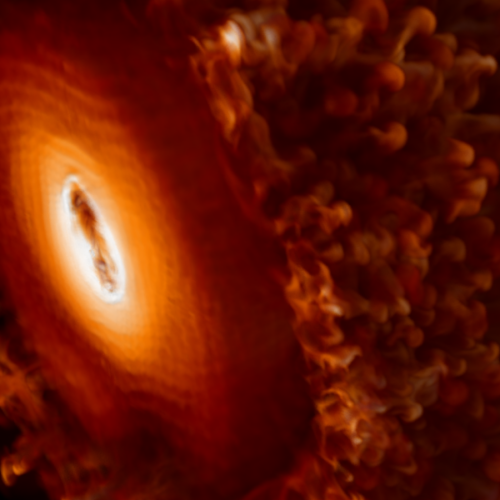
A new study, published in Physical Review D, proposes a possible explanation for why real-world supernova observations don't quite match theoretical models: neutrinos changing "flavour" (identity) as they stream out of a collapsing star's core. Neutrinos are already known to be crucial to triggering the explosive collapse of massive stars, but current models don't account for their well-documented tendency to switch between types, and this omission may be skewing predictions of which stars explode and which simply collapse into black holes.
Existing discrepancies include a mismatch between the observed rate of star formation and the frequency of supernovae, a shortage of red supergiants among identified progenitor stars, and a "mass gap" in black holes detected via gravitational-wave mergers that current theory struggles to explain. In standard models, neutrinos escaping the collapsing core transfer energy to infalling material, heating it enough to overcome gravity and drive the shock wave that destroys the star; without this boost, the star's contents collapse entirely into a black hole with no explosion. The new research suggests that if neutrinos change flavour mid-flight, some energy may escape the process differently than expected, potentially explaining why some collapses fail to produce a visible supernova.
- Neutrinos changing identity may explain supernova model discrepancies.
- Current models ignore neutrinos' known ability to switch flavours.
- Effect could explain why some collapsing stars fail to explode.