Science news and discussion on TalkFuse.
What is Jodrell Bank and what does it do?
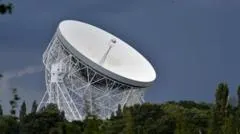
The UK government has decided to withdraw funding for the Jodrell Bank Observatory in Cheshire, prompting warnings that all scientific work at the UK's largest telescope could cease within two years. The University of Manchester, which owns the site, is now searching for alternative funding before the cuts take effect in 2028, while astronomers have condemned the decision as "short-sighted" and damaging to Britain's research standing.
The funding, withdrawn by UK Research and Innovation (UKRI), threatens 28 jobs and the work of thousands of scientists who rely on the observatory's data. Jodrell Bank, a UNESCO World Heritage Site, is home to the 250ft Lovell Telescope, built in 1957 by Sir Bernard Lovell and once the largest radio telescope in the world; it links with the UK's e-MERLIN network to study black holes, galaxies and spacecraft. The cut comes as the international Square Kilometre Array project in South Africa and Australia prepares to begin gathering data within five years, with experts warning the UK risks losing out on that scientific opportunity without continued investment in Jodrell Bank.
In short
- Government pulls funding for Jodrell Bank Observatory, threatening its future
- University of Manchester seeks alternative funding before 2028 deadline
- 28 jobs at risk; astronomers call the decision short-sighted
Steelman: both sides, in good faith
The strongest fair case each way — we don't pick a winner.
The case for
Advocates for preserving Jodrell Bank's funding emphasise its continued scientific value in fundamental research on black holes, galaxies and gravitational phenomena. They argue that the Observatory represents irreplaceable expertise and infrastructure that positions the UK competitively in international astronomy, particularly as the Square Kilometre Array begins operations – a project where British participation could be severely hampered by the loss of experienced radio astronomers and supporting facilities. The investment represents a relatively modest commitment compared to its contribution to the nation's scientific standing and the loss of 28 jobs and thousands of scientists' access to crucial data.
The case against
Those supporting the funding withdrawal argue that government budgets require difficult prioritisation amongst competing research priorities. With international projects like the Square Kilometre Array now operational and alternative radio astronomy capabilities available globally, decision-makers may reasonably assess whether Jodrell Bank's current operational costs represent the best use of finite public research funds, particularly when substantial investment would be needed to maintain competitiveness with newer facilities. The decision reflects the realistic assessment that not all established institutions can be sustained indefinitely at current funding levels.
Explained simply
Jodrell Bank is a radio observatory in Cheshire that has been one of Britain's leading science facilities for nearly seven decades. At its heart is the Lovell Telescope, built in 1957 and 250 feet tall, which was once the world's largest radio telescope and remains a symbol of British engineering.
The observatory uses its telescopes to study the universe, investigating black holes, distant galaxies, and tracking spacecraft. Its data contributes to research projects involving thousands of scientists across Britain and internationally.
Jodrell Bank holds a significant place in British science because radio observatories like this one are rare and require decades of expertise to operate effectively. The site is also recognised as a UNESCO World Heritage Site for its scientific and historical importance.