Culture news and discussion on TalkFuse.
Will Russia’s answer to the Falcon 9 rocket ever take flight?
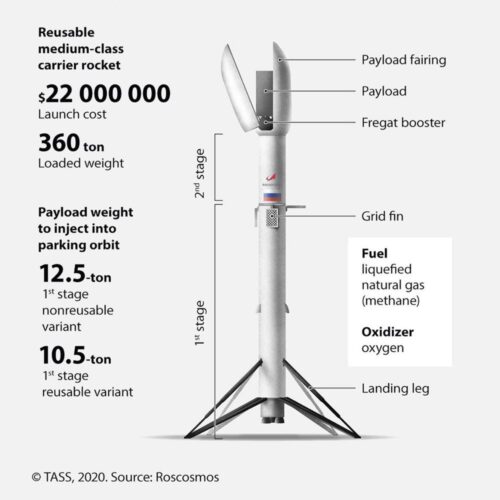
Roscosmos has confirmed further delays to its Amur-LNG rocket, Russia's planned reusable answer to SpaceX's Falcon 9, with a working demonstrator not now expected to begin flight tests until 2028. The rocket, first unveiled in 2020 with a promised debut this year, is intended to eventually replace the ageing Soyuz 2 as Russia's main crew and cargo launcher, but the programme's timeline keeps slipping while rivals in the US and Asia race ahead with reusable rocket technology.
Dmitry Baranov, Roscosmos' Deputy Director General for Rocket Programs, told the RBC business publication that work is currently focused on a "demonstrator" first-stage hopper, similar to SpaceX's early Grasshopper test vehicle, with two test flights planned from 2028: an initial hop below 1km and a more ambitious 10km flight involving an engine restart and landing on deployable legs. A Roscosmos display in May had already indicated Amur-LNG flight tests would not begin until 2031, meaning the rocket's projected debut has slipped five years since its 2020 announcement. Meanwhile, China, Japan and several US firms including Blue Origin, Rocket Lab and Stoke Space continue to advance their own reusable rocket efforts.
In short
- Russia's reusable Amur-LNG rocket faces further long delays
- Demonstrator hopper tests now pushed back to 2028
- Full flight tests not expected before 2031, five years late
Steelman: both sides, in good faith
The strongest fair case each way — we don't pick a winner.
The case for
Roscosmos continues active development with concrete plans for demonstrator tests from 2028, following sound engineering practice similar to SpaceX's early approach. Russia retains significant spaceflight expertise and industrial capacity, and development delays in advanced rocket programmes are common; the project, whilst behind schedule, remains technically feasible and could still deliver an operational launcher.
The case against
The project has already slipped five years without flying hardware, whilst competitors in the US, China, and Japan advance their own reusable systems substantially ahead. Russia faces mounting constraints from international sanctions, economic pressures, and documented technical-sector brain drain that make completing an ambitious new launcher increasingly difficult, and even if a demonstrator eventually flies, the path to operational status presents further major obstacles.
Explained simply
Russia is developing a rocket called Amur-LNG that is designed to be reusable, meaning it can be used for multiple flights rather than being discarded after one launch. This approach was pioneered by SpaceX's Falcon 9 rocket, which demonstrated that recovering and reusing rockets can dramatically reduce the cost of space launches.
The Amur-LNG is meant to replace Russia's ageing Soyuz 2 rocket, which currently serves as the country's main rocket for launching crews and cargo. Mastering reusable rocket technology has become strategically important because it represents the future of affordable space access and determines which nations and companies can compete effectively in the global space industry.
Several countries and private companies are racing to develop reusable rockets. China, Japan, and American firms including Blue Origin and Rocket Lab are all working on their own systems, making reusable rocket technology a key area of international competition in space exploration.
Culture Europe Space Technology Travel World