Hochul says officials failed woman in reopened Cornell assault case
Developing story first seen 2 hours ago
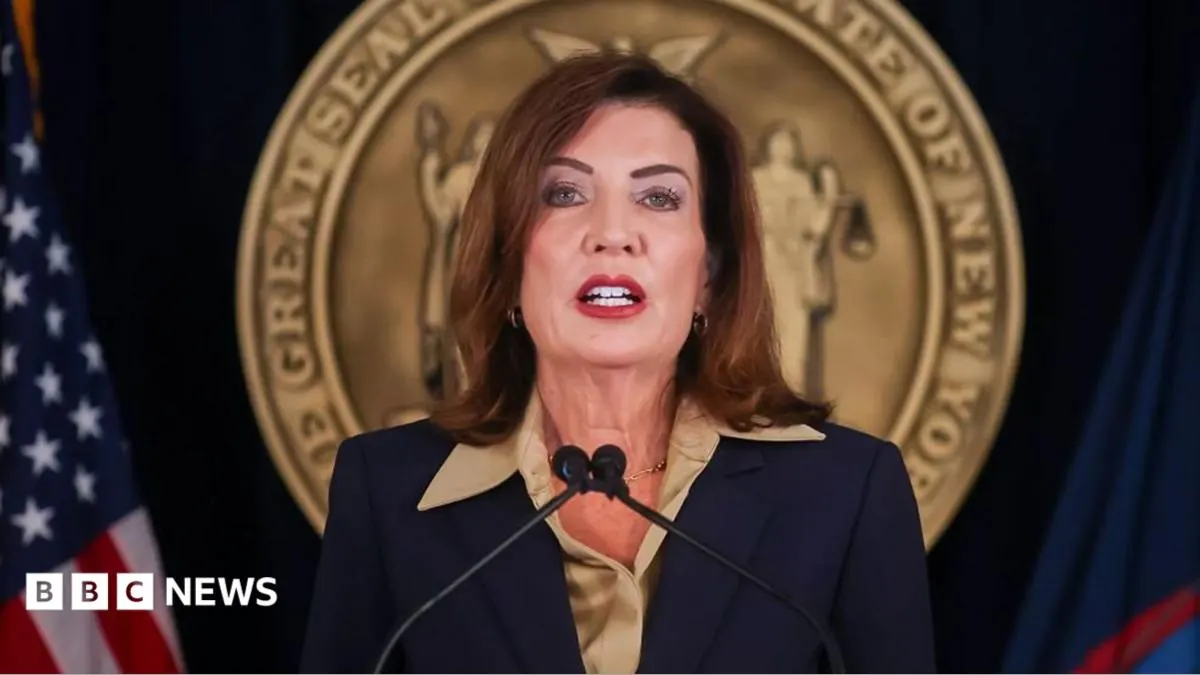
New York Governor Kathy Hochul has appointed Attorney General Letitia James to lead the reopened investigation into a 2024 alleged sexual assault involving a Cornell University student, saying local officials failed the woman. Hochul’s move follows her loss of confidence in the local prosecutor and renewed scrutiny after the woman filed a civil lawsuit.
The woman, identified in court documents as Jane Doe, alleges she was drugged and raped by several men at a fraternity house; no charges were brought after the original investigation. Hochul criticised investigators for not interviewing her and backed a bill to clarify that someone’s voluntary use of drugs or alcohol does not mean they can consent when too intoxicated. Former lead prosecutor Matthew Van Houten said his office lacked sufficient evidence and had not received all the information later made public, while Cornell says it shared evidence including a fraternity group chat.
- Letitia James will lead the reopened Cornell assault investigation.
- Hochul says local officials failed the woman.
- A proposed bill would clarify consent and intoxication law.
New here? Start with this
A woman has alleged that she was drugged and raped by multiple men at a Cornell University fraternity in an incident that has raised questions about how sexual assault investigations are conducted. A state investigation began in 2024 but resulted in no criminal charges being brought. The woman has since filed a civil lawsuit, prompting authorities to review the original inquiry.
The original investigation has faced criticism for gaps in its conduct. The woman was not interviewed by the lead investigators, and important evidence—including communications from a fraternity group chat—was not provided to prosecutors when they decided whether to bring charges. The former prosecutor said his office lacked sufficient evidence at the time, although much of this material later became available.
The case highlights broader concerns about how states investigate sexual assault allegations and whether existing laws adequately address situations involving voluntary consumption of alcohol or drugs. Gaps revealed in this particular investigation have prompted officials to consider whether changes to state procedures or law are needed to better protect people who make such allegations.
Both sides, in good faith
The strongest fair case each way — we don't pick a winner.
The case for
The initial investigation reveals serious procedural failings, most notably that the alleged victim was never interviewed by local investigators—a critical gap that undermines confidence in its thoroughness. Key evidence, including communications from the accused men, apparently wasn't properly integrated into the original inquiry, suggesting systemic problems that justify a fresh state-level review.
The case against
Criminal prosecution properly requires evidence sufficient to prove guilt beyond reasonable doubt, a demanding standard that protects the accused and reflects the seriousness of such charges. The former prosecutor's decision to decline charges reflects this principle; if his office lacked adequate evidence or wasn't provided information that emerged later, that indicates a coordination problem rather than investigative negligence, and pursuing charges without sufficient evidence would serve neither justice nor the victim's interests.
Full account
New York Governor Kathy Hochul has sharply criticised the conduct of a sexual assault investigation at Cornell University, declaring that a young woman at the heart of the matter received inadequate protection from the authorities and institutions bound to support her. The complainant, designated as Jane Doe in court documents, alleges she was sexually assaulted by several individuals at a fraternity house in 2024. Despite an initial investigation, prosecutors declined to bring charges at that time. The matter has recently gained public prominence after the woman initiated civil proceedings last month.
In response, Hochul has transferred the criminal investigation to New York's Attorney General Letitia James, citing diminished confidence in how local prosecutors have managed the matter. The Governor expressed particular alarm that the district attorney's office made no attempt to conduct a face-to-face interview with the complainant. Matthew Van Houten, the district attorney in question, subsequently explained his decision to forgo criminal charges by citing insufficient evidence that met the appropriate legal threshold. He noted that crucial information from recent public disclosures had not reached his office at the time of the original review.
The case has sparked renewed debate about a contentious provision in New York's rape statute. The law creates a distinction based on whether intoxication resulted from the victim's own actions or was imposed upon them without consent. Where someone was rendered intoxicated through means beyond their control—such as being unknowingly drugged—prosecutors have clearer grounds to argue absence of consent. However, when a person has willingly ingested drugs or alcohol, even under pressure or manipulation, the legal picture becomes considerably murkier. The woman in question apparently took ketamine, cannabis and alcohol of her own volition before reaching a state where meaningful consent became impossible.
According to Van Houten's account, the woman's initial statement to police indicated neither that intoxication was forced upon her, nor that physical compulsion featured in the alleged assault, nor that she was unconscious throughout. Based on these factors, his office determined that criminal prosecution was not warranted. The investigation has since been reopened. Hochul has signalled her intention to pursue legislative remedies, seeking to eliminate what has become colloquially known as the 'voluntary intoxication loophole'. She argues that statutory protections should extend to anyone incapable of meaningful consent, regardless of the origin of their incapacity.
Since the case has entered the public domain, the woman has contended with substantial negative consequences. According to her legal representative, she has become a target for online intimidation and coordinated attempts at public identification. University records reviewed by Cornell's internal investigation team revealed exchanges between fraternity members—specifically a group chat on Snapchat—in which they discussed having a 'free' sexual encounter with the woman during the evening in question. Attorney General James has committed to thoroughly examining witness testimony and pursuing criminal charges should the evidence justify such action.
Where outlets differ
Source 1 emphasises institutional accountability and prosecutorial failure; Source 2 focuses on technical aspects of consent law and statutory interpretation
Source 1 highlights the failure to interview the complainant directly; Source 2 provides expert legal analysis of why the voluntary-versus-involuntary intoxication distinction affects prosecution
Source 1 includes specific evidence of Snapchat communications between fraternity members; Source 2 omits this detail
Source 1 frames the issue as institutional negligence requiring immediate governmental intervention; Source 2 frames it as a legislative problem requiring statutory reform
Source 1 foregrounds the complainant's current suffering and online harassment; Source 2 foregrounds the structural obstacles prosecutors encounter under existing law
More coverage
Read the full article at the source →
Originally published by BBC World as “Woman at centre of Cornell rape inquiry was ‘failed’ by officials, says New York governor”.