World humanoid robot games show runners breaking records, bursting into flames
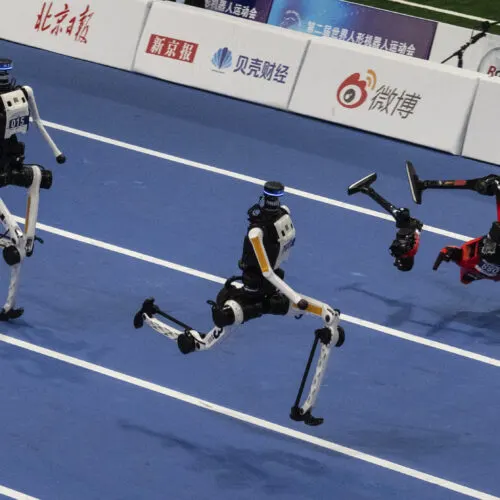
The second World Humanoid Robot Games, held in Beijing from 22–26 August, showcased both striking progress and glaring limitations in humanoid robotics, as sprinting robots broke human records while others crashed, fell apart or caught fire. Organised with backing from Chinese state media and the Beijing city government, the event highlights China's push to demonstrate the commercial potential of its rapidly developing robotics industry, even as experts caution that these machines remain narrowly engineered for single tasks rather than genuine general-purpose autonomy.
Robots surpassed human world records in the 100-metre sprint and standing high jump this year, having lagged behind human benchmarks at the inaugural 2025 games, which experts say reflects real advances in whole-body robotic control. However, sprinting robots could not slow down after crossing the finish line, often crashing into barriers or falling apart because they were optimised purely to complete the race, not to stop safely. One standout was an X-Humanoid robot that went viral for winning a 400-metre race using an unusual "shy person" running posture, developed through reinforcement learning. The games also introduced more mundane household chore challenges, such as laundry-washing and folding, where robots performed markedly slower than humans — a benchmark researchers suggest may prove more meaningful than flashy but narrowly engineered feats like racing.
- Beijing's humanoid robot games saw sprinters break records and literally fall apart.
- Robots excel at single tasks but lack general-purpose autonomy or safe stopping.
- New household chore challenges showed robots still lag well behind human speed.
New here? Start with this
The World Humanoid Robot Games is an international competition where humanoid robots from different manufacturers compete in athletic events, such as sprinting and jumping, alongside more everyday tasks like folding laundry. The second edition of the event ran in Beijing from 22 to 26 August, backed by Chinese state media and the Beijing city government. It brings together robotics firms and research teams eager to show off what their machines can do, both physically and commercially.
The event matters because it offers a rare, public snapshot of how far humanoid robots have come, and how far they still have to go. China has been investing heavily in robotics as an industry it wants to lead globally, and events like this are partly about demonstrating progress to investors, the public and the state. At the same time, robotics experts point out that these machines are typically built and trained for narrow, specific tasks rather than the kind of flexible, general intelligence a human has.
That gap between spectacle and real-world capability is central to why the games draw attention each year. Tasks like sprinting make for dramatic footage, but researchers say slower, less glamorous challenges, such as household chores, may better reflect genuine progress toward robots that could be useful in everyday life.
Both sides, in good faith
The strongest fair case each way — we don't pick a winner.
The case for
The year-on-year improvement from 2025—with robots now exceeding rather than lagging human benchmarks—demonstrates genuine algorithmic and mechanical progress in whole-body control. Competition-driven research has historically accelerated innovation across entire fields, and the creative engineering solutions developed, such as reinforcement-learned gaits, may contribute to future general-purpose systems.
The case against
These achievements fundamentally misrepresent progress because robots are so narrowly optimised for single metrics they become dangerously unstable and entirely impractical for real application. The state-backed spectacle prioritises national prestige over genuine advancement, particularly evident in robots' dramatic failure at mundane real-world tasks like laundry folding compared to humans.